


Issue:
January 2024
From Rwanda to Gaza, politicians employ subliminal messaging to dehumanise their foes. Journalists need to call them out
Even before the soldiers start marching and the cannons start firing, the war of words heats up to rile public opinion and frame the crisis. The narrative is often that action must be taken, and must be taken against an enemy that is existentially inferior. And it must be taken urgently.
Hitler used it against Czechoslovakian leader Edvard Benes in 1938, declaring to the press before the invasion: “My patience is exhausted,” adding: “If Benes does not want peace, we will have to take matters into our own hands.” George W. Bush’s policy advisor, James Baker, used a similar justification for attacking Saddam Hussein’s Iraq, telling the Washington Post that Saddam could not be allowed to “sit astride” the Western “economic lifeline”. And in Rwanda, radio announcements in 1994 extolled ethnic Hutus to “cut down the tall trees” - a euphemistic reference to taking machetes and slaughtering an estimated 800,000 ethnic Tutsis.
In these cases, the press and the technology of journalism became conduits of deliberate messaging, grappling with ethical questions as the clouds of war gathered.
The British writer, actor, and intellectual Stephen Fry left jokes aside at a talk in 2011, telling his audience “…we have seen examples in our lifetimes, in Rwanda and Burundi, and we’ve seen it in other places, where massacres of quite extraordinary brutality have taken place, and in each one of these … genocidal moments ... each example was preceded by language being used again and again, and again, to dehumanize the person that had to be killed in the political eyes of their enemies”.
This preliminary, or priming, dehumanization is sometimes blatant and unfiltered, as in Hitler’s characterizations of German Ubermenschen [supermen] and others deemed Untermenschen [subhuman] or Affenmenschen [ape-men].
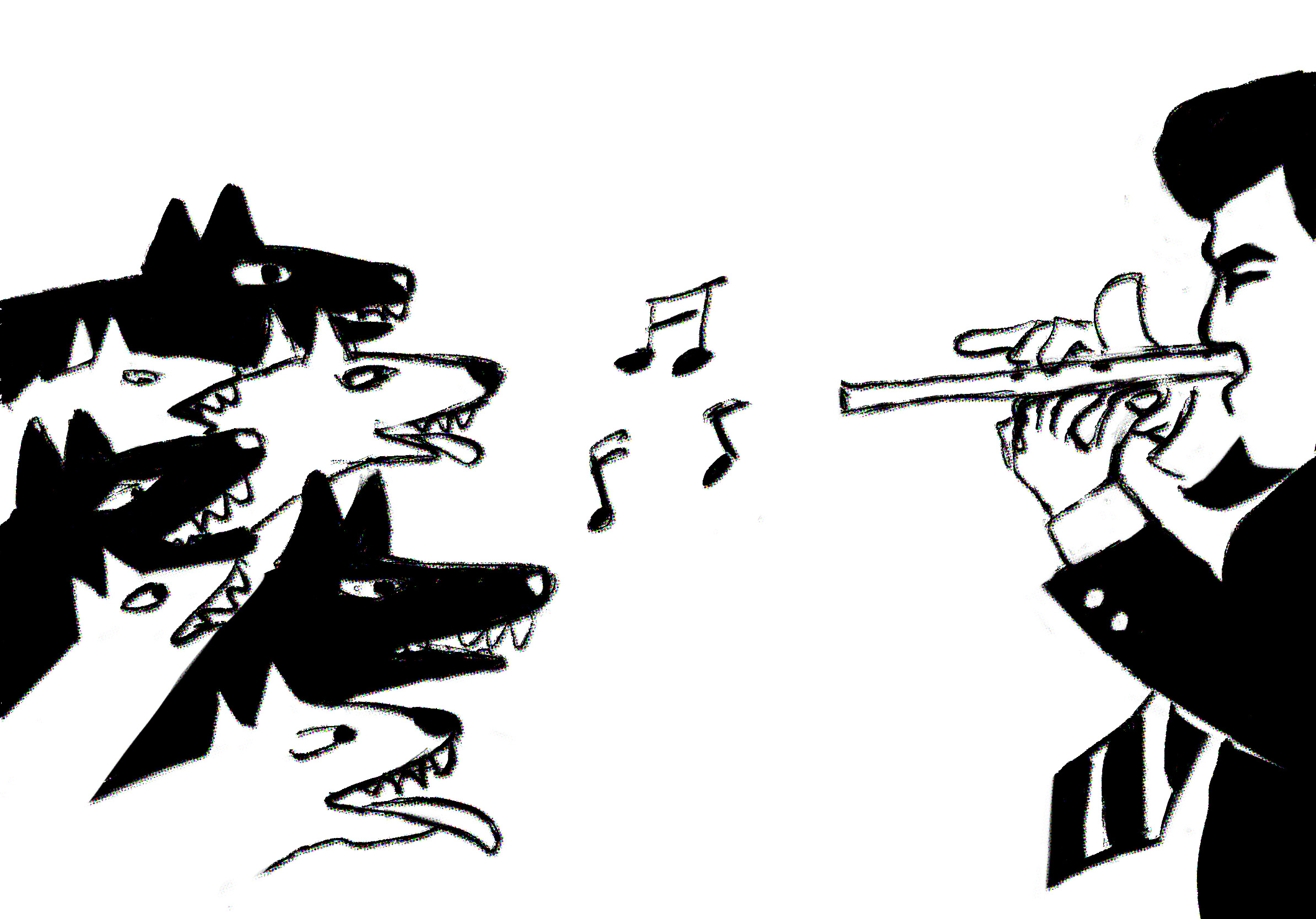
In other cases, the language is filtered through subtly coded phrases, known by the increasingly popular term “dog whistle”. This linguistic device describes double-meaning expressions that might seem innocuous to the casual observer, but which have a hidden, coded meaning for those in tune with the speaker’s agenda, much like a dog can hear a high-pitched whistle that is silent to human ears.
Examples in recent years include “Let’s Go Brandon”, a dog whistle phrase meaning “F**k Joe Biden”. And there is the racist “13 percent”, a derogatory dog whistle for the African-American population in the United States. Social media posts might include insulting phrases such as, “That crime was probably committed by the 13%.”
Current U.S. presidential hopeful and Florida Governor Ron DeSantis was accused of using a layered dog whistle to smear a political opponent as a black liberal by saying, “The last thing we need to do is to monkey this up by trying to embrace a socialist agenda ….” It contained all of the elements: a dichotomy of “we” belonging to the white audience he was appealing to; the monkey evoking racist tropes of African-Americans being subhuman and inferior to DeSantis’ mostly white audience; and a warning of physically coming into a hug with a near-communist who has some long-term nefarious plan.
One of the sly characteristics of dog-whistle expressions is deniability: accuse someone of using a dog whistle and they respond with, “No, you’re just imagining things, that’s not what I meant at all.”
And so it is with the press and the current bloodbath in Palestine.
One troubling dog whistle that has emerged in the Gaza conflict has gone largely unchallenged. Pro-Israeli sources have recently used the phrase “cut the grass” and the “mow the grass” and “mow the lawn”. The action and imagery imply that the human population of Gaza is akin to so many nameless and indistinguishable blades of grass that need to be cut down. If the context were a gardening blog, it might seem innocuous, but in a social media post by an Israeli government official, it is decidedly not a call for vigilant landscaping. The similarities with the genocidal phrase in Rwanda - “cut down the tall trees” - are glaring and undeniable.
One social media user responded to a short video of a woman screaming over the deaths in Gaza: “One woman is not stop screaming with a screeching voice. [sic] Imagine being married to her? Cut the grass now. Cut the grass now.”
In a 2021 article in the Washington Post, Adam Taylor made reference to “mowing the grass”. Even then it was a dog whistle for the repeated, systematic killing of Palestinians. “The phrase implies the Palestinian militants in the Gaza Strip and their supply of crude but effective homemade weapons are like weeds that need to be cut back,” Taylor wrote. “Such tactics have faced significant criticism from international human rights groups, often due to the disproportionate number of deaths caused by Israeli forces, compared to those caused by Palestinian militants during conflict.”
Extending the analogy and dehumanization, one Israeli analyst said:
“Just like mowing your front lawn, this is constant, hard work.” That was David M. Weinberg of the Jerusalem Institute for Strategy and Security. “If you fail to do so, weeds grow wild and snakes begin to slither around in the brush.”
Mayssa Issauoi wrote in the multilingual journal Pressenza: “The expression ‘mowing the grass’ has been employed by Israelis and Israeli militants for over a decade now. It is a metaphor that describes the military operations that Israel launches on Gaza Strip on a seasonal basis.”
There are also see-saw patterns of dog-whistle accusations, met with subsequent pushback. The latest target is a rhyming slogan, which has drawn widespread condemnation, chanted at demonstrations spanning the world from Cape Town to Copenhagen: “From the river to the sea, Palestine will be free.”
Some spin doctors have been quick to paint the slogan as a dog whistle promoting genocide against Israelis. U.S. Congresswoman Rashida Tlaib (who has Palestinian family roots) dismissed the accusation, describing the phrase as aspirational, evoking self-determination for the native population of Palestine, extending from the inland Jordan River to the shores of the Mediterranean Sea in “freedom, human rights and peaceful coexistence, not death, destruction or hate”.
Palestine’s U.N. delegation asserted that Palestine has for centuries been a multi-ethnic and multi-religious society, with Palestinians being Christians, Muslims, Druze, and Jews rather than an ethno-state founded on a single religion.
As the war in Gaza drags on, with its devastating human toll, there are valid ethical questions about whether the press is an observer, or an active participant, in the war of words. As journalists, writers, diplomats, and educators, it is important to remain vigilant in confronting dog-whistle narratives, and to maintain ethical rules of journalistic engagement.
We should use our critical thinking skills to recognize when a press campaign employs possible dog-whistle tactics, and protect ourselves from political decision-makers and media influencers who attempt to exploit the media as conduits of dog-whistle strategies. Finally, we should remain vigilant in pushing back when a government attempts to tar its target with accusations of dog-whistle tactics, when the real objective is to limit free speech.
N. Shibly is a political branding consultant. He is author of A Monkey with a Razor Blade: Political, Social and Racial Insults from Simple Jests to Advocacy of Genocide.
