



November 29, 2024
The Film Committee regrets that the planned screening of “Flames of a Flower” must be rescheduled for 2025, following the postponed release of the film.
However, we will be screening another exciting new film in the same time slot: Wednesday, December 4 from 6:00pm. Details will be announced later today.
- Karen Severns, Film Committee
----------------------------------------------------------------------------------------------------------------------------------------------------------------------------------------------------------
Exploring the fine line between fire that heals and fire that kills
Sneak Preview Screening: "Flames of a Flower"(Hi no Hana) followed by a Q&A
with director Oudai Kojima, producer Changbak Kim and actor Ikken Yamamoto
Wednesday, December 4 at 6:00 pm*
*Please note early start time.
In Japanese with English subtitles
Japan 2024 124 minutes

Directed by: Oudai Kojima
Written by: Oudai Kojima, Ikken Yamamoto
Produced by: Changbak Kim
Starring: Ikken Yamamoto, Yurina Yanagi, Yohei Matsukado, Ippei Tanaka, Yujiro Hara,
Jun Niioka, Kim Changbak, Takashi Yukawa, Kento Imamura, Dankan, Masato Ibu
Film courtesy of Animoproduce
Oudai Kojima's timely and compelling tale of personal recovery, "Flames of a Flower," draws its inspiration from an actual incident, reported in 2016 but covered up by the government, after Japan sent a 350-member team to join the UN peacekeeping operations (PKO) in war-torn South Sudan. In 2018, two Japanese Self-Defense Force officers who had also participated in the mission committed suicide, but the Ministry of Defense stated there was no connection to their experiences in Africa.
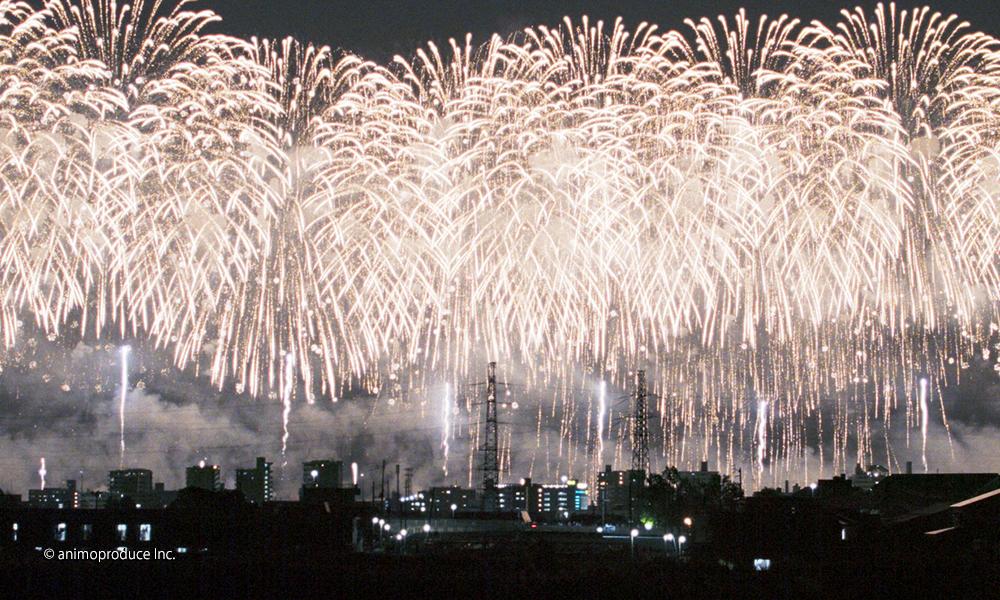
While Kojima's new film is not entirely nonfiction, it tackles truths that have been essentially taboo in Japanese cinema. Delving into the dark side of PKOs and addressing the challenges of living with PTSD, "Flames of a Flower" vividly depicts the harrowing experiences of a former SDF member who has begun training as a fireworks artisan - although he continues to moonlight in illegal arms manufacturing.
Tosuke Shimada (Yamamoto), has been suffering from severe PTSD following the loss of a comrade in a firefight in South Sudan. He's introduced to a job at a traditional fireworks factory in Niigata, where he impresses the boss, Yoichi Fujii (Ibu) with his understanding of gunpowder - a material that is paradoxically used to create bullets that kill, as well as fireworks that heal.
As he begins constructing fireworks alongside his friendly fellow craftsmen, Tosuke's future seems more hopeful. Yet, parallel to his journey toward the light, Tosuke's former comrades-in-arms, led by Captain Ito (Matsukado), join forces to expose the government's cover-up, pulling him back into the darkness he thought he'd left behind.
Please join us for this sneak preview of the riveting, thought-provoking "Flames of a Flower" before the film's Japan release on December 20.
For more (in Japanese): https://hinohana-movie.com/
Writer-director OUDAI KOJIMA grew up in Kobe and New York City, studied architecture at the University of Tokyo, and decided he would rather make films. A busy director of music videos, commercials and short films, he made his feature debut with "Joint" in 2021. It played in competition at the Osaka Asian Film Festival and the New York Asian Film Festival before being released in theaters nationwide in Japan to great acclaim and a long run, leading him to win the Silver Prize at the Shindo Kaneto Awards. "Flames of a Flower" is his second feature.
IKKEN YAMAMOTO made his powerful acting debut with Oudai Kojima's 2021 "Joint," after which he appeared in the Korean film "The Policeman's Lineage" (2022), and will soon be seen in Brillante Mendoza's "Chameleon." Yamamoto worked with Kojima to develop his original story into the script for "Flames of a Flower."
Producer and actor CHANGBAK KIM was raised in Japan, began his career as a model in South Korea, and started his acting career after returning to Japan in 2018. He also produced and starred in Oudai Kojima's 2021 "Joint."
IMPORTANT NOTE: Please make your reservations at the FCCJ Reception Desk 03 3211-3161 or register online. All film screenings are private, noncommercial events primarily for FCCJ members and their guests.
- Karen Severns, Film Committee