


Issue:
May 2025
Donald Trump’s appearance at the FCCJ 32 years ago proved prophetic
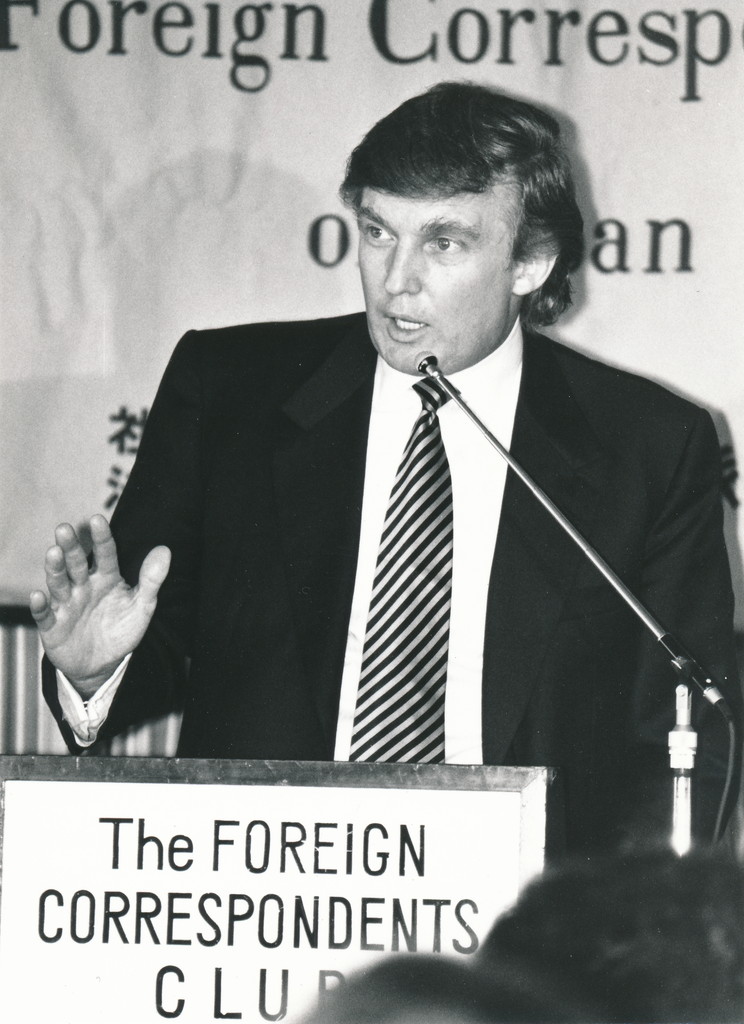
In April, the U.S. president, Donald Trump, announced a policy of reciprocal tariffs, arguing that America had been taken advantage of by "cheaters" and "pillaged" by foreigners. Since then, stock markets around the world have plummeted, and concern has spread that Trump's moves will trigger a recession that risks bringing down the system of trade that has been in place since the end of World War II.
A strong backlash immediately ensued, with the Financial Times describing Trump's moves as "utter lunacy" and "an act of war against the entire world". Trump is now viewed as one of the most domineering, and most unpredictable, politicians in the world.
The archive of the Foreign Correspondents’ Club of Japan contains a precious beacon that casts light on Trump's unpredictable behavior. This is in the form of an audio recording of Trump, who visited Japan 32 years ago not as a politician, but as a businessman.
On August 18, 1993, while on a visit to Tokyo, Trump held a press luncheon at the FCCJ, which at that time was located in the Yurakucho Denki Building. He was in the process of discussing various business ventures such as real estate and casinos, but suddenly changed the subject to the trade imbalance between Japan and the United States. In his view, in the previous U.S.-Japan trade negotiations, America had been represented by "morons".
“I think the Japanese negotiators have done one of the great tap-tap-taps ever. That’s keeping the ball rolling, giving absolutely nothing and having the American idiots say, ‘Thank you’.”
At the time, the U.S. had a huge trade deficit with Japan, and was demanding the opening of sectors such as automobiles, semiconductors and supercomputers. Dissatisfied with the slow progress of the negotiations, Trump singled out Carla Hills, the U.S. Trade Representative under President H.W. Bush, for criticism.
“When I look at the job that Carla Hills did, saying that we must understand it takes time … it really doesn’t take time. It doesn’t take time at all. Free trade doesn’t take time. You don’t have to sit back for four years and eight years and not have free trade.”
He continued: “The Japanese friends I’ve seen over the last few days – and they’re very good friends – they themselves laugh at the stupidity of my government. They laugh … they all know I’m right. They say I’m right.”
There was a portentousness to Trump's remarks.
Six years before his press conference in Tokyo, on September 2, 1987, Trump had published an open letter in major American newspapers, including the New York Times and the Washington Post. In the letter, he sharply criticized Japan and other nations for taking advantage of the U.S. over the past decades.
“The saga continues unabated as we defend the Persian Gulf, an area of only marginal significance to the United States for its oil supplies, but one upon which Japan and others are almost totally dependent. Why are these nations not paying the United States for the human lives and billions of dollars we are losing to protect their interests?
“The world is laughing at America’s politicians as we protect ships we don’t own, carrying oil we don’t need, destined for allies who won’t help.”
From this perspective, we can see that Trump's worldview was created in the late 1980s or early 1990s, and the language he uses today has not appreciably changed. In other words, he is still living in the world of 1993.
The origin of Trump's worldview can be attributed to his anger at the U.S. government for not immediately resolving Japan's huge trade surplus vis-a-vis the U.S., at a time when Japan was ranked as the world's second largest economy. And the reciprocal tariffs announced by Trump last month were to be the weapon he would wield to resolve the trade imbalance.
What is important here is the significance of the year 1993.
Just four years earlier, the Berlin Wall had fallen, tearing down the Iron Curtain that had divided Europe since the end of World War II. In December 1991, the Soviet Union also collapsed. Communism had finally been defeated, and from now on Western-style democracy and capitalism could be expected to spread throughout the world. Americans were filled with a sense of optimism and exaltation.
Ironically, Trump was confronting multiple challenges to his businesses at the time.
In the 1980s, Trump had expanded his business empire to include hotels, casinos, and an airline, but wound up incurring huge debts. One of those companies, Trump Shuttle, was an airline that connected New York, Washington DC and Boston. However, after Iraq's Saddam Hussein invaded Kuwait in August 1990, fuel prices surged and passenger demand dropped, while costs of running an airline soared. Trump eventually sold it off to a competitor.
At the FCCJ, he remarked to reporters:
“I was unlucky in going into a very lousy business, something called the airline business. Have any of you been involved in the airline? This business is the worst, I’ll tell you.”
President Bush marshalled the U.S.-led multinational forces, attacking Iraq, and successfully liberating Kuwait. Trump, however, criticized the first Gulf War as a “shame”.
“Nobody knows the real price the United States paid in this war. Nobody knows. And we weren’t compensated properly for it at all. And we were foolish.”
Interestingly, Trump is now pushing for a deal with Ukraine for its mineral resources, which would serve as compensation for military aid the U.S. has provided to Kyiv since Russia launched its full-scale invasion in February 2022. At first glance, this may seem like a wild idea, but it is understandable considering the trauma and heavy damage the Gulf War had caused to Trump's business.
The FCCJ press conference also gave us another important clue for understanding Trump: loyalty. He looked back on the time when his business struggled in the 1990s, and compared it to war.
“You learn things when you go through a war … You learn who’s loyal; you learn who’s not loyal. You learn who your friends are, and the truth is you can’t really tell. I wish I could say that everybody with blonde hair or black hair or dark skin or light skin was loyal. But it just doesn’t work that way. People I would have bet the ranch on – excuse me for the term – screwed me.”
He added: “I say that at one point in my life, I’d like to be in trouble, so that I can find out who’s going to be loyal and who’s not going to be loyal … You do learn a lot about loyalty. And I think it’s a very important word.”
Trump has been true to his word, appointing people to cabinet posts chosen on the basis of their loyalty. He is also demanding that jobseekers hoping to join the administration be subjected to loyalty checks. To Trump, loyalty is everything.
Loyalty may count for everything, but at the same time, there was irony in his predicament. At a time when Trump was struggling to extricate himself from a difficult business situation, the people who offered most fervent support were investors in Hong Kong and Japan. At the FCCJ, he said this about his supporters:
“Our largest group of purchasers are from Hong Kong and from Japan. And I just want to thank so many of them because they did stick with me. They did buy my products. They did go to my casino and they did, perhaps most importantly, make deals with me on casino bonds.”
Yet last month Trump announced reciprocal tariffs on Japan, one of the sources of his main benefactors. Unfortunately, it appears that those who were loyal to Trump were not treated with reciprocation.
Trump's Tokyo press conference 32 years ago provides us with great insights into his mentality and the standards that guide his behavior. Those remarks remained fully consistent with his current actions and policies as they relate to foreign affairs, defense, the economy and personnel. They might even be said to be prophetic. In that sense, President Trump has been consistent in his words and actions.
His speech contained only one remark that could be regarded as contradictory. If Trump had continued to follow his words with the same conviction, not only would he have possibly changed the history of the United States, but the history of the world as well.
He told his Tokyo audience: “I’m not running for public office. Who cares if I'm politically correct?”
Eiichiro Tokumoto is a writer living in Tokyo.
