



Abe No Seimei Gets a Spectacular Origin Story
Sneak Preview Screening: "The Yin Yang Master Zero (Onmyoji 0)"
followed by a Q&A with director Shimako Sato and actor Shota Sometani
Wednesday, April 10 at 6:00 pm*
*Please note early start time.
In Japanese with English subtitles
Japan 2024 113 minutes
Attention: "Due to limited seating, FCCJ members (and spouse members) will be limited to one guest only."
Directed by: Shimako Sato
Written by: Shimako Sato, based on the novel series "Onmyoji" by Baku Yumemakura
Produced by: Kazuya Hamana, Keiichiro Moriya
Sorcery advisor: Nanami Kamon
Starring: Kento Yamazaki, Shota Sometani, Nao, Masanobu Ando,
Nijiro Murakami, Rihito Itagaki, Jun Kunimura, Kazuki Kitamura, Kaoru Kobayashi
Film courtesy of Warner Bros. Pictures Japan
While it's become more common for female directors to helm big-budget fantasy films in Hollywood (think "Wonder Woman," "Captain Marvel" and "Barbie"), writer-director Shimako Sato is truly a pioneer in Japan. Yet after a career quietly spent behind the scenes of box-office hits like the "Unfair" series, avoiding the limelight is sure to be more of a challenge with the upcoming release of the "The Yin Yang Master Zero," starring Japan's hottest actors and based on one of the most popular stories of all time.
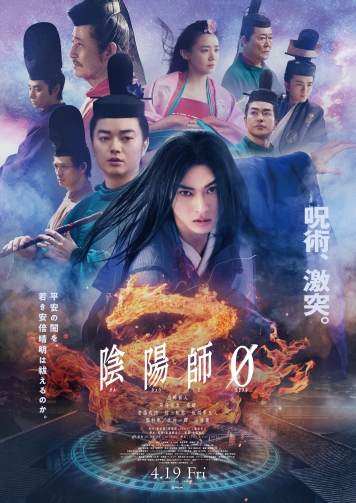
Sato's film commemorates the 1,100th anniversary of the birth of Abe no Seimei, Japan's most powerful Onmyoji (yin yang master), and has been made with the full cooperation of Baku Yumemakura, whose ongoing series of 18 novels about the historic character and his milieu has sold nearly 7 million copies globally. Sato's origin story for the Abe no Seimei saga has been shot on an unprecedented scale with eye-popping visual effects, and is sure to captivate audiences world wide.
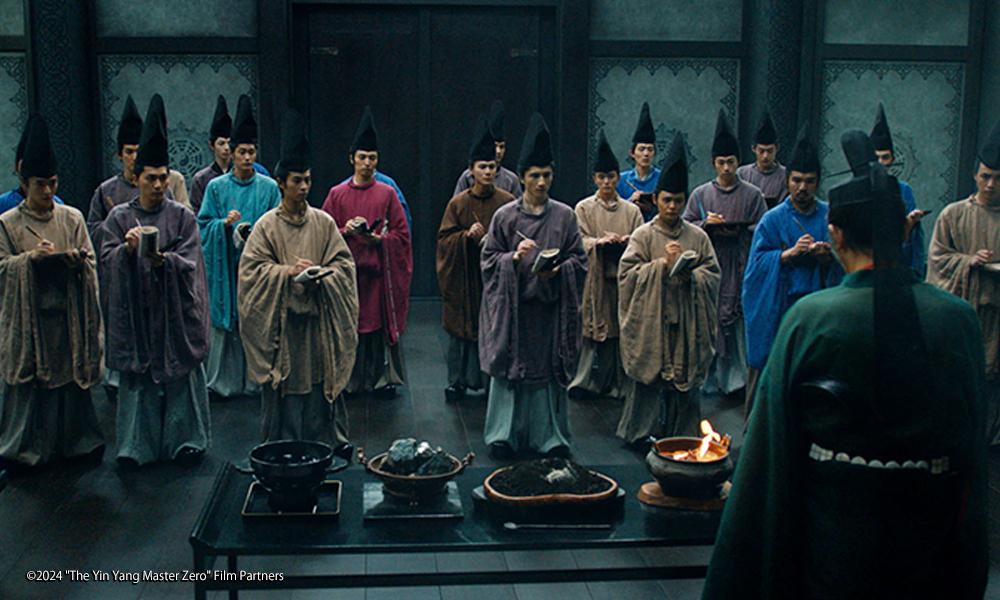
Set in the mid-Heian Period, "The Yin Yang Master Zero" follows the goings-on at the Onmyoryo Bureau of Taoist Geomancy, where the Onmyoji help the emperor decide policies by divination, astrology and other spiritual practices, to protect the ancient capital from curses, demons and other threats. Among the young apprentices studying esoteric cosmology there is Abe no Seimei (Yamazaki), an impudent youth who has a great talent for witchcraft but no desire to advance up the food chain. One day, he's asked by aristocrat Minamoto no Hiromasa (Sometani) to investigate a mysterious phenomenon at Princess Yoshiko's palace and reluctantly complies. But no sooner do the two begin probing than the princess (Nao) disappears and a powerful curse descends upon the imperial court.
Despite the film's prevalence of fantastical occurrences, there is contemporary resonance in its tug of war between men of magic and men of science (with the protagonist repping the latter despite his obviously magical powers). And there is hilarious interplay between Yamazaki and Sometani's characters. They have such an easy Holmes-Watson vibe, one can only hope that "The Yin Yang Master Zero" is the first in a franchise, so we can look forward to more of them.
Please join us for this sneak preview of the star-studded fantasy "The Yin Yang Master Zero" before the film's Japan release on April 19.
For more (in Japanese): https://wwws.warnerbros.co.jp/onmyoji0/
SHIMAKO SATO studied at the London Film School and made her directing debut with "Tale of a Vampire" in 1992. Her 1995 film "Wizard of Darkness" won the Minami Toshiko Award at the Yubari International Fantastic Film Festival. She has written extensively for television, as well as the silver screen, and in 2006, helped propel the "Unfair" series into the bigtime, with a trilogy of films that were huge hits. She also directed "K-20: Legend of the Mask" (2008) starring Takeshi Kaneshiro, and wrote "Space Battleship Yamato" (2010) for director Takashi Yamazaki.
A child actor from the age of nine, SHOTA SOMETANI burst on the international scene when he won the 2011 Marcello Mastroianni Award at the Venice Film Festival for his star turn in "Himizu." In 2012, his performance in "A Liar and a Broken Girl" earned him a Newcomer Award at the Mainichi Film Awards, and he quickly became one of Japan's most popular leading men. Among the many highlights of his career are "Lesson of Evil," "Wood Job!" "Tokyo Tribe," "Kabukicho Love Hotel," "Legend of the Demon Cat," and "First Love," as well as a string of films for director Takashi Yamazaki, including "Always Sunset on Third Stree," "The Eternal Zero," and "Parasyte Pt. 1 and 2."
IMPORTANT NOTE:
Attention: "Due to limited seating, FCCJ members (and spouse members) will be limited to one guest only."
Please make your reservations at the FCCJ Reception Desk 03 3211-3161 or register from below.
All film screenings are private, noncommercial events primarily for FCCJ members and their guests.
- Karen Severns, Film Committee