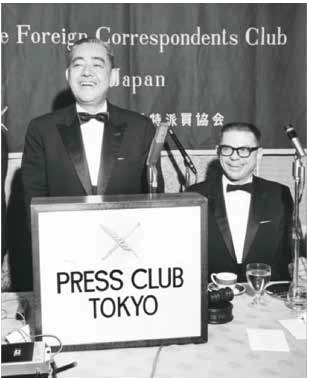


“Guerrilla Journalism,” Kiyoshi Hayakawa, editor-in-chief, Shukan Shincho
Shukan Shincho editor-in-chief Kiyoshi Hayakawa calls his weekly magazine “guerrilla” journalism. Since its 1956 founding, the Shukan Shincho has positioned itself in the vanguard of muckraking journalism in Japan. Hayakawa claims the magazine is willing to criticize and attack anyone: the imperial family, politicians, leftists or rightists.
The publication has bucked the trend of falling magazine sales (a 40% slump over the last 10 years for the top four weeklies) to become a close second to Japan’s best-selling weekly, Shukan Bunshun. Hayakawa attributes that to hard-hitting investigative journalism at a time when other magazines flinch in the face of numerous and expensive libel cases.
Hayakawa spoke to No. 1 Shimbun about the press-club system, the severe financial situation facing the weeklies, the challenge of the Internet, and, of course, the Shincho’s bête noire, Soka Gakkai.
What is the circulation of Shukan Shincho, and who are your readers?
We sell 500,000 copies a week, which is not much compared to 10 million for a newspaper. But you can compare newspapers to the regular army, and we are like guerrillas.
[Our average reader] is probably someone in their 50s or 60s. There are probably more male readers than female. Actually, we don’t do research [on our readership]. The Shukan Shincho’s founder, Juichi Saito, thought the best way to make an interesting magazine was to write about things that you think are interesting yourself. If it doesn’t sell, you can change the editor.
How do Japanese weekly magazines and newspapers differ?
The biggest difference is that Japanese newspapers mostly carry the same articles. The Asahi, Mainichi, Yomiuri – the big papers – all look the same. Only the Sankei newspaper has a slightly different feel. The weekly magazines on the other hand all have completely different articles.
The reason for that is Japan’s press-club system. Articles are written based on information distributed through the clubs. That is why the articles are amazingly similar, whichever newspaper you look at.
It seems that the newspapers don’t compete against each other…
The newspapers aren’t competing against each other. Because of the press-club system, newspapers don’t need scoops to ensure their existence. They are going to keep going anyway.
Another factor is the newspapers’ large circulations. In their situation, it’s difficult for them to be critical. Take Soka Gakkai and Komeito. Even though there are lots of problems connected with Soka Gakkai, there is no way any newspaper would criticize them. They are worried about losing readers who are Soka Gakkai members.
Another problem is newspaper printing. Soka Gakkai has its own newspaper, the Seikyo Shimbun. It is printed at factories owned by the newspapers. [Also] Soka Gakkai are rich and they advertise. The newspapers can’t afford to lose that money.
Isn’t lack of access to the press clubs a problem for the Shukan Shincho?
Not at all. As a rule, the kind of information you get directly from the press clubs is nothing special. On the other hand, when we do need such information, we can get it through newspaper journalists.
Is it true that newspaper journalists pass on stories they can’t write themselves?
Yes. There are stories that newspapers can’t carry. Articles about Soka Gakkai are one example, also articles about rightists, articles to do with the imperial family. [There are situations] when the Imperial Household Agency is being awkward or not properly disseminating information. That kind of thing happens often. The journalist would be thrown out of the press club if they wrote the story. So they ask a weekly magazine to write the article.
Another example is if there is a [criminal] incident. Sometimes there are aspects of the case that are difficult for newspapers to write about. For example, there may be a suspicion that the culprit is a relative. Sometimes, there is a problem with discrimination against burakumin. Even though the newspapers know the facts, they don’t use them, particularly with political stories. In those situations, the “regular army” newspapers don’t take action, so there is a lot of room for guerrilla weekly magazines in Japan.
What is the financial situation like for weekly magazines?
Magazine circulations in Japan peaked 10 years ago … in other words, it’s an extremely tough situation. As a whole, the circulation of weekly magazines is about 60% of a decade ago. One big reason is the Internet. Shukan Post and Shukan Gendai used to be first and second by sales, but now they are third and fourth. The reason they were first and second was nude photos – “hair nudes.” But because of the Internet, people can see as many hair nudes and videos as they want on their computer or their cell phone. They don’t need to buy magazines. Shukan Bunshun and Shukan Shincho didn’t carry that kind of thing.
English-language journalists talk about a crisis in print media, but I get the impression that the crisis hasn’t reached Japan yet.
Actually, I think the crisis is already here. Young people [in Japan] hardly read newspapers or weekly magazines now. What will determine the fate of newspapers and newspapers is: will those young people read weekly magazine and newspapers when they are in their 30s, 40s and 50s? We don’t know.
Personally, I think the Internet is extremely useful for practical information: finding a restaurant or where to shop. But if you want to know what is happening in the Diet or the business world, there is far too much information on the Internet. And how do you know which information is true?
I think the weekly magazines’ role is to conduct careful research and carefully convey that information to readers. If readers see that a weekly magazine’s articles are new and trustworthy, they will keep buying the magazine.
I’ve heard that it’s getting harder and harder to sell scandal articles in Japan?
Yes, basically you can say that. Shukan Gendai is a good example. [Once a scandal-heavy magazine], it has gone from the top seller to No. 4. These days, even if a magazine gets a scoop, TV will soon broadcast the story. People can see the story on TV, and that’s all they want.
How about the scandals themselves? Are there fewer taboo topics left?
Twenty or 30 years ago there were taboos [about coverage] of the imperial family, burakumin, labor unions, Chosen Soren (General Association of Korean Residents in Japan) and right-wing groups. When we wrote a critical article about Kim Jong-il, Shichosha was besieged by the Chosen Soren for a week. Some time ago we wrote an article about the imperial family, and right-wing sound trucks came here time after time. About 40 years ago we covered the extreme left, and our office building was firebombed.
But those opposition groups – people who oppose something that you write – have gradually become weaker. In that sense, I think that basically media taboos have got weaker. Anyone can write about the imperial family now.
You might say there is more freedom of speech now. But basically, in the past and now, if you wanted to write about something, you could. Even now for example, the newspapers create this Soka Gakkai taboo themselves. There is still a lot of that kind of self-censorship left in the media.
Even in the weekly magazines?
It is a particular problem in the newspapers. But you can’t say self-censorship has disappeared from the weekly magazines either.
Haven’t libel actions become more common?
Yes, they have. I don’t think that political influences, say Abe or Koizumi, have had an effect of freedom of speech in Japan, but the law has changed a lot. [Libel] damage payments have been deliberately raised. If we write an article about a politician following their election defeat, irrespective of the factual accuracy of our article, the court might decide that he is no longer a public figure and it becomes libel.
There is also a problem with disclosure of sources. In the past, it was often enough for us to show the court our research notes. Now if we don’t disclose the source we will lose. To that extent, the legal hurdles are much higher now. In the past libel payments were, at the most, about ¥100,000. Now there are judgments awarding ¥500,000 or ¥1,000,000.
Do you have any ongoing cases now?
Probably more than 10. [The increase in litigation] started about six or seven years ago. At the time the weekly magazines were forced to decide which to do: either avoid court cases by writing “safe” articles, or resign themselves to the risk of litigation and keep writing what they have always written. The magazines that gave up on scandal articles were the Shukan Post and Shukan Gendai. Shukan Bunshun and Shukan Shincho have kept doing what they always did, despite the risk of litigation. I think that decision has had an influence on sales.
The number of cases has probably doubled in the six and a half years I have been editor. We don’t like court cases, but if we are always afraid of litigation, what’s the point? We would end up writing the same articles as the newspapers. That would be suicide for a weekly magazine.
What proportion of Shukan Shincho’s contents would you describe as investigative journalism?
Half of our content is what you might call “reaction” to events. For example, if gyoza dumplings come from China and poison is discovered in them, we have to write about it that week. I would like the other half to be articles that are researched carefully over time. From next week we’re starting a series on the Japanese court system. Three journalists have worked on the series for six months.
If the weekly magazines want to survive, they need to increase the amount of investigative reporting. If we want to win against the Internet, we have to convince readers than our articles are trustworthy.
Why are the Shukan Shincho’s articles written
anonymously?
Shukan Shincho was started 52 years ago by a publishing house. Since weekly magazines need a national network of writers, at the time they thought that they had no choice but to use [anonymous] articles by newspaper journalists. That doesn’t happen now. The anonymous articles are kind of a tradition from that time. The other reason is that articles are often written and researched by teams.
Do you think there is a problem with the number of anonymous quotes in weekly magazine articles?
Personally, I have a feeling that use of “anonymity” in the weekly magazines has gone a little far. I don’t know if it is a particularly Japanese thing. There are people afraid of the reaction to their comments, that they will lose their position at work.
I think that it is obvious that the people who might lose their position should be quoted anonymously. Originally, anonymous quotes should have been limited to people who might lose their jobs, but they are being used when people won’t have that much of a problem – they are just worried about the reaction to their comments.
Are you trying to reduce the number of anonymous quotes?
As an editor, that’s what I want journalists to do. There’s much more reality to a story when you know the names of the people speaking. I ask journalists not to use anonymous quotes. But it has become very easy for sources to request that their name isn’t used.
How would you describe the Shukan Shincho’s political stance?
As a rule, Japanese weekly magazines and newspapers don’t say clearly whether they support the Liberal Democratic Party or the Social Democratic Party or whoever. It is not like in America, where all the newspapers and magazines directly state who they support at election time. Although the Shukan Shincho doesn’t support a particular political party, we follow “common sense.” What does that mean? If something is normally thought strange, we say it is strange.
People often say that we are closer to the right than the left. For example, we have fought against the railway unions, teachers’ organizations and Soka Gakkai. But, to put it quite strongly, we fight with everyone. We have criticized the LDP, the DJP, Soka Gakkai, the Communist Party and the imperial family. The Sankei and right-wing magazines wouldn’t criticize the imperial family, but the Shukan Shincho doesn’t consider itself right wing. We have a history of criticizing the imperial family more strongly than the Communist Party. If the imperial family or the Communist Party says something we think goes against common sense, we will be critical.
Do you have a particular stance against China?
Basically, our stance toward China is a tough one. Personally, I think it has to do with Japan’s geopolitical position. In the future, we will have to choose between the Chinese way of thinking or the U.S. way of thinking. What are we going to do? I think we should value democracy and freedom and choose America. The other issue is a practical one. The war was 60 years ago now, but China is still using it as a diplomatic negotiating tool. Yasukuni Shrine is one example. That is interference in Japan’s internal affairs. It’s a battle over national interests. If China uses that card, Japan needs to think what she should do. China is much more powerful than Japan and we need to be wary. ❶
This is a translated and edited text of an interview in Japanese.