

Issue:
June 2023
The Ukrainian leader’s ‘surprise’ attendance at the G7 forced global TV networks to rip up their scripts
The G7 summit in Hiroshima was expected to cover a wide number of issues, including Chinese economic aggression, climate change, and nuclear disarmament. All of that changed when the Ukrainian president, Volodymyr Zelenskiy, made a “surprise” in-person visit on Saturday, May 20.
The more cynical among us might suspect that it had been planned from the very beginning.
The Group of Seven, or G7 for short, is an international organization made up of the top seven economies in the world, excluding China and India. The annual leaders’ summit is held by whichever member is the current chair. It became the G8 after Russia joined in 1998, and reverted to seven members after Russia was expelled over its 2014 invasion of Crimea.
It might have been absent, but Russia was on everyone’s mind.
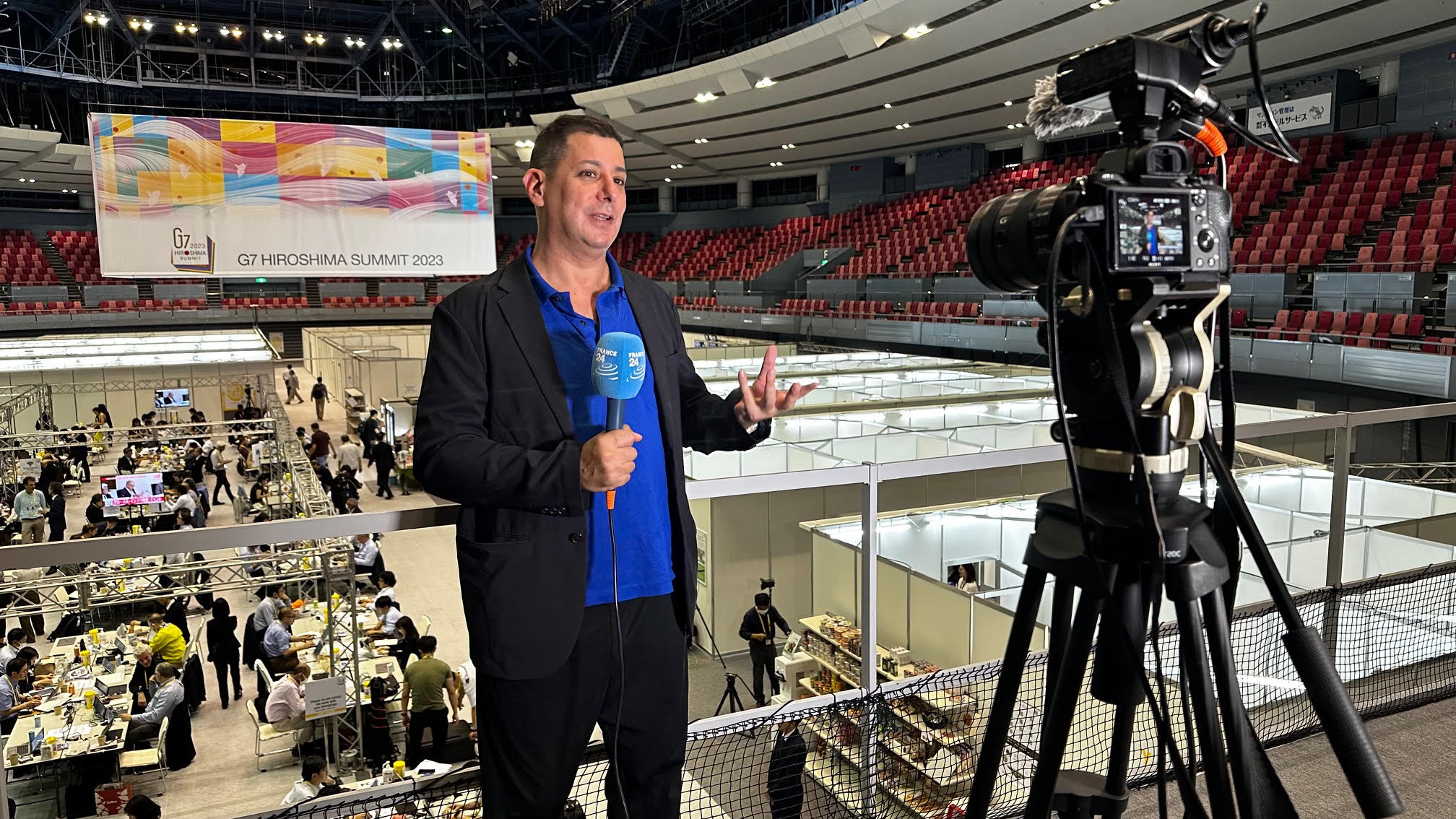
I was there covering the event for France 24 TV. The security was airtight and the restrictions on coverage so draconian that I spent most of my time in the yellow, blue and red zones of the International Media Center doing live updates.
Ukraine dominated the conversation from day one. Zelenskiy was supposed to phone in on Saturday, or possibly Sunday. There were talks about the war and pledges for unity in supporting the Ukrainian resistance and isolating Russia. There was discussion about how to stop China from using its economic power to force political change. However, the focus of the summit shifted to the war in Ukraine when it was leaked on Friday that Zelenskiy would be coming to Hiroshima. The Financial Times was the first to report it, and other media quickly followed suit.
Zelenskiy’s arrival at Hiroshima airport on the Saturday afternoon was reported as if King Charles III himself had touched down in Japan. There was live coverage on several channels. The scripts I had prepared on other topics went out the window. I had planned to discuss Prime Minister Fumio Kishida and South Korean President Yoon Suk Yeol’s pilgrimage to a memorial for Koreans who died at the atomic bombing of Hiroshima – a strong sign of reconciliation – but suddenly that wasn’t worthy of a live update.
It was the Zelenskyy show.
I can’t deny it was an interesting change in the programming schedule. It was apparent that world leaders who had been noncommittal about the Ukrainian conflict would find themselves face-to-face with Zelenskiy. If his aim was to hijack the summit and make an appeal for the war effort, he succeeded beyond his wildest dreams.
He made his intentions very clear in a tweet shortly after landing: “Important meetings with partners and friends of Ukraine. Security and enhanced cooperation for our victory. Peace will become closer today.”
He did a whirlwind round of face-to-face meetings on Saturday afternoon and evening, including an apparently encouraging session with the Indian prime minister, Narendra Modi. It was the first time they had met since Russia invaded Ukraine 15 months ago. Modi pledged that India would do everything in its power to find an end to the war, and tweeted pictures of the encounter, including one showing the two men shaking hands.
India has been supportive of Ukraine on the surface, but still buys Russian oil and is one of the leading consumers of Russian diamonds. Diamonds bring Russia nearly $5 billion in revenue every year, and even on day one of the summit, there were heated discussions about how to stifle that trade through sanctions.
Charles Michel, the president of the European Council, said the G7 that they would be working to stop the traffic in diamonds, channeling James Bond when he announced: “Diamonds are not forever.” Vladmir Putin, meanwhile, was playing the role of supervillain Ernst Stavro Blofeld.
Zelenskiy joined the G7 summit sessions on Sunday, forcing the organisers to issue the leaders’ communique a day early. The G7 leaders had discussed the Ukraine situation on Friday, the first day of the talks, and released a statement pledging unwavering support for Ukraine. U.S. President Joe Biden announced that he would not oppose Ukraine obtaining F-16 fighter jets. By Sunday, the G7 was in direct talks with Zelenskiy, including more detailed discussions of how they planned to supply Ukraine with F-16s and train its pilots.
Zelenskiy also attended a special session on peace and security, along with invited leaders of non-G7 nations, included Brazil, which has so far taken a neutral stance on the war.
It was the first time Brazil had been invited to the summit in 14 years. President Luiz Inacio Lula da Silva had drawn attention for his previous comments on Ukraine, suggesting the West should be blamed for prolonging the conflict and that Ukraine could relinquish some land to Russia to make peace. Perhaps he had been invited to Hiroshima to bring him into line with the other G7 nations.
One of Zelenskiy’s aims was to get non-aligned states such as India and Brazil to join in efforts to further isolate Russia. He appeared to make progress with Modi, but not Lula, who blamed Zelenskiy for effectively cancelling a planned bilateral by turning up late.
Japan’s prime minister, Fumio Kishida, who calls Hiroshima his hometown even though he was born in Tokyo, gave a final, stage-managed press conference on Sunday, but it was Zelenskiy who had the last word in a more off-the-cuff encounter with the media later that evening.
The symbolism of holding the summit in the first city to be attacked by an atomic bomb seemed profound at a time when the Kremlin has implied that it would consider using tactical nuclear weapons in Ukraine.
And it was not lost on Kishida, who said: “There is a difference between dreaming and ideals. Ideals are within our reach. All of us are now citizens of Hiroshima, we should take practical steps, step by step, toward the ideal of our children, grandchildren, and descendants to live on a nuclear-weapon-free earth. A nuclear war must never be fought and can never be won.”
Against the backdrop of Hiroshima, Zelenskiy was less optimistic, warning that Russia appeared willing to play the nuclear card and pointing out that Russian forces were effectively using a seized nuclear power plant in southern Ukraine as a shield.
"Because of their stupidity, the whole world is now exposed to the threat of nuclear war,” he said. “We need to force Russia to respect international law and Russia must renounce this nuclear threat. We seek to stop all of the ambitions of Russia to ruthlessly take over other territories. This will discourage other nations from doing the same thing. We want to send a strong message to the world. The peace in Ukraine will help establish better safety for people all over the world.
“We have different flags but we all share the same future. War should be condemned to the past. We believe that everyone should respect borders, human life and human dignity. Everyone must do their duty to bring about peace….”
And he thanked the people of Hiroshima for their support.
Earlier in the day, Zelenskiy had changed out of his combat fatigues and into a black suit to visit the Hiroshima Peace Memorial Museum. Referring to that visit, he ended his final speech on a defiant note. “I was very touched by the exhibit of the Hiroshima citizen who perished after the explosion and only his shadow remained on the ground. Russia wants us to be gone and wants our country to be a shadow like that. But that will never happen.”
Perhaps the G7 was supposed to be a call for peace, but Zelenskiy’s presence turned it into a forum on how to help Ukraine win the war against Russia.
The Zelenskiy Show proved a boon for Kishida, who won praise for doing a decent job as ringmaster at the G7 circus; his approval rating popularity shot up nine percentage points to 56% immediately after the summit – its highest level in months.
Jake Adelstein had been an investigative journalist in Japan for 30 years. He hosts the true crime podcast The Evaporated. He is the author of Tokyo Vice: An American Reporter on the Police Beat in Japan, which inspired HBO Max's 2022 television series of the same name starring Ansel Elgort as Adelstein.
