

Issue:
October 2026
To counter bullying, Asia needs a new security alliance
Editor's note: The FCCJ community was deeply saddened by the passing of Anthony Rowley, a veteran journalist and longtime contributor to the Number 1 Shimbun, on Oct. 3, 2026. This is his final article for the magazine. An obituary will be published in due course.
There are numerous cross-border political and economic alliances in Asia and it might appear that the last thing the region needs is more military or “security” alliances given global trends toward an arms race. But an Asia-wide security alliance might produce surprising economic as well as security benefits.
Asian nations are coming under increasing pressure to “choose sides” between the U.S., Japan and China as these superpowers contend for greater regional influence. Smaller nations do not have the individual or collective military capability to resist such pressure.
There is no Asian equivalent of NATO, which was created by 12 countries from Europe and North America in 1949 and has since grown to 32, all committed to mutual self defence.
Some Asian politicians and analysts (not least in Japan) are calling for the creation of an Asian version of NATO, mainly to counter the “China threat.” But something of a wider nature, a pan-Asian alliance with a broader perspective, is arguably needed.
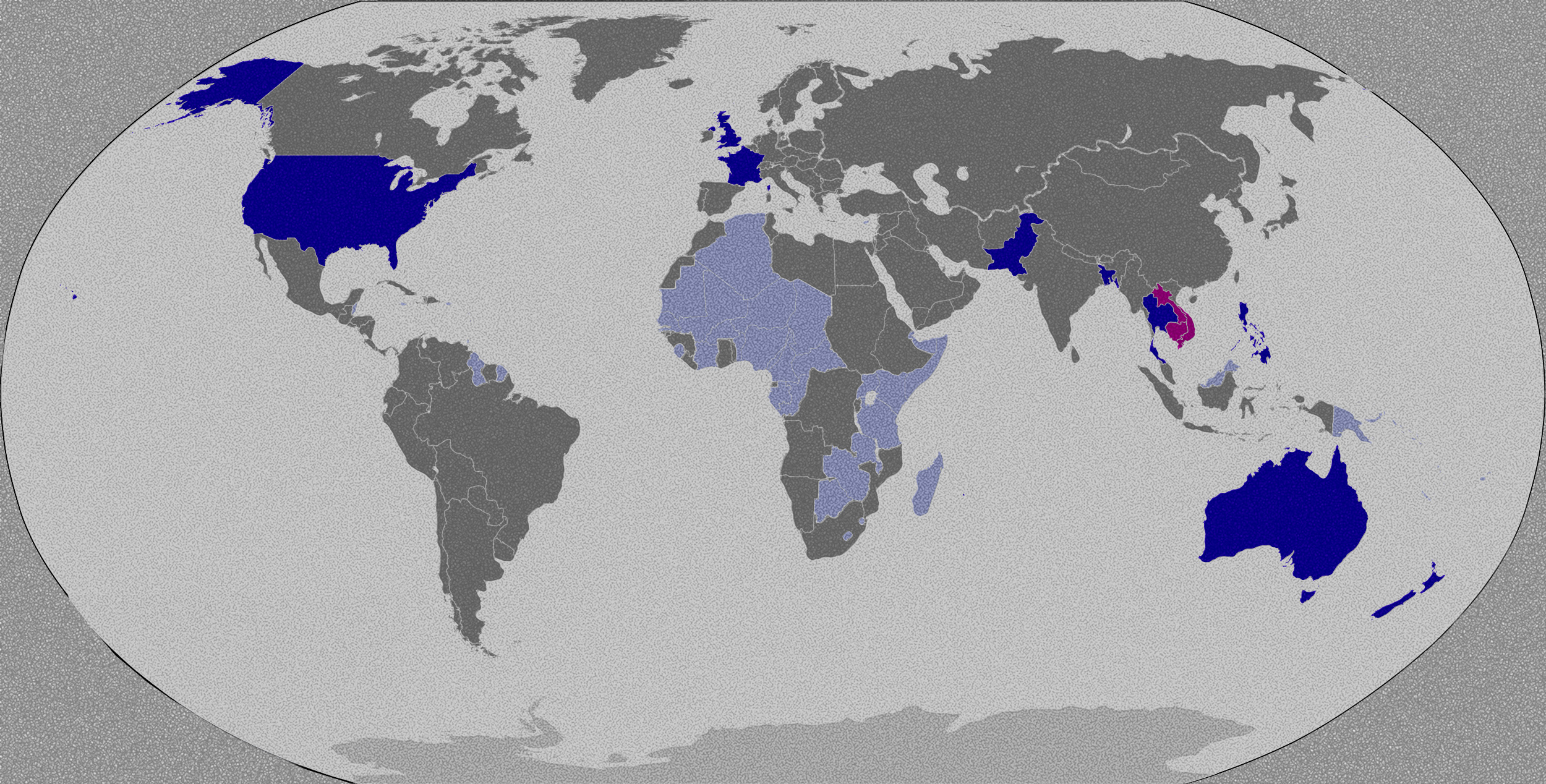
An organization perhaps along the lines of the now-defunct Southeast Asia Treaty Organisation (SEATO), which was formed in 1954 by the U.S., France, Britain, New Zealand, Australia, the Philippines, Thailand and Pakistan, but with wider membership.
The idea of Asian countries consciously and collectively developing the capability to “meet force with force” may seem rather odd or overly aggressive and in opposition to the long-standing tradition of peaceful coexistence within the region. But the times call forth the strategy.
Increasingly, force is seen to be the tactic of first resort, not least by the U.S. and also, in response, by China (not to mention Japan) in a rapidly rearming world. In this changing environment, deterrence capability can be important.
If the U.S. and China are the only ones that are, realistically, able to “call the shots,” then the collective ability to wield a credible weapon may be a balancing factor. Superpowers would be forced to think twice before trying to impose their will upon or to bully smaller but united Asian states.
Canadian Prime Minister Mark Carney in effect enunciated the need for such a strategy in his address to the World Economic Forum earlier this year. Carney advocated greater cooperation between the world's middle powers and other smaller countries in order to protect their vital interests in light of what he termed a "rupture" in the world order due to erratic shifts in U.S. foreign and economic policy. Canada is not least among middle powers to suffer from this.
As things stand, the U.S. is free to act as it wishes in imposing tariffs on or launching trade wars against lesser powers. Asia has become a global nexus of manufacturing supply chains, many of them linked to both U.S. and Chinese markets, and they are vulnerable to disruption by either party or by third parties without the joint ability to defend them. Might truly has become right.
Time was when supply chains existed to support alliances. Today, alliances increasingly exist to protect supply chains.
A bigger and better form of SEATO might offer a solution to Asia’s present predicament. The Bangkok-headquartered SEATO was an international organization for coordinating collective defence in Southeast Asia through the Southeast Asia Collective Defence Treaty signed in Manila by eight countries.
It was founded mainly to prevent further communist gains in Southeast Asia around the same time that the Vietnam War erupted. Now, SEATO is considered to have been a failure, as internal conflict and dispute hindered general use of the SEATO military; it was dissolved in 1977.
Founded in 1967, the Association of Southeast Asian Nations also had security objectives although the emphasis was primarily economic. But neither of these organizations had the military clout that is needed now in a much-changed regional and international political environment.
One consequence of the current fragmentation is that it allows the U.S. as well as China to deal with Asian nations one at a time. They lack “collective bargaining” power. They may believe they can protect their autonomy by balancing between the two superpowers, preserving access to Chinese markets while relying on the United States for security. But there are limits to how long that strategy can succeed.
Lyric Hughes Hale, director of Consulting and Global Research at Hale Strategic Associates based in Chicago, observed in a recent commentary that there are already a multitude of overlapping working groups, alliances and institutions in the Asia region, “but none rival the power and cohesion of NATO. Since NATO was formed, the world’s economic centre of gravity, and increasingly its security interests, have shifted away from Europe toward the Middle East and the Indo-Pacific.”
Perhaps SEATO was premature, she suggested, “but we might have waited too long to revive it.” Now there is ANZUS, AUKUS, the Quad, Five Eyes, APEC, U.S. alliances with Japan, South Korea and the Philippines, Australia-Japan security cooperation, and a growing collection of trilateral arrangements. Intelligence is handled by one group, advanced defence technology by another, mutual-defence obligations by bilateral treaties and strategic consultation by still others.
The result, Hughes Hale suggested, is integration without consolidation. The problem is not too little cooperation, but too much fragmented cooperation in a world where “Collective action is not necessarily the surrender of sovereignty, but the means of preserving it.”
Anthony Rowley is a columnist and contributor for the South China Morning Post.
