


Issue:
October 2026
Renowned singer-songwriter Masashi Sada regales fans with tales of his family and his passion for music

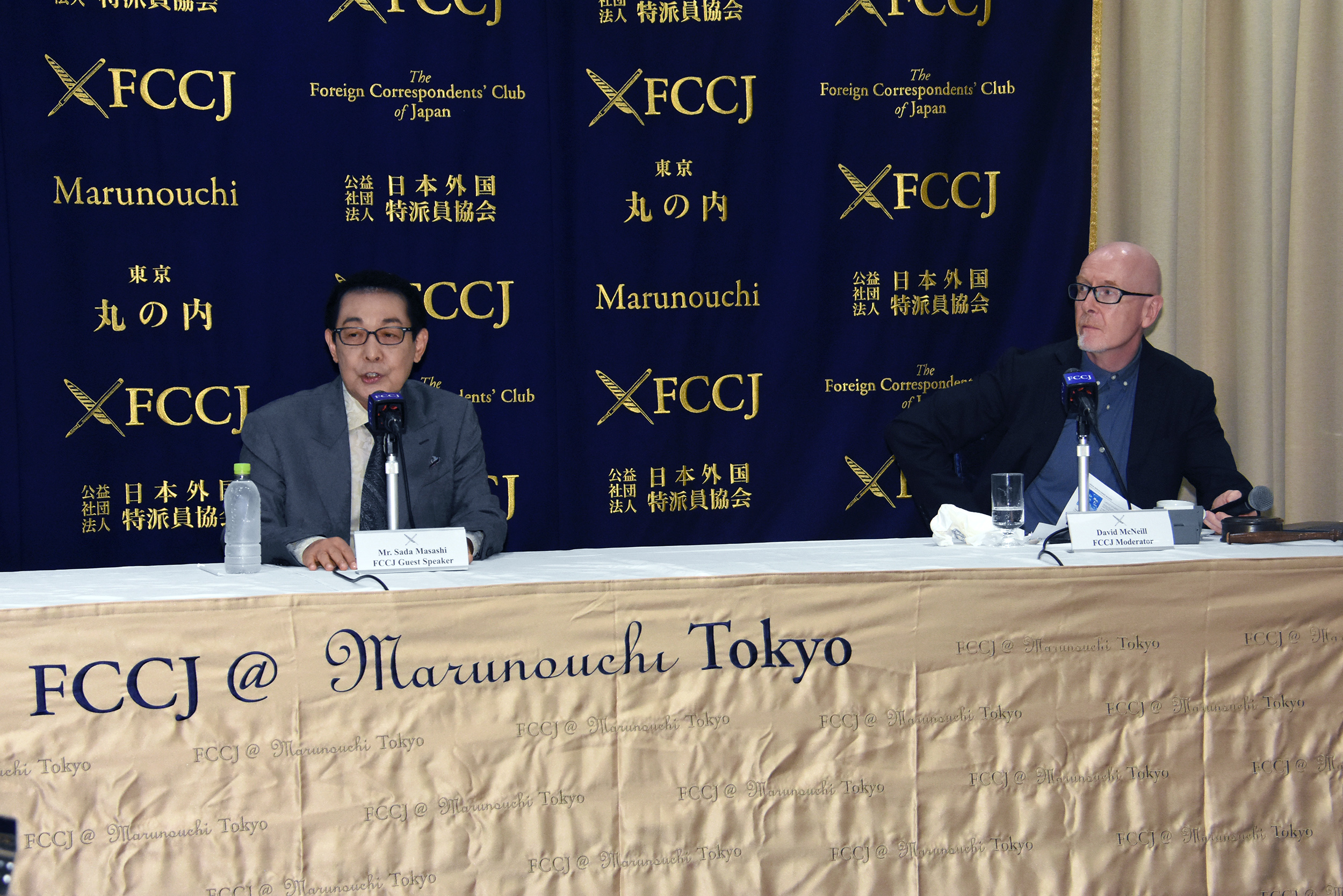
Masashi Sada’s chart success peaked in the early 1980s, so you might be forgiven for thinking that he’d struggle to pull a crowd, but you’d be wrong. The veteran songwriter and crooner attracted the FCCJ’s biggest audience of the year when he spoke at a professional luncheon event on Sept. 15.
The turnout was testament to the evergreen popularity of a musician who, at 74, still records and tours relentlessly. A famously witty, loquacious speaker, Sada had just performed his 4,772nd concert and was promoting an album of new material called Kamisama no Iutori (“As the Gods Say”).
“I don’t see myself stopping,” he told the FCCJ.
Sada’s lyrics deal with the stuff of life and death. He began the event by playing “A Long Way From Kiev,” an antiwar song he wrote in the week after Russia launched its full-scale invasion of Ukraine in 2022. He said his pacifism dates to his upbringing in Nagasaki, which had been destroyed by a U.S. atomic bomb seven years before he was born.
“My beloved aunt was my mother’s younger sister and she passed away from the aftereffects of the bomb, aged 67,” Sada said. “I talked to her about what had happened quite a lot. I asked her in her final year of life if she was resentful of the bomb but she said it was just a consequence of war. And that motivated me to think about war objectively.”
“I’m a musician, and music is built on very brittle foundations,” he continued. “When something happens in the world, music stops. During the coronavirus pandemic, all concerts were canceled. I was the only musician in Japan to tour, since my audience is very conscientious about safety. There is no music without peace. My most important mission as a musician is to protect peace.”
Conflict influenced not just his musical themes but his choice of career. Sada said that he started playing violin at just age 3 and went to Tokyo, age 13, to study music. But he abandoned plans for university during the Vietnam War. It was the era of folk singers, when “people just picked up guitars and started singing, and I thought ‘Maybe I can do this too,’” Sada recalled. “And that was the start of my musical career.”
His goal, he said, has since been to make interesting, progressive, fun music, though he wonders if he got the balance right.
“I was aiming for sophisticated music while ensuring it was fun, too. But not many people understand the quality of a good song. What draws attention is the funny part. I really regret that Sada Masashi is known most for being funny.”
Less well-known, perhaps, than his musical journey in Japan is his early affinity with China. Sada speaks Mandarin and once made a famous travelogue, funded out of his own pocket, about traveling along the Yangtze River. The movie put him heavily in debt. At one point, he was one of the best-known Japanese artists in China.
His colorful family tree also includes roots in China and Russia. He told the FCCJ audience that his father was born in Vladivostok, where his grandmother ran a Japanese restaurant. His grandfather was a spy who was chased by government forces into the restaurant. He hid in the attic.
“Eventually he seems to have moved himself to the bedroom,” he said to laughs. “My grandfather was a good spy, so his name isn’t recorded. Bad spies get caught and their names come out.”
When he was a boy, Sada’s father lived in Manchuria and also spoke Chinese. He was eventually conscripted into the Japanese army and became a guerrilla fighter. “He fought the Chinese but loved China as well, which was interesting.”
Sada said his maternal grandfather was a gang leader in Nagasaki. “So I’m the son of a spy and a gangster, perfect for a musician,” he joked.
This tangled cultural mix fed Sada’s musical muse. One attendee asked about the role of creativity and individual artistry in an era of computer-generated music and artificial intelligence.
“AI is pretty good at creating music,” he admitted. “But it can’t replace the philosophical depth of human creativity.”
“The most difficult sound that a human can generate is the vocals,” he continued, before paraphrasing Brahms. “Great music is to be in dialogue with God. If you listen to music by Brahms, it really does feel like a dialogue with God. That can’t be replicated by a computer.”
Is there a cutoff point for such a remarkable musical career? Sada’s hero Paul Simon is still going at 84, as is Paul McCartney. Sada is clearly not the retiring type either. “Concerts are my lifeline, my artery – I can’t stop performing. I would like to keep going until I collapse and die. And I hope I do.”
David McNeill is professor of communications and English at University of the Sacred Heart in Tokyo, and co-chair of the FCCJ’s Freedom of the Press Committee. He was previously a correspondent for The Independent, TheEconomistand TheChronicle of Higher Education.
