


Issue:
October 2026 | Letter from Hokkaido
Prime Minister Takaichi’s muted response to Trump’s attack on the International Criminal Court may give her opponents a new opening.
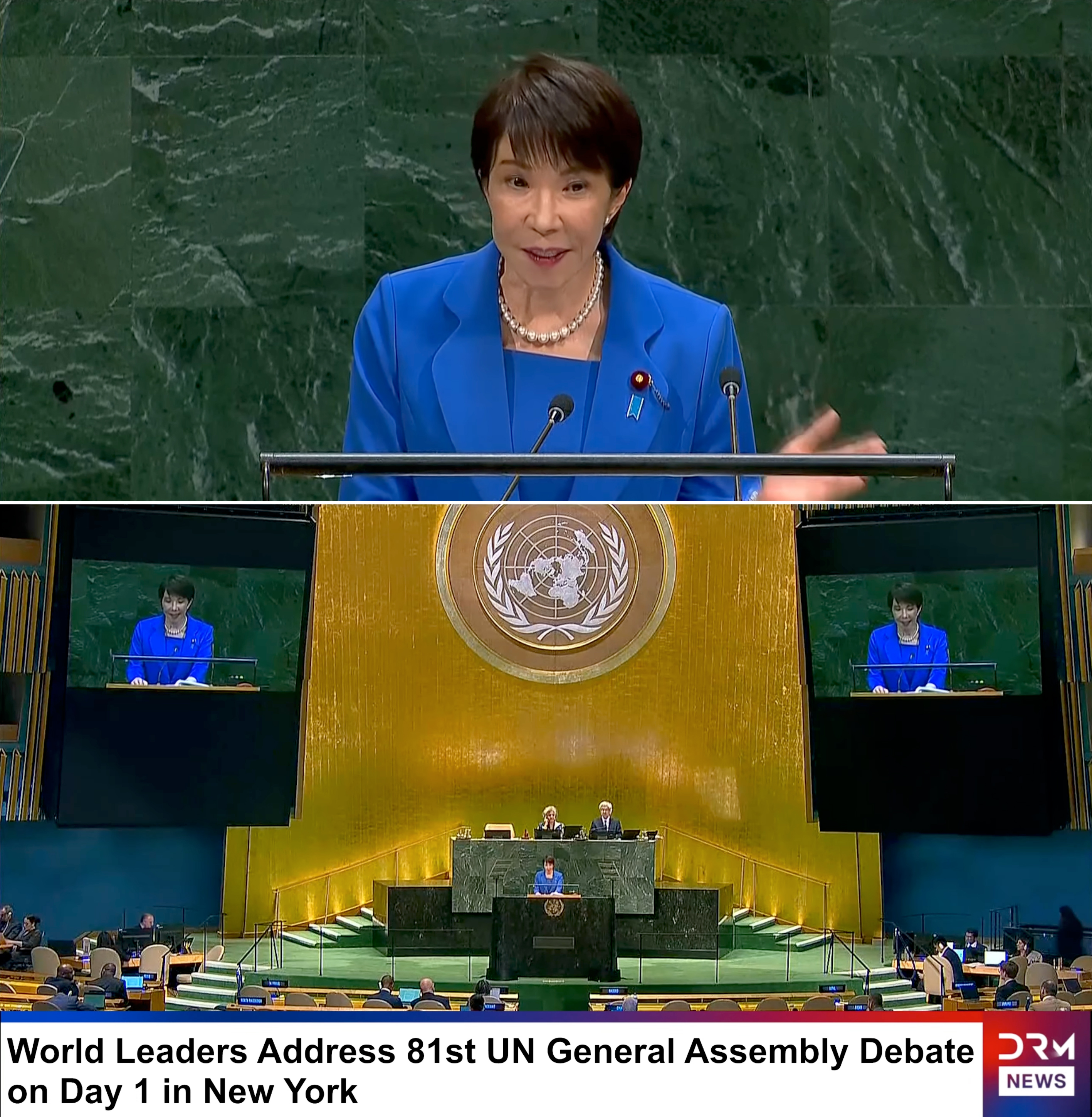
On Sept. 22 — one year to the day since the Liberal Democratic Party presidential campaign she would go on to win kicked off — Prime Minister Sanae Takaichi made her debut at the United Nations.
At the annual U.N. General Assembly session, she gave a speech that was to some degree overshadowed in the international press by the looming summit between U.S. President Donald Trump and Chinese President Xi Jinping.
“Since the end of the Second World War, Japan, as a peace-loving nation, has attached great importance to the rule of law in the settlement of any disputes. This is demonstrated by Japan’s consistent support for, and its contributions of judges to, various international judicial organs, such as the International Court of Justice (ICJ), the International Criminal Court (ICC) and the International Tribunal for the Law of the Sea (ITLOS).”
Takaichi speech
It was the kind of official rhetoric that in the past would have gone relatively unnoticed either at home or abroad. But this year, it was closely followed. It was seen both as a litmus test for Takaichi’s commitment to the norms of international law and her willingness to confront Trump and his administration’s August sanctions against International Criminal Court President Tomoko Akane, a Japanese national.
In sanctioning Akane, as well as ICC Senior Trial Lawyer Abdoulaye Seye of Senegal, U.S. Secretary of State Marco Rubio was belligerent, saying in an X post that the move was due the the U.S. government’s “unwavering mission to protect Americans from this sham of a court.” A separate State Department announcement promised a sweeping campaign “to dismantle the threat posed by the ICC to national sovereignty.”
Rubio on ICC
The decision to personally target Akane, who assumed her post in March 2018, appears to have caught Japan by complete surprise. Takaichi, who had virtually no experience in diplomacy or foreign affairs before becoming prime minister, appeared unsure of what to say at her initial press briefing on the issue. So she called the move by Trump — a man she had suggested last year deserved the Nobel Peace Prize — “unfortunate,” and stopped short of the kind of full-throated criticism of Trump or the U.S. decision that many in her own party were demanding.
This sparked criticism from all quarters, including members of her own party, that her response was too weak, and that she and her administration were too concerned about placating Trump and the Americans. The U.S.-Japan Security Alliance, especially the growing military and military-industrial relationship, was important, all agreed. But that didn’t mean Japan should mute its criticism and let the U.S. get away with slapping personal sanctions on a Japanese national who was the head of the ICC, an institution dedicated to enforcing the rule of law around the world, a principle Japan had greatly benefited from.
In an eloquent defense of the ICC, Akane on Aug. 26 gave a remote video press conference at the Japan Press Club. She said that despite the personal inconveniences caused by the sanctions, including problems with electronic banking, “they will not alter my approach to my judicial duties. Nor will I be crushed by such threats.”
Akane speech
The press conference was the centerpiece of a broader public and political pressure campaign on Takaichi to get tougher because Japan’s international credibility was at stake. But there was a domestic political element as well.
Though not close to Takaichi, former Defense Minister Gen Nakatani, head of a nonpartisan parliamentary association on human rights diplomacy, remains a powerful presence within the party. Speaking at the FCCJ on Sept. 4, Nakatani criticized the sanctions, noting the U.S., which is not a member of the ICC, was strengthening its efforts to effectively dismantle it or render it dysfunctional.
Nakatani speech
“Destroying the ICC’s ability to function would amount to destroying the rule of law itself. We can’t simply stand by and ignore what’s happening,” Nakatani said.
In response to charges that Takaichi kept the Japanese government’s response to the U.S. sanctions too mild, he said that upholding the alliance and defending the rule of law were not mutually exclusive.
“However, an alliance that remains silent in the face of an attack on the rule of law will eventually lose the values upon which that alliance is founded,” Nakatani said.
Takaichi reshuffled her Cabinet last month, but kept her finance, foreign, and defense ministers. They will likely face questions in next month’s session of parliament about Japan’s response to the Trump administration’s sanctions, and what Japan should or should not do to convince the U.S. to drop them.
It’s a political headache Takaichi did not expect, especially as it gives potential rivals a talking point that could dent both her high poll numbers and her control over the party.
Nakatani is close to both former Prime Minister Shigeru Ishiba and Yoshimasa Hayashi. Both have fundamental political and personal differences with not only Takaichi but also LDP vice-president and shadow shogun Taro Aso, the man responsible for getting Takaichi elected as party president last year. Nakatani backed Hayashi’s bid for LDP president against Takaichi.
The two remain close, and Nakatani invited Hayashi to his home district of Kochi on Sept. 20 to give a speech. Nakatani is also on good terms with another LDP veteran, Ryota Takeda, who has a cool relationship with Takaichi.
Nagata-cho watchers are keeping an eye on whether these men, plus a few other potential Takaichi rivals like Yuko Obuchi, are forming the nucleus of a rival LDP group. They could increase pressure on Takaichi over how she handles Akane and the ICC going forward, but also controversial legislation such as reduction of the food consumption tax to 1% or reducing the number of Lower House seats — both of which have opponents within the LDP.
Known for having few close allies, Takaichi hopes to run unopposed in the LDP presidential election next year. She has done well this past year due to her cautious approach and lack of verbal gaffes (her remark last year about Taiwan was a notable exception that made tense relations with China worse), the strong support of Aso, no clear intraparty challenger, and the failure of the opposition parties to either unify or win deep, broad public support.
High public approval ratings have so far kept potential rivals quiet. But whatever the final outcome of the U.S. sanctions against Akane, they have given members of the LDP a new opening to criticize Takaichi, who may face more attacks in the months ahead.
Eric Johnston is the Senior National Correspondent for The Japan Times. The views expressed here are his own and not necessarily those of The Japan Times.
