


Issue:
November 2026
Filmmaker Rionne McAvoy broaches a taboo issue devastating families in Japan
In 2001, Rionne McAvoy, an amateur wrestler and karate black belt, left Queensland, Australia, for Tokyo. He was harboring a dream to become an action movie star. After building a successful career as pro wrestler Rionne Fujiwara, McAvoy is now a documentary maker earning respect for his focus on Japan’s hidden, painful social issues. His work has won him praise for his empathetic lens.
“I am not trying to reform Japanese society,” McAvoy said in an interview. “My approach is to give people room to decide those experiences in their own voices.”
McAvoy was referring to his “Left Behind” series. The latest film, “Left Behind: When Tomorrow Feels Impossible,” explores teenage suicides and the overwhelming isolation of youth in Japan. The country leads the Group of Seven in youth suicide rates, a crisis that has drawn increasing attention.
“Children can appear to be doing well while feeling overwhelmed or unheard. It has made me question how we define success and how much space we actually need,” said McAvoy.
Excerpts of “When Tomorrow Feels Impossible” were screened at the FCCJ in October.
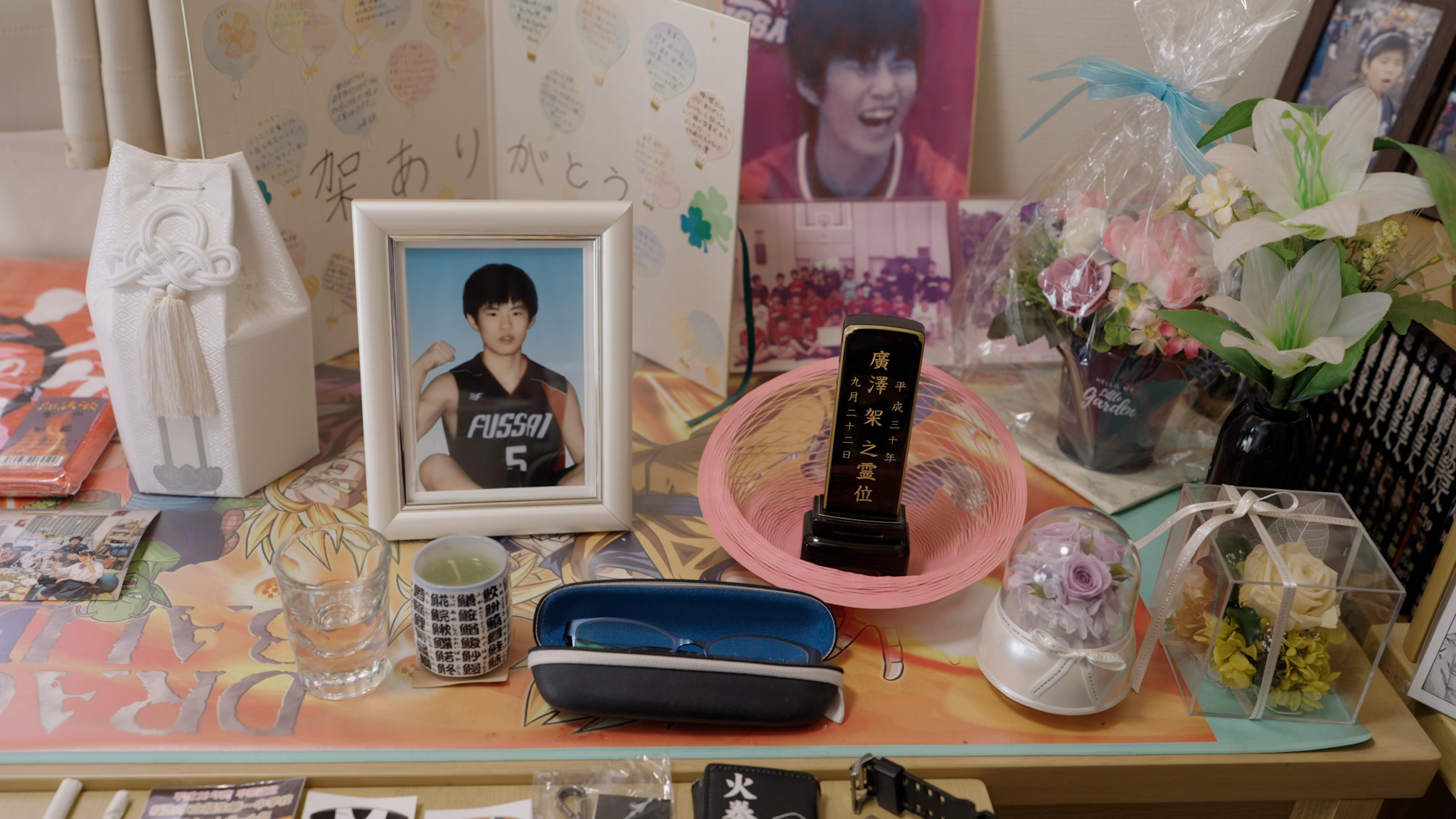
Joining McAvoy at a press conference that day was Tetsu Hirosawa, whose son Kakeru took his life in 2018 when he was only 14. In McAvoy’s film, Hirosawa talks of the tragedy that has left the family still asking why and searching for answers. He also expresses his deep gratitude to McAvoy.
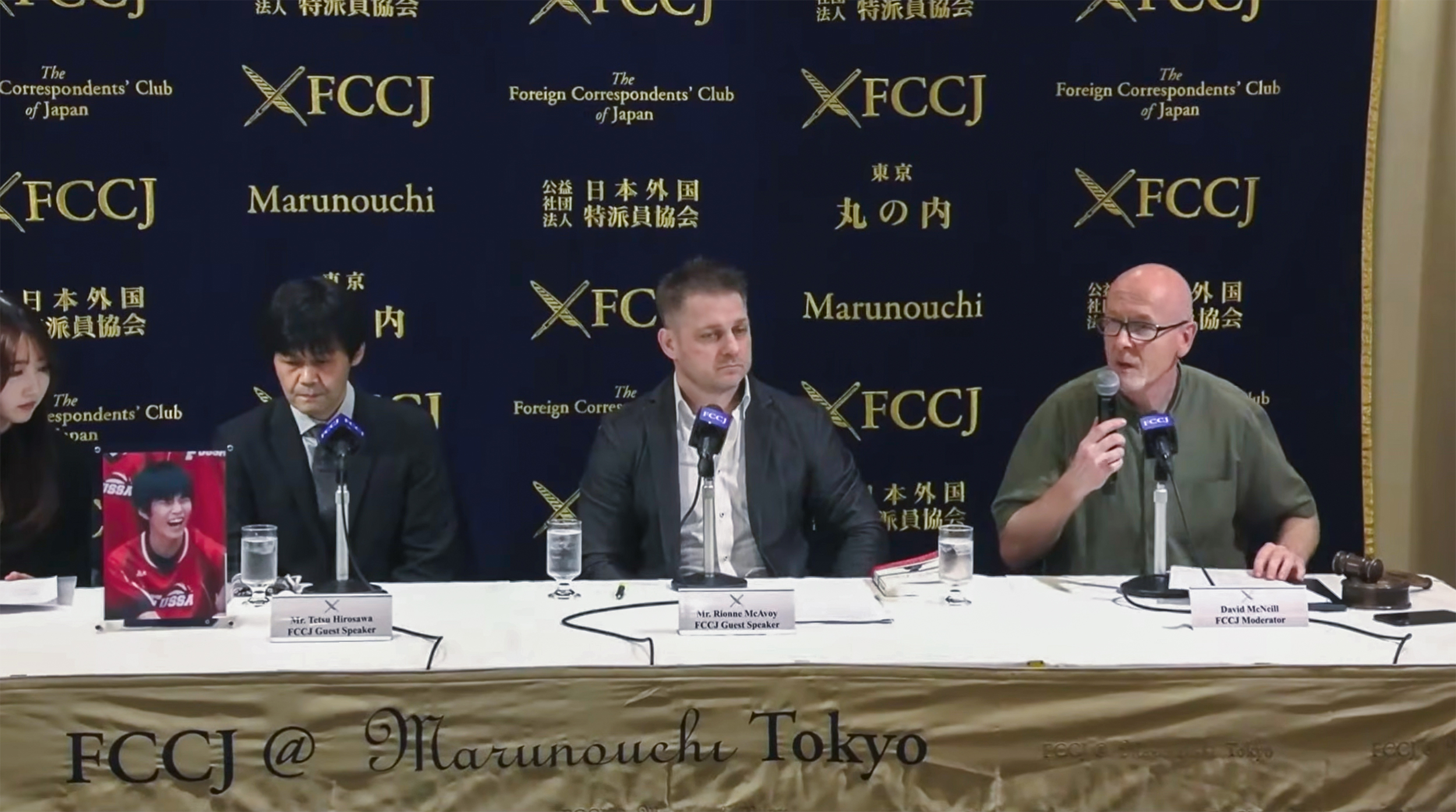
Rionne McAvoy and David McNeill (moderator).
“His films have opened social taboos that lie buried in Japan,” he said. Hirosawa explained that Japanese children are rarely able to share their deepest secrets with others.
“In Japan, the value of communicating honestly falls behind the emphasis in society to follow the rules,” he said. That constraint leaves young people feeling alone and without hope for a future, a desperation that contributes to vulnerable teenagers taking their lives.
McAvoy established Japan Media Services in 2015, which also produces films for clients such as the BBC. Becoming part of Japanese society and building trust is a long-term process but he feels he is slowly achieving that goal.
McAvoy’s first documentary exposed the toll of poverty and mental strain that burden single mothers—Japan has more than 10,000 Kodomo Shokudo, or children’s cafeterias, set up by grassroots groups to provide low-cost and free meals for hungry children whose parents cannot afford to feed them.
The director describes his films, which he funds with his commercial work, as a space to move beyond the search for a single explanation.
“Bullying, academic pressure, family relationships, isolation and school culture all need attention, but each person’s circumstances are different. We have to leave room for that complexity,” he said.
Released in 2023, “The Ones Left Behind: The Plight of Single Mothers in Japan” received 41 international festival selections and won 17 Best Documentary awards. It has been endorsed by Japan’s Ministry of Education, Culture, Sports, Science and Technology for educational screenings. Most of all, he thinks, it has helped strengthen child support laws in the country.
“Speaking Japanese allows me to hear people’s experiences directly, while growing up in Australia gives me another perspective on things people here may have learnt to accept,” said McAvoy.
He adds that after so many years, he still encounters realities he knew very little about. “Making these films is also a way of challenging my own assumptions,” he said.
McAvoy links his unfailing commitment to his job to his upbringing—his father taught him martial arts and discipline to keep going when something was difficult, while his mother taught him to care about people and to try to be a good person through his actions.
He added that another benefit of filmmaking is encountering the extraordinary care displayed by Japanese people: etched in his mind is a father who learned to make the sweets his dead son had once loved.
“By telling me their stories, they are trusting me,” he said.
Suvendrini Kakuchi is Tokyo correspondent for University World News and a former president of the FCCJ.
