


Issue:
June 2026
The short-lived genre of Kasutori pulp magazines entertained and titillated the masses during the immediate postwar period
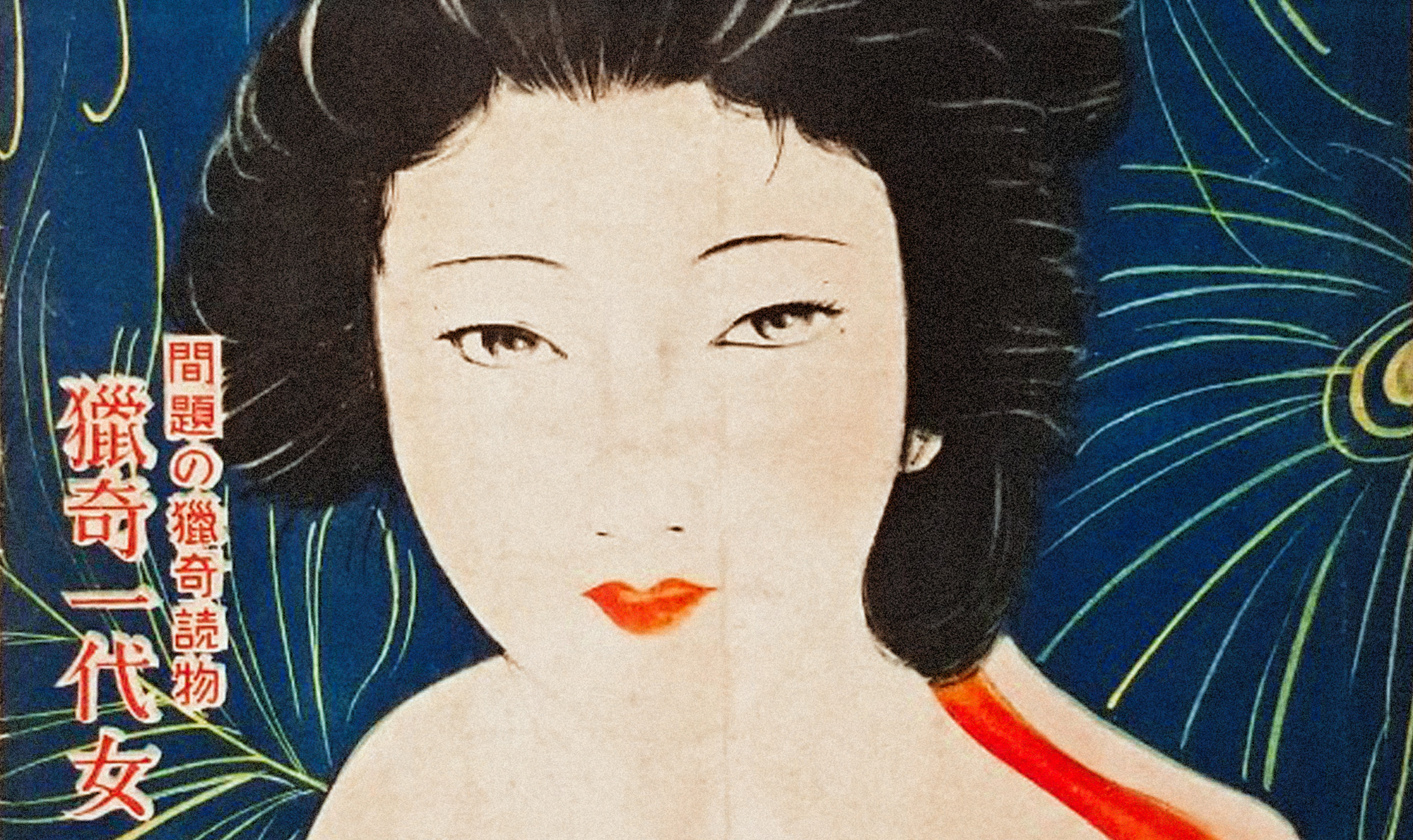
In October 1945, the Publishing Business Order and its Enforcement Regulations were abolished, freeing up Japan's publishing activities. The following month came a surge in reprints and new publications.
Paper shortages remained a serious problem, however, and as late as 1947 even newspapers were reduced to tabloid size. Being extremely difficult for entertainment-oriented publications to secure paper, they resorted to using a type of paper called senka-shi, which was not controlled by the rationing system. Senka-shi is a poor-quality recycled paper made from re-processed waste paper, making it prone to deterioration. Print-through, where the ink bled through one side of the paper, making it visible on the reverse, was common.
Thus began the genre of Kasutori magazines. Printed on this low-grade paper, they took their name from the cheap shochu (grain spirits), distilled from leftover dregs in the distillation process.
As long as the publications avoided politics or criticism of the occupation, the authorities generally gave a green light to the content of these magazines, and as a result many came to be dominated by lurid, sexually charged stories. These typically included explorations of red-light districts, bizarre crimes, deviant sex and soft porn fiction.
While many considered them lowbrow and vulgar, they were seen by others as a sign of the joy felt by Japan's citizens who, having managed to survive the war and live under decades of repression by the militarists, were eager to embrace their newly gained freedoms.
The Kasutori, however, did not pop up out of nowhere: Many publications had direct links to a previous trend in popular culture, remembered today as so-called "ero-guro nansensu" (erotic and grotesque nonsense), which had thrived during the Taisho and early Showa eras. Its heyday ran from the publication of Edogawa Rampo's short story, Inju (The Beast in the Shadow), which had appeared in Shinseinen magazine in 1928, to the bloody coup attempt by an Imperial Army faction on February 26, 1936.
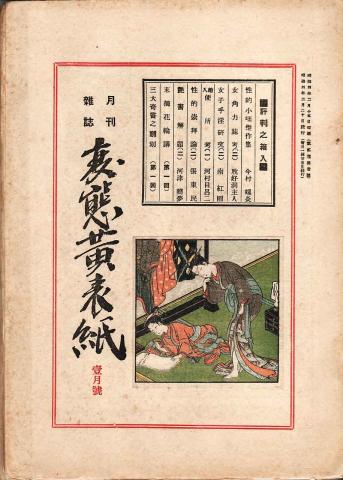
It should be noted, however, that stories of deviant sex and bizarre fetishes were nothing new to Japan's popular culture, having circulated underground during the later years of the Edo period. These aspects of Edo culture were researched and disseminated by such literary non-conformists as Gaikotsu Miyatake (1867-1955) and Hokumei Umehara (1901-1946).
Partial list of magazines launched in 1946 and 1947.
- Riberaru (Liberal) – Jan. 1946
- Van – May 1946
- Pin Up – Aug. 1946
- Ryoki (Bizarre) – Oct. 1946
- Aka to Kuro (Red and Black) – Sep. 1946
- Liebe – Jan. 1947
- Jochi no Kao (Shameless Face) – Feb. 1947
- Sei Bunka (Sex Culture) – Feb. 1947
- Queen – Mar. 1947
- Hanzai Yomimono (Crime Stories) – Mar. 1947
- Venus – May 1947
- Ningen Fukko (Human Revival) – Jun. 1947
- Hanzai Jitsuwa (True Crime) – Jul. 1947
- Kyoraku – Jul. 1947
- Lovely – Sep. 1947
- Nanba Wan – Sep. 1947
- Thriller – Nov. 1947
- Fuu Danitto (Whodunit) – Nov. 1947
- Okay – Dec. 1947
- Subaru – Dec. 1947
While Kasutori magazines were widely disparaged even during the brief years of their existence, some people maintain that they served as a "place holder" that kept the magazine genre alive in the immediate postwar years, supporting writers, artists, editorial staff, typesetters, printers and distributors.
As Akira Yamamoto wrote in his expansive 1998 study of the Kasutori genre, "Even back then, people looked down upon Kasutori magazines. However, as mentioned in my introduction, Kasutori magazines in a broad sense included contributions from famous writers and individuals who later became well-known. For example, writers such as Renzaburo Shibata (1917-1978) and Yorichika Arima (1918-1980) publicly stated that they made a living writing for Kasutori magazines, and there are many others who, without public disclosure, wrote for Kasutori magazines under their real names or anonymously.
"Chiyozo Kitagawa, author of the provocative story about Colonel H's Wife in the second issue of Ryoki, used several pen names and later continued to write under the name Sumihiro Tokuda. Also, from what I've heard directly, I know quite a few now-famous literary figures and critics who tell me things like, 'When I was a student, I wrote erotic novels for Kasutori magazines as a part-time job. The stories? I've forgotten whatever they were. I don't even remember the magazines' names. Anyway, they paid an astonishing amount of money for a student in exchange for the manuscript, so I suppose I wrote for them two or three times.'"
Other contributors include some literary figures who were seen as being responsible for the war effort at the time. These people were singled out for expulsion from public office or banned from writing for major publishing houses. It was these types of writers who were put to work by pulp magazines and entertainment magazines.
The heyday of pulp magazines was also a time of stagnation for those writers whose works actively supported the war (Yamamoto describes them as senpan sakka, literally war criminal writers), although it's uncertain if the words were intended to be accusatory.)
When the purging from public office was finally lifted in the autumn of 1950 and Japan's political affairs began to swing in the opposite direction, these writers gradually began to return to write for major publishing houses.
"So," writes Yamamoto, "we have the strange paradox in that influences from the prewar and wartime eras came to live on in the new magazines."
Coincidentally, the purges in Japan were somewhat reminiscent of the blacklisting of more than 300 Hollywood artists by America's House Un-American Activities Committee around the same time period.
Machiko Hasegawa's wartime story titled "The Strange Housewife" is one example of how wartime subject matter was modified for postwar audiences.
As Yamamoto relates, "The story's protagonist isn't named Sazae-san (Hasegawa's beloved manga character), but she's very much like her. She greets her neighbor's wife and is met with a cold shoulder. In the earlier version, the wife explains to her husband, 'She's holding a grudge over something so trivial. I just accidentally blacked out the decorative string on the gift.'" (A reference to wartime blackouts.)
"I seem to recall that the same story was later used in an episode of the Sazae-san cartoon, but I'm not entirely sure."
Ryoki (Bizarre) magazine, launched in October 1946, had been preceded by a prewar magazine named Grotesque. Ryoki's publisher claimed the entire 20,000-copy print run of its inaugural issue was sold out within two hours of being placed on sale. Clearly, the public was famished for affordable entertainment.
Each publication had its distinctive style and reader appeal. Kitan Club, first published in Osaka in November 1947, was originally a magazine of true stories, but the following year, when illustrator and bondage artist Toshiyuki Suma joined the editorial staff, it established itself as a comprehensive SM/hentai magazine. It survived the demise of the Kasutori magazines and enjoyed a fanatic readership until folding in 1975.
Uramado was a comprehensive SM/hentai magazine that Kitan Club's artist Suma transplanted to Tokyo, where it eventually thrived. Fully supported by Tetsu Takahashi, author of the best-selling erotic technique book “Arus Amatoria" (Arusu Amatoria: An Analysis of the 62 Sexual Positions), Amatoria was launched in March 1953 and attracted attention for its innovative approach to the "science of sex." Jitsuwa Survival magazine featured a hard-boiled private detective patterned after the works of Raymond Chandler. Then there was *Sen-Ichiya* (A Thousand and One Nights), with a focus on film starlets.
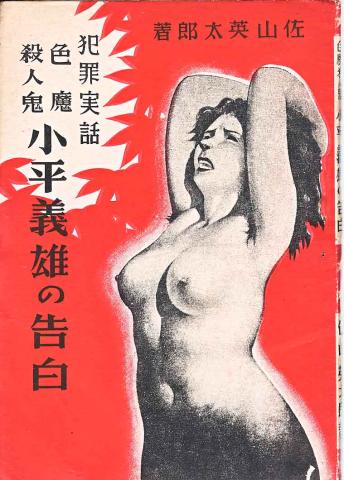
To get past the censors, writers applied their creativity, coining hundreds of new erotic euphemisms such as tsubomi (bud/clitoris), kiku (chrysanthemum/anus) and kaben (petal/labia) coming into vogue. Such words eventually filled an entire dictionary of expressions in erotic fiction."
Owing to a novelette that remains a topic of study even today, the second issue of Ryoki was pulled off the stands over an article titled The Wife of Colonel H.
In author Chiyozo Kitagawa's story, Colonel H had been convicted of war crimes and sentenced to hang. Mineko, the colonel's widow, conducts an affair with Takao, a young draft dodger from a wealthy family.
In addition to infidelity by the wife of a high-ranking military officer -- who had engaged in a tryst with a man who'd feigned illness to avoid military conscription -- the narrative also raised the topic of war crimes just at the time the allies were preparing to hold the Tokyo Tribunal. Both points touched on a raw nerve with the authorities, who decided to invoke Article 175 of the Penal Code (distribution of obscene materials), and that issue of Ryoki was withdrawn from sale.
A nine-page portion of the original Colonel H story appears in Go Watanabe's lavishly illustrated book, Kasutori Zasshi: Sengo no Adabana (Kasutori magazines, fruitless blossoms of the postwar era, 2019).
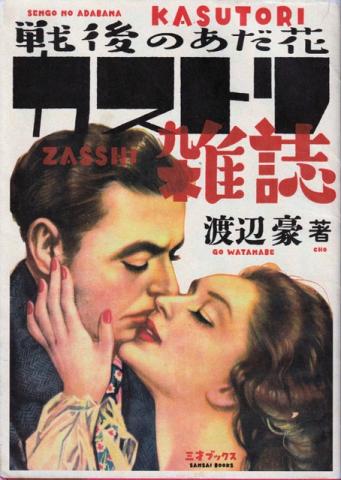
The most complete data on the Kasutori genre can be found in a 500-page paperback by Akira Yamamoto published by Chuko Bunko in 1998. Yamamoto organized his book into chapters touching on the most common themes taken up by the Kasutori magazines. In order of appearance, these included: The democratization of kissing in Japan; the striptease; knickers as a symbol of eroticism; the glory and afterglow of the bizarre; leisurely socialites yearning for modernism; masturbation as a taboo; the downfall: The sorrows of women from the middle class; "panpan" as a form of prostitution; the image of widows as sex symbols; chastity: the cessation of fornication as a crime; love between elder sister and younger brother: a look at incest; ero: that principle of justification; Sada Abe: pushing sexuality to its limits* (see footnote); and demobilized soldiers: carrying the scars of war
The Kasutori magazines served as a source of work for established writers whose careers had stalled in the postwar period, while also being keen to encourage new writers. It is generally agreed that the genre laid the groundwork for the later era of mid-range magazines.
Until the mid-1950s, a more serious genre of general weekly magazines had remained the exclusive purview of Japan's major newspaper publishers. This changed with the launch of Shukan Shincho, by publisher Shinchosha, in February 1956. A writer for Asahi Geino magazine recently noted that reporters at the time of Shukan Shincho's debut acknowledged that the style and themes of the news stories for many of the newly launched weekly magazines in their early years had been inspired by the Kasutori magazines.
"Hearing accounts like this," he wrote, "I believe that the Kasutori magazines were by no means a 'postwar curse.'"
- * [Footnote: In May 1938, Sada Abe (age 33) gained nationwide notoriety after she killed her lover during a sexual misadventure and sliced off his male apparatus to keep as a souvenir. During the postwar years, books and magazines launched an "Abe Sada revival," beginning with Sakunosuke Oda's "The Enchantress,"published in March 1947. Followed was a succession of sensationalist books, such as Ichiro Kimura's "Showa's Sensual Woman: O-Sada's Confession," published in June of the same year in the form of a sensually dramatized, confession-style adaptation of Sada's police interrogation transcript. It reportedly sold over 100,000 copies within two months of its release.
- Ms. Abe, once again exposed to the gaze of curiosity, was initially outraged and sued the publisher for defamation, but subsequently came out and led a turbulent life, engaging in a dialogue with popular author Ango Sakaguchi, touring the country and even portraying herself in a drama about Sada Abe.
A translator, columnist, author, and book collector, Mark Schreiber has lived in Tokyo since 1966.
