


Issue:
June 2026 | Cover story
The 2026 Reporters Without Borders (RSF)’s World Press Freedom Index highlights a dramatic downfall that threatens democratic systems.
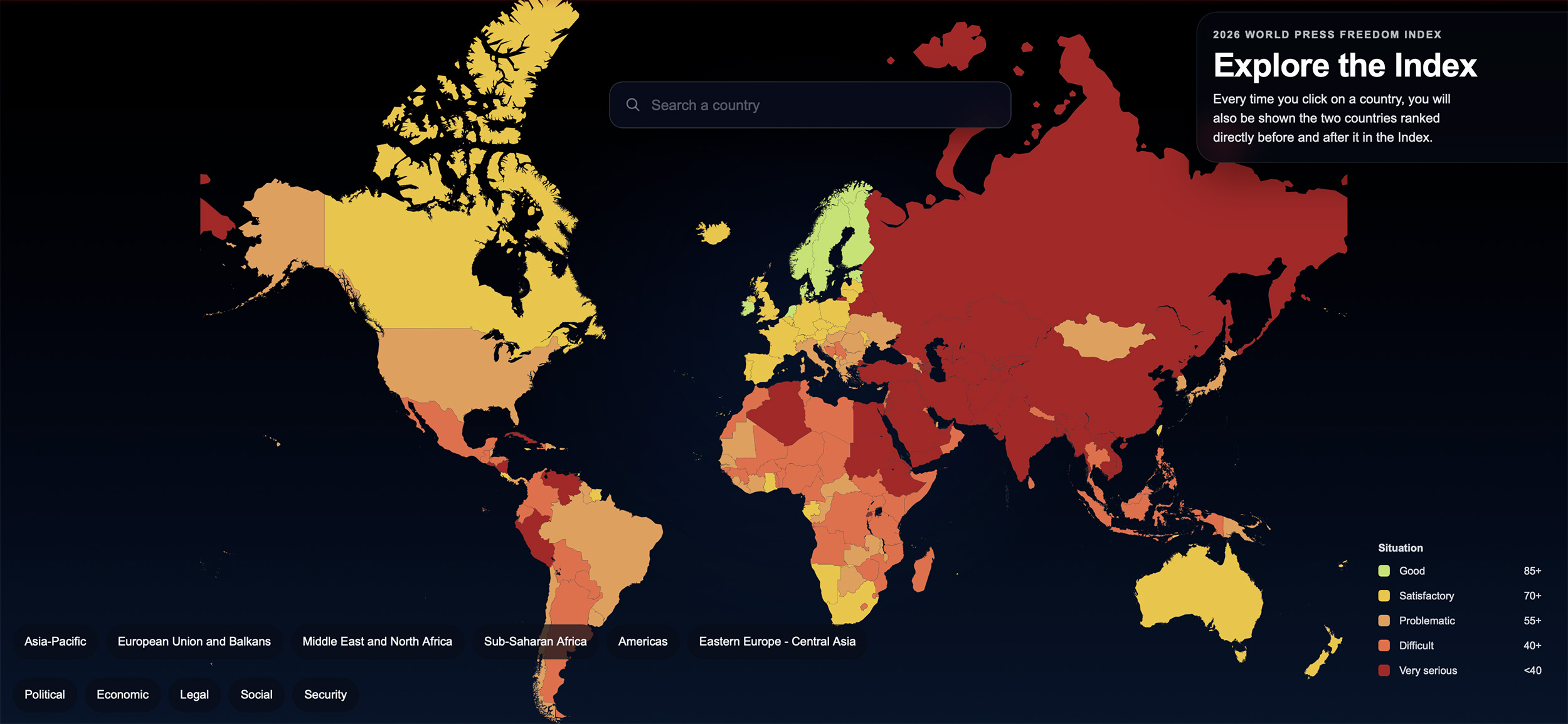
Reporters Without Borders (RSF) began publishing the World Press Freedom Index 25 years ago (RSF’s World Press Freedom Index). Since the first release of the index in 2002, the global score has fallen 25%.
17% of that fall has been over the past decade.
Currently, 52.2% of the world population live in a country in which access to factual information is made extremely difficult, while they were only 13.7% at the creation of the index. On the opposite side, less than 1% live in countries categorized as “good”, while the figure was 20% in 2002. In the past two decades, approximately 2,000 journalists have been killed or gone missing. Nearly 500 are still being detained, mainly in China, Russia, Syria and Myanmar.
The chaotic situation of journalism in the digital age can be explained by the combination of four factors :
- A disastrous economy, caused by the massive loss of advertising revenues to the benefit of digital platforms, which leads to unprecedented media concentration in the hands of billionaires and global companies;
- Technologies making information manipulation increasingly affordable and realistic (ie. AI-generated “deep fake” videos), and whose viral potential is being amplified by the lack of a proper moderation on digital platforms;
- Growing violence on journalists, whether perpetrated by authoritarian regime’ security apparatus, snipers and drone operators in war zones, or mafias and gangs, often on behalf of politicians and corporations;
- In democracies, the criminalisation of journalism through national security laws and abusive legal suits. In the US, a former stronghold of press freedom, President Donald Trump’s systematic attacks on the media have pushed the country down to 64th place.
Public policies worldwide have failed to provide a structural solution: in more than 80% of the countries analyzed, protection mechanisms for journalists are seen as non-existent or ineffective. How much longer can we tolerate this? Whenever press freedom ceases to be enforced, whenever information is constantly being manipulated, free elections become a mockery and the powerful can’t be held accountable anymore. In other words, democracy turns into oligarchy.
To reverse this trend is possible, but it requests everyone’s mobilization. In particular, the public in democracies must apply repeated pressure on their representatives, so that they take concrete and sustained action to protect their right to reliable information. If nothing is done now, the next generations may never know the difference between fact-based reporting and propaganda.
Cédric Alviani is the RSF Asia-Pacific Bureau Director.
| To go furtherSee the Index https://rsf.org/en/indexRead the methodology behind the 2026 RSF World Press Freedom Index in full.See the infographic in full screen https://infog-index.rsf.org/Video: The 2026 RSF World Press Freedom Index |
