


Issue:
August 2026
A reminder, again, that truth is the first casualty in war
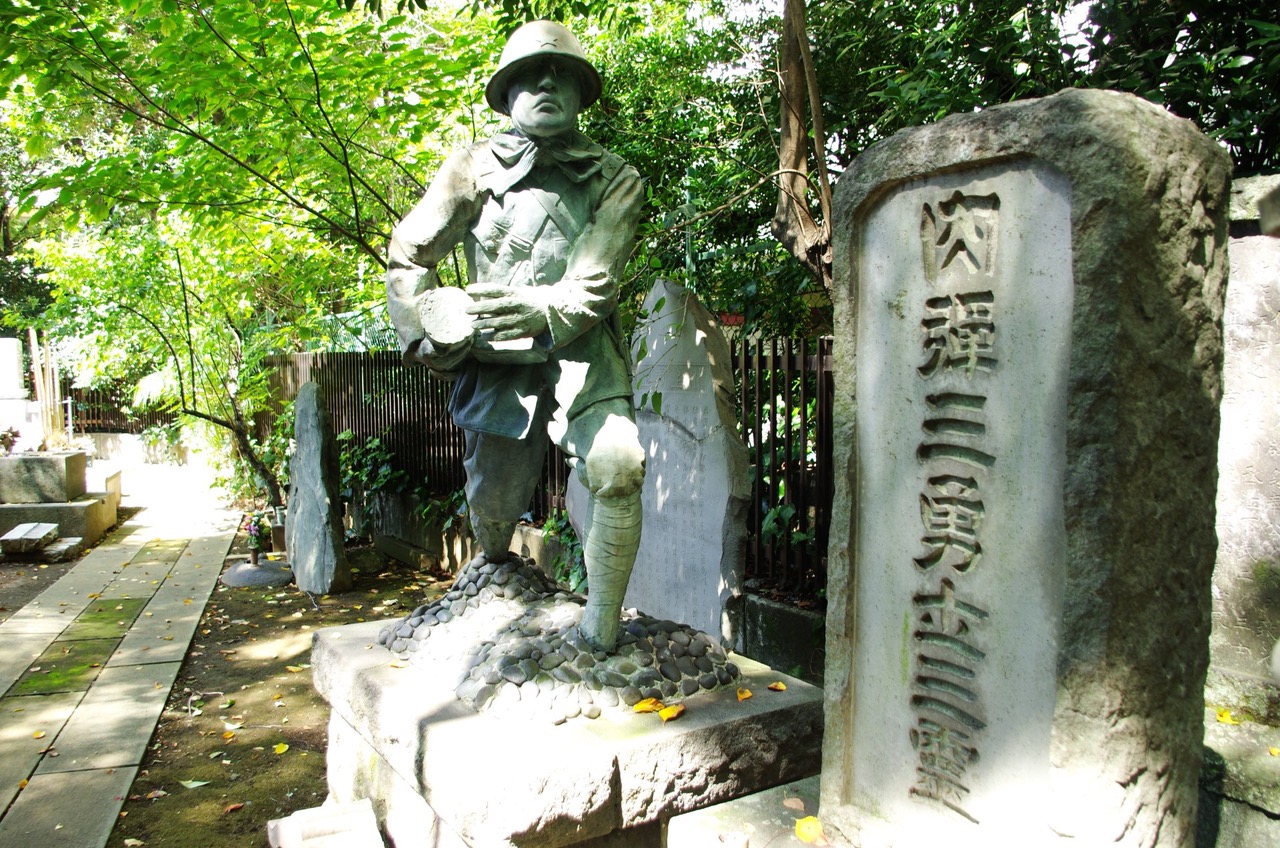
In the cemetery at Seisho-ji, a large Buddhist temple in the Atago district of Tokyo's Minato Ward, stands the statue of a Japanese soldier killed in action in China on February 22, 1932. A native of Saga Prefecture, his name was Takeji Eshita, rank of private first class, who belonged to the 28th Kurume Regiment.
The memorial's inscription reads:
"The three 'human bombs' became the first war casualties to be designated gunshin (military god, a heroic figure revered for supreme sacrifice) during the Showa era.
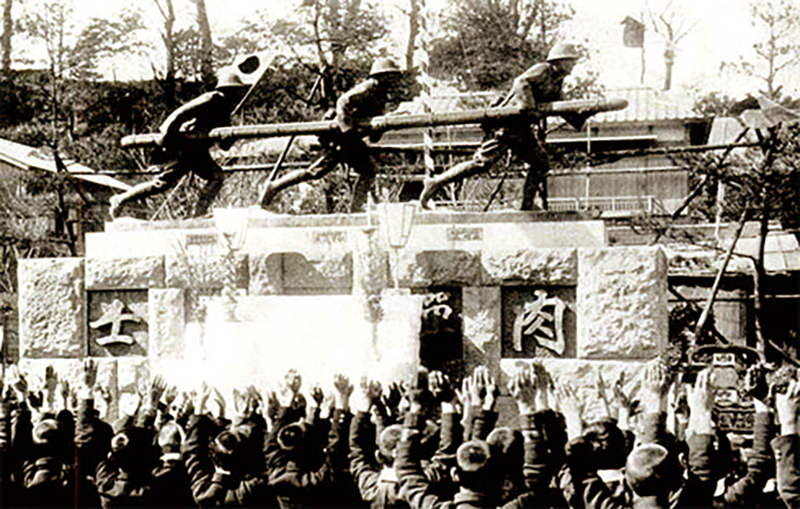
"In February 1934, a bronze statue was erected in front of Seisho-ji using funds raised from around the country. The remains of the 'Three Brave Soldiers' were interred beneath the statue; in effect, the statue served as their grave. However, after the war, the statue was removed by its supporting association – performed proactively as occupation forces had demanded the removal of statues that glorified war.
"Presently what remains is a statue of Private First Class (posthumously Corporal) Eshita and a stone marker, serving as a grave."
Although members of Japan's armed forces were obliged to memorize the Imperial Rescript to Soldiers and Sailors issued on January 4, 1882 -- which stated that "duty is heavier than a mountain; death is lighter than a feather" -- it would be decades before the terms "banzai charge" and "kamikaze" came into widespread use to describe suicide tactics. But the stage had already been set by 1932, at the time of the First Shanghai Incident (also referred to as the January 28 Incident), a major clash between Chinese and Japanese forces in Shanghai.
Anti-Japanese feelings were already running high in China due to the Manchurian Incident, a false-flag operation that occurred on September 18, 1931, in which Japan's Kwantung Army set off a bomb beside the tracks of South Manchurian Railway near Mukden (present-day Shenyang), and used it to justify Japan's military takeover of the China's three northeastern provinces. On March 1, 1932, Japan installed Henry Aisin Gioro Puyi (1906-1967) -- the last monarch of China's Qing Dynasty -- as emperor of the puppet state of Manchukuo.
In Shanghai, several ultranationalist Japanese Buddhist priests provoked rioting by Chinese, and from January 28, areas outside of the International Settlement became war zones, prompting mass evacuations of civilians. In addition to infantry battles, Japanese warships bombarded parts of the city from the Huangpu river.
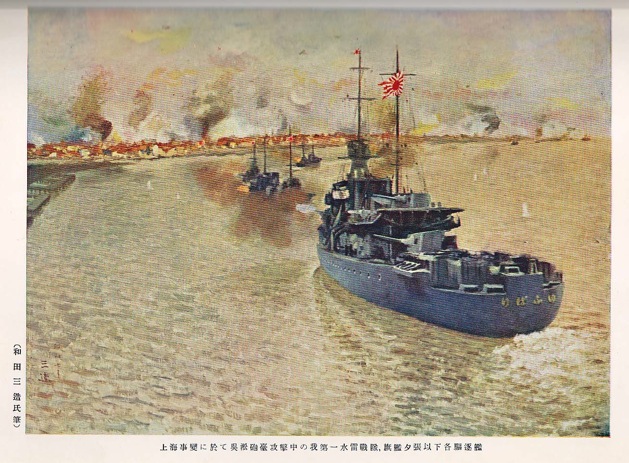
cruiser Yubari and other ships approaching Wusong on the Yangzi river en
route to attacking Shanghai
Despite being outgunned, the Chinese 19th Route Army mounted stiff resistance and held out for over a month. International pressure, particularly from Western nations concerned about their interests in the Shanghai International Settlement, helped mediate a ceasefire in March, leading to a negotiated truce in May.
Thousands of Chinese troops and as many as 10,000 civilians were killed; Japan claimed to have lost 738 soldiers, with 2,257 wounded. This episode would foreshadow the full-scale hostilities that broke out at the Marco Polo bridge outside Beijing in July 1937.
On February 22, three combat engineers belonging to Japan's 28th Kurume Regiment -- Inosuke Sakue, Susumu Kitagawa and Takeji Eshita -- were ordered to demolish Chinese fortifications near a village called Miaohang in preparation for a night attack. The three were armed with a Bangalore torpedo, an elongated bamboo tube filled with explosives and scrap iron, whose purpose was to blast an opening for the infantry. The torpedo exploded prematurely, killing the three soldiers.
Several possible explanations have been offered for what occurred: The torpedo's fuse was cut short and lit before the men charged; the leader of the trio, Kitagawa, was shot, causing all three to fall and lose time; when the soldiers attempted to retreat, they were ordered to charge regardless, so they proceeded, only for the bomb to detonate just as -- or even before -- they reached the target.
Documents at Japan's National Archives record a similar account heard by a combat engineer, from a soldier who framed the event not merely as a technical failure but as a situation where the men tried to turn back but were ordered to advance by their superior, a corporal named Uchida. The explosion occurred just as they reached the barbed wire, leading to the conclusion that the three men were essentially killed by the order from their superior -- meaning they did not voluntarily sacrifice their lives.
That, however, was not how the men's deaths were reported in the Japanese media, which trumpeted their deaths with such headlines as "Shouting 'Long Live the Emperor,' They Were Blown to Pieces" (Tokyo Asahi Shimbun, February 24), "Loyalty and Valor: Shattering Their Bodies for the Cause" (Seibu Mainichi Shimbun, February 25) and "A Grand Display of the Hagakure Spirit" (Osaka Asahi Shimbun, February 25).
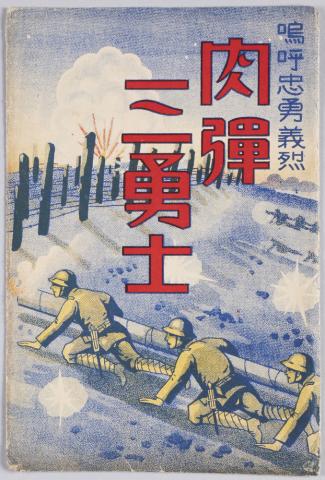
In the months and years that followed, the saga of the Nikudan Sanyushi, the "three courageous bombs of flesh," inspired a veritable flood of commemorative goods, from printed materials, songs, and cinema to keepsakes ranging from ceramics and paperweights to food items.
Among the first of many articles to challenge the story's veracity appeared in the New York Times of January 26, 1947, in which correspondent Burton Crane pulled no punches in describing the Miaohang incident as a "complete fraud upon the Japanese public."
Crane wrote: "The Japanese forces were being checked by trench-warfare tactics, in which German officers had schooled the Chinese. Planning to break the Chinese wire and launch a night attack, the Japanese command sent into the wire two three-man teams, each carrying a bangalore torpedo...Only one team returned. That night the true story reached all newspapers, but the Army suppressed it and forced all to print a version ignoring the survivors and stressing that the three missing men went on a suicide mission. A wave of enthusiasm for these manufactured national heroes swept the nation and many statues were erected..."
Noting that "Imperial Japanese soldiers sacrificing themselves in war and launching suicide attacks is a familiar trope today," historian Jackson van Uden observed that Japan's military doctrine had begun to undergo significant change by 1932.
"Although many associate these acts with samurai values and Japanese culture," Jackson wrote, "suicide attacks were not common in the military until the later years of WWII.
"The legend of the Three Human Bombs inspired a new generation of devoted nationalists. The story became prominent in government-run education programs. School lessons and textbooks altered and exaggerated the legend to fit the patriotic narrative."
This account of the three soldiers appeared in a government-approved textbook:
As the fuse is just about to reach its end, the three sappers transcend our normal state of existence to become flesh bomb heroes. The Bangalore torpedo pierces the barbed wire. Heaven and earth rumble from the explosion. Our infantry troops charge forward. The sappers' commanding officer finds Sakue lying on the ground and says "Sakue, you did well. Do you have any last words?" Sakue replies, "No, sir. Was the mission a success?" Sakue’s broken body is repositioned so that he may view the damaged stronghold for himself. In a loud voice, the commanding officer declares, "Over there, our brigade is charging through the hole you made." Sakue responds with a final "Long Live the Emperor" and then closes his eyes forever.
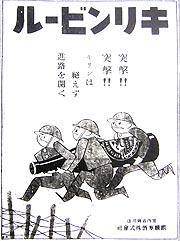
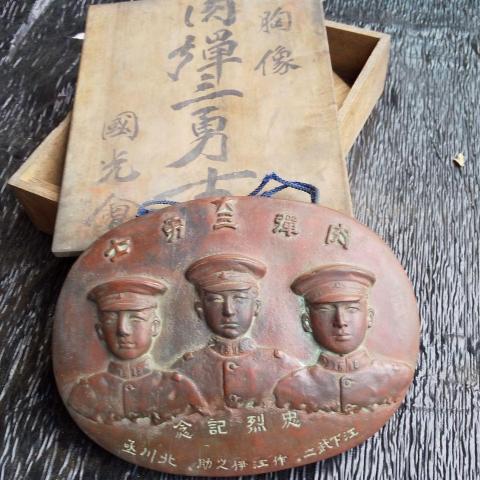
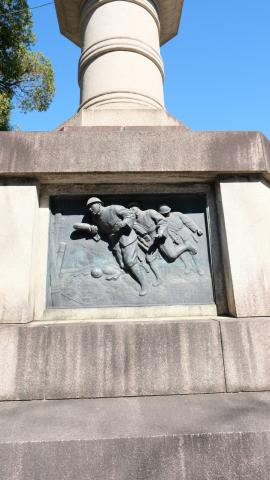
Interestingly, it was not postwar occupation authorities who ordered removal of most of Japan's nationalistic statuary; that process had begun more than two years before the war's end, in May 1943, when the government ordered removal and melting down of bronze statues to address metal shortages. By August 1945 an estimated 90% had already been removed.
The statue of the Three Human Bombs at Seisho-ji was exempted, but after the war the temple presumed the statues would be ordered taken down and removed them proactively. What remains today is the life-size statue of PFC Eshita gripping a section of the Bangalore torpedo.
In his 1967 book "The Pacific War," historian Saburo Ienaga wrote:
“Lest censorship make the war seem vague and far off, the government churned out fabricated stories to drum up enthusiasm. The famous Three Human Bombs of the Shanghai fighting was a notorious example. Three engineer soldiers were accidentally killed by a short fuse on a charge they set.”
Ienaga attributed the fabricated story to intelligence operative and later major general Ryukichi Tanaka, who concocted an account that the men had wrapped explosives around themselves and died heroic deaths in a valiant assault on the enemy.
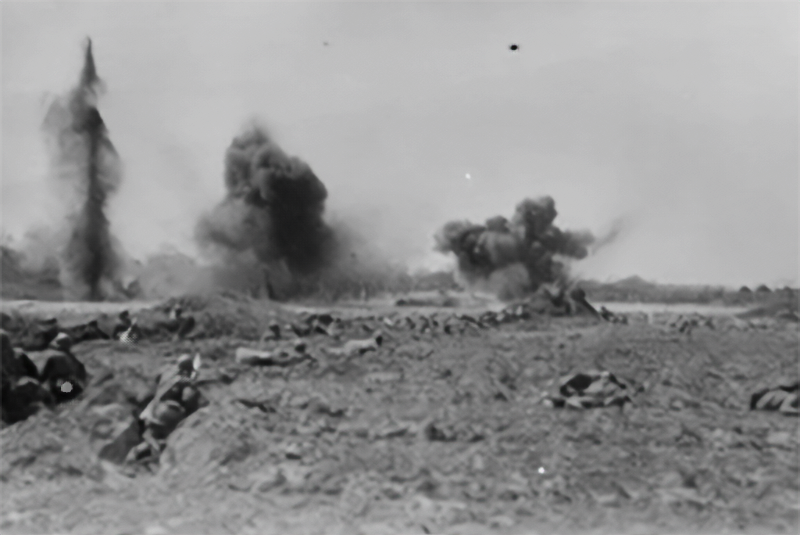
Almost a century later, new revelations challenging the original narrative continue to emerge. The Mainichi Shimbun of February 4, 2025, reported that a series of 13 photos at Miaohang village credited to combat photographer Shigeo Sato – supposedly taken at the moment of the soldiers' deaths – was identified as a reenactment shot five days after the actual action.
Deadly Dishonor
Just as the fervor surrounding the "Three Human Bombs" was beginning to wane, the death of major Noboru Kuga was hailed as another heroic tale. It first appeared as an extra edition of the Tokyo Nichi-Nichi Shimbun (April 2). The story would subsequently inspire films and books.
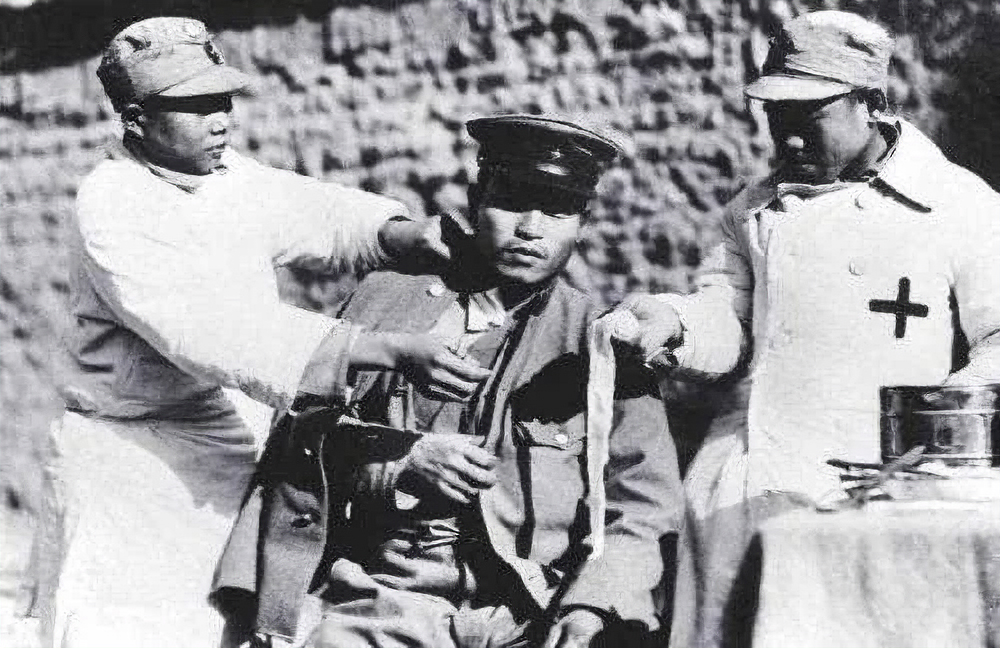
As reported in TIME magazine of April 11, 1932:
Typical of Japanese militant fanaticism, from which the Imperial House now stands aloof, was the conduct at Shanghai last week of Major Noboru Kuga, a battalion commander in the heroic Japanese 9th Division... On March 16 Major Kuga who had been captured by the Chinese, was released in an exchange of prisoners. Promptly he faced a Japanese courtmartial such as always investigates when a Japanese warrior has been taken prisoner and released. To the Court's satisfaction it was proved that Major Kuga on Feb. 20 led a gallant assault on the no less gallant Chinese 19th Route Army, advancing with such vigor that his small Japanese detachment found itself presently engulfed by Chinese and was soon almost wiped out. Kuga, knocked senseless by the explosion of a hand grenade, did not even know his enemies had captured him until he woke up in a Chinese hospital. The Japanese courtmartial...complimented Major Kuga and dismissed him with all honor -- but his hero's brain throbbed with the madding, ignominious fact that he had been "captured." Major Kuga wished to commit harakiri -- to disembowel himself with his sword -— but his own sword had been broken in the battle, an aggravation of his shame. Brooding and white-lipped Major Kuga walked last week to the exact spot on Shanghai's battlefield where the hand grenade had knocked him unconscious. There, putting his service pistol to his head, he fired one well-aimed shot. "The suicide of Major Kuga," said the Japanese military spokesman at Shanghai, "has aroused the greatest sympathy and admiration in Japanese military and civilian circles here." (M.S.)
A resident of Tokyo since 1966, Mark Schreiber published his first article, for Sumo World magazine, in 1973.
