
Issue:
August 2026 | Cover Story
The ouster of a key Nissan director at the carmaker’s shareholder meeting in June should get more media attention for what it reveals about the plot to remove Carlos Ghosn.
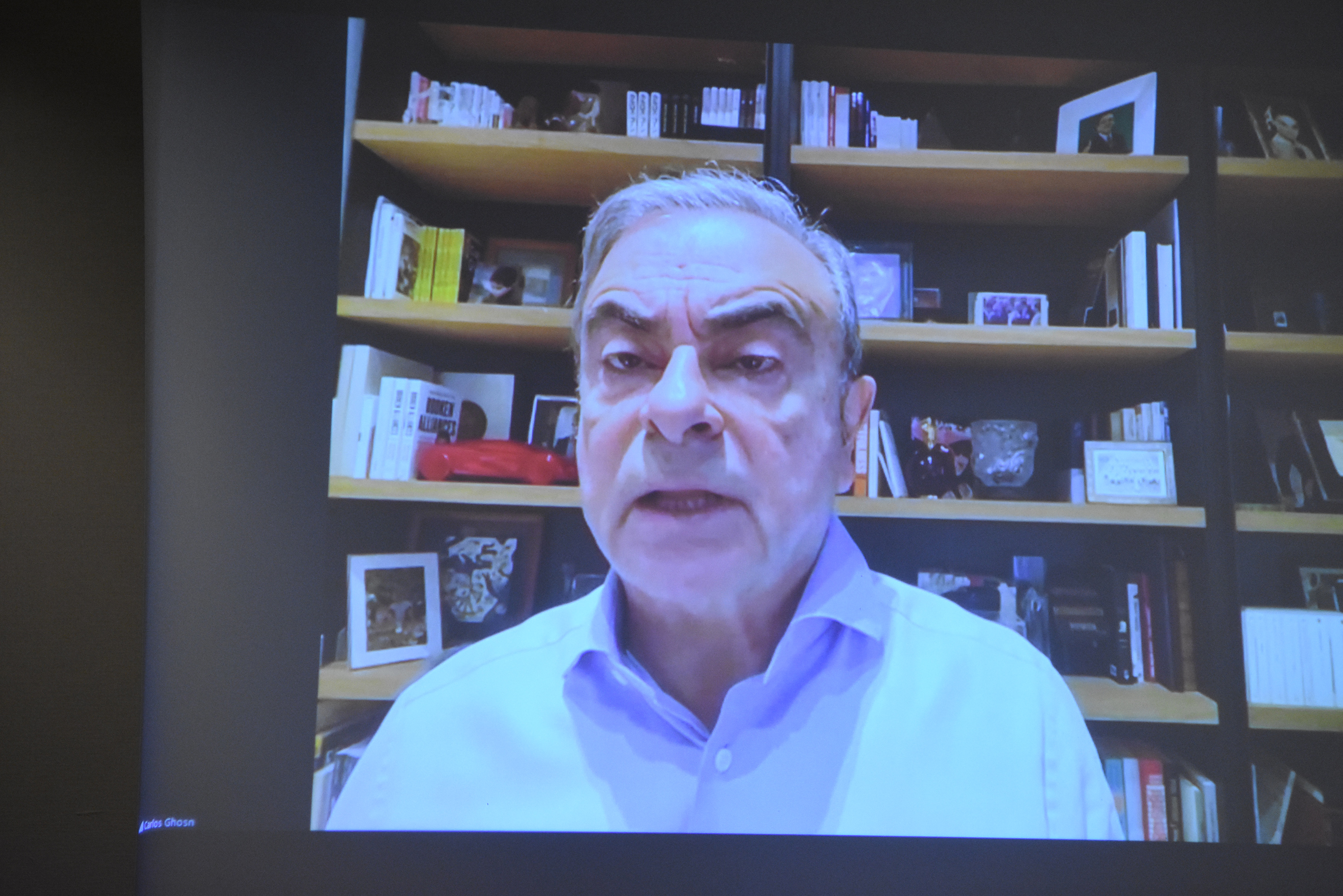
Almost eight years since Carlos Ghosn’s arrest, nobody has produced a full account of what happened inside Nissan. The company convulsed for the better part of a year as it moved to have Ghosn prosecuted and to unwind its alliance with Renault.
Nissan supplied the villain, the motive and the evidence, and the global press ran with it: a chairman who understated his pay and an internal investigation that caught him. But the central charge does not survive scrutiny with Nissan’s own paperwork, which reporters were mostly denied or lacked the context to read.
That gap between what the record shows and what the world was told is why the ouster of Motoo Nagai from the Japanese carmaker’s board is important. Nissan shareholders rejected Nagai’s reappointment in June after what Bloomberg called a “rare public standoff”.
Link to article on Nagai’s ouster
Nagai is not a minor figure in that story. As chairman of Nissan’s audit committee, he received, and then buried, the most serious internal warning ever raised about how the company investigated Ghosn.
Renault held two board seats while that warning was ignored and said nothing at the time. Now, with Nissan’s annual vehicle sales nearly halved, its stock price down by over 60% since Ghosn’s ouster and its losses topping ¥1.2 trillion in the past two business years, Renault has picked off one of the last board members still standing from 2019. What Renault did to Nagai matters less than what it concedes about itself.
Coverage of the vote focused on questions about Nagai’s independence. He joined Nissan as an outside auditor in June 2014 after nearly a decade as an executive and adviser in the Mizuho Financial Group, one of Nissan’s main lenders. If that conflict were disqualifying, Nagai would never have made it onto the board in the first place. A more likely explanation is that Renault wanted to signal, seven years late, that it never accepted Nagai’s role in ousting Ghosn and covering it up.
Renault still owns about 36% of Nissan’s stock, although 19% of that is being held in a trust in France to eventually be divested. Renault’s voting rights of the remaining 17% holding are capped at 15%, the same as Nissan’s in Renault.
Ghosn has told me that Nagai belonged to the group inside Nissan that sought his removal. There is no direct proof, but there is a telling circumstantial trail: Nagai sat beside Hidetoshi Imazu in Nissan’s audit office, and Imazu led the initial internal investigation into Ghosn while separately meeting with Hitoshi Kawaguchi and Hari Nada to plan the ouster.
What is not circumstantial is Nagai’s role in burying a warning from Ravinder Passi, Nissan's global general counsel, in the summer and fall of 2019. On July 24, Passi met Nagai, newly named audit committee chairman, to raise concerns about Hari Nada, the in-house lawyer at the center of the effort to remove Ghosn, including possible criminal conduct by Nada.
The next day, Passi emailed Nagai his memo detailing Nada’s conflicts of interest, backed by a legal analysis from Cleary Gottlieb Steen & Hamilton LLP and Mori Hamada & Matsumoto. Nagai never responded, neither to that memo nor to Passi’s follow-up memos two and three weeks later.
Passi did not let the matter rest. On September 9, he hand-delivered a six-page conflict-of-interest memo to every outside director except Nagai, who had already seen it, and Thierry Bolloré, Renault’s chief executive, who also sat on Nissan's board. He urged the directors to contact Christina Murray, the internal investigator who had just been pushed off the Nada inquiry. The board never discussed it. Instead, at that same meeting, directors spent their time debating whether to oust CEO Hiroto Saikawa over his backdated stock options.
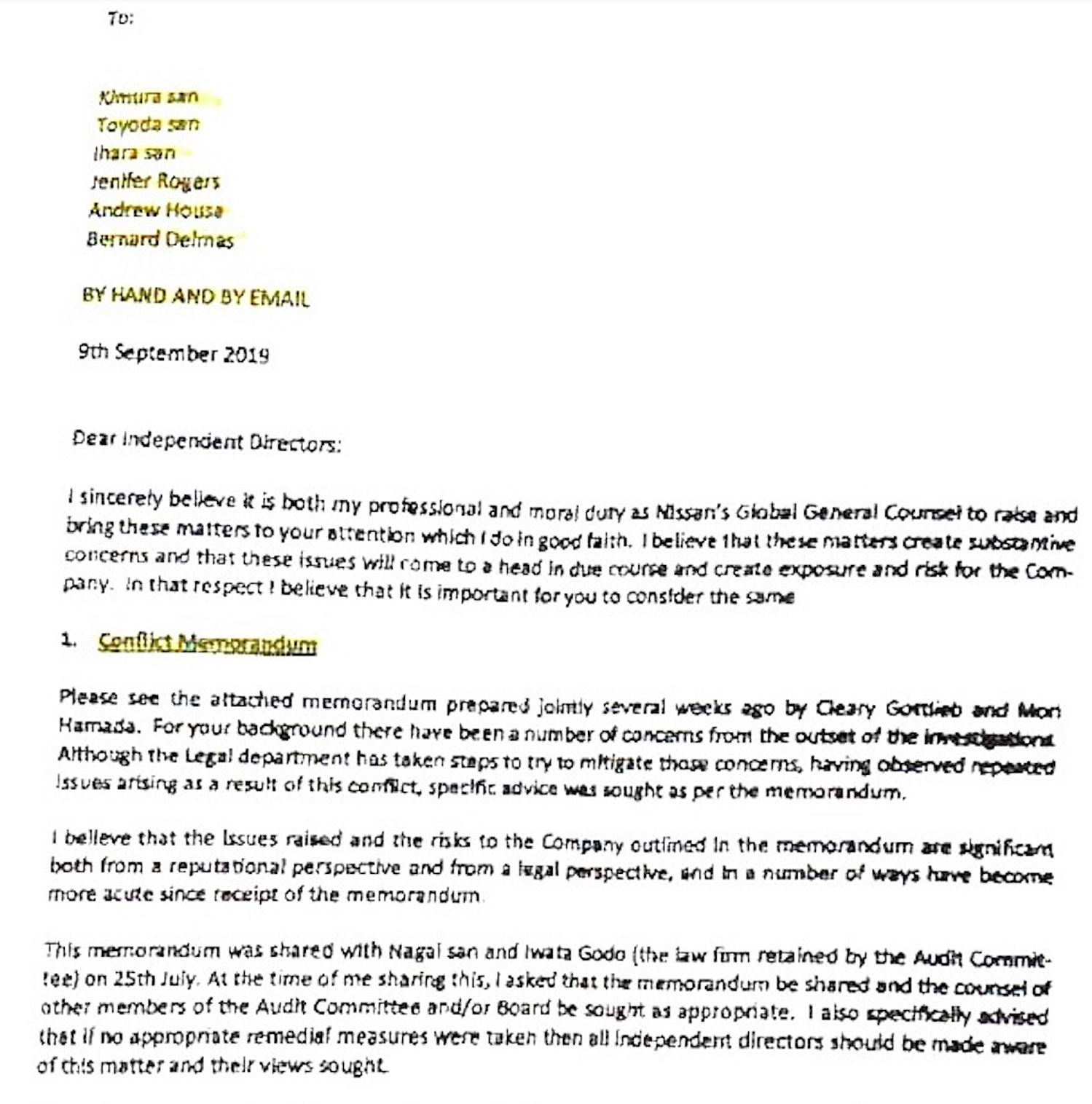
Bolloré eventually got his hands on the report and acted on it. At Nissan’s October 8 meeting, he delivered a scathing rebuke of the board’s inaction, citing Murray’s forced resignation and Passi’s sidelining, and submitted more than 60 questions about Nada’s conduct, demanding answers by October 21.
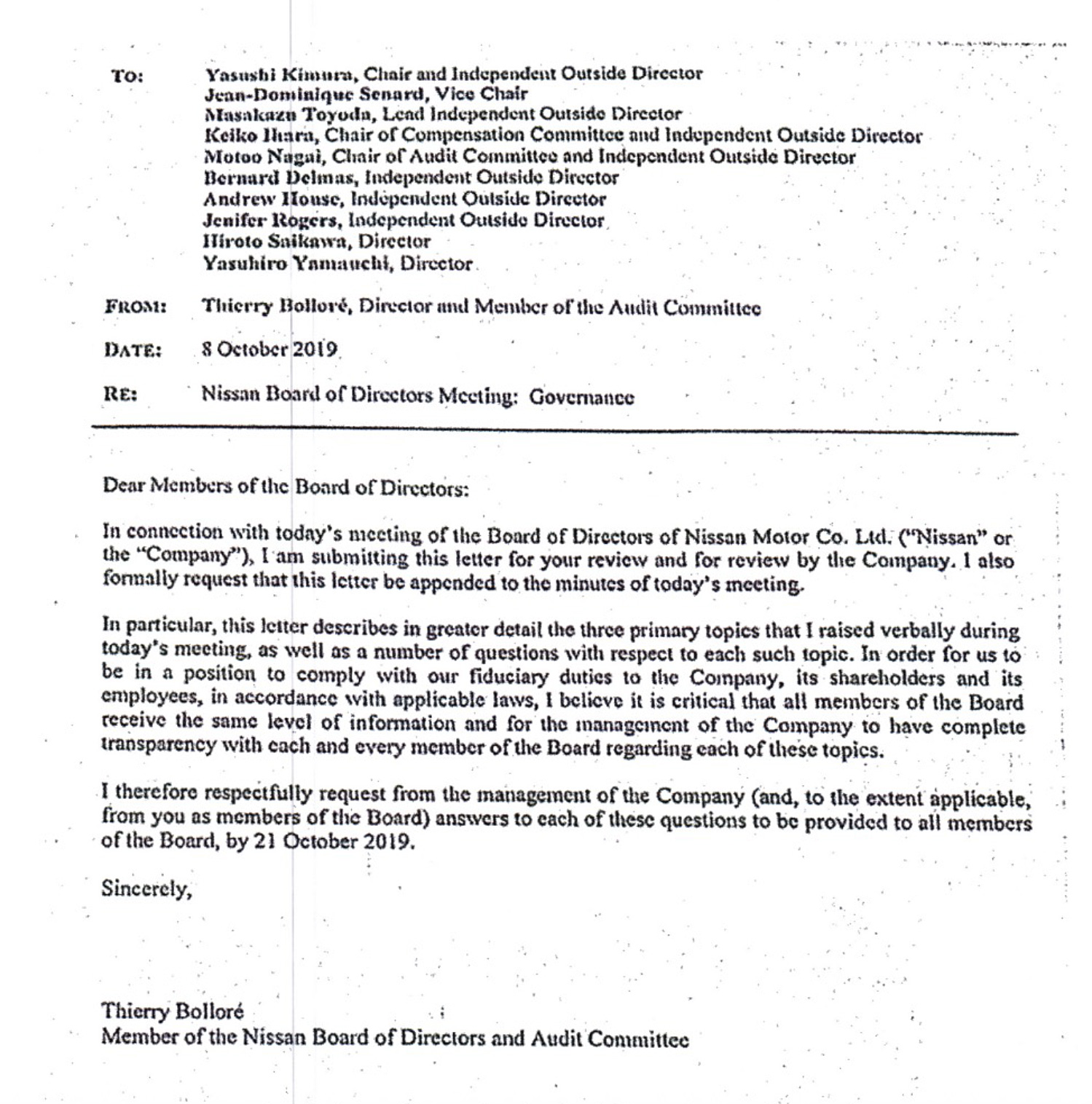
It cited a whistleblower who said Nada “manipulated” the inquiry from the outset, and that Yoshii, a Latham & Watkins partner in Tokyo, had been “instructed by Mr. Nada for many, many years”. The same whistleblower said Nada and Nagai together drove Murray's resignation by “reducing her responsibilities” and “creating an intolerable work situation”.
The day after that meeting, Nissan announced Nada had been cleared of wrongdoing, even though the two officials who tried to investigate him, Passi and Murray, had already been pushed out. Murray submitted her resignation letter on August 29, a day after Nagai told her she could not pursue Nada any further in a parallel probe which centered on 80 individuals who aided Ghosn if the charges against him were to be believed.
Passi was formally removed from the Ghosn investigation on September 12 by Saikawa, in one of his last acts as CEO. Nissan’s press statement didn’t address Passi’s concerns about Nada and instead named Nada “senior adviser overseeing special projects”, putting him in charge of the very Ghosn- and Kelly-related legal matters he stood accused of manipulating.
The original inquiry, led first by Imazu and then by Murray's team, had strained credulity by treating Nada as a whistleblower rather than a suspect. Nada was the head of the CEO office as well as being a lawyer. He was directly involved in virtually every aspect of the transactions he later framed as criminal violations.
It is not clear what drove him, but he had a vengeful side. In a message to Nissan’s CEO, Hiroto Saikawa five days before Ghosn’s arrest, he urged Saikawa to support a media campaign to “destroy CG’s reputation.” Then several days later, he discussed his plan to “disenfranchise Renault.”
The new board, assembled to project good governance, buried Murray's report in two sentences in the Kali-10 report, punting it to the audit committee that Nagai chaired. It also omitted that Nada had received a backdated ¥30.2 million stock appreciation right bonus, the same offense that forced out Saikawa, who took a ¥47 million backdated bonus.
The board accused Ghosn’s board ally Greg Kelly of falsifying the paperwork behind Saikawa’s payment, even though it was the head of the corporate secretariat, Toshiaki Ohnuma, who signed off on the bonus and then separately struck an immunity deal. His and Nada’s immunity were part of a new plea-bargaining system that had been introduced half a year earlier to enlist their testimony.
Only Seiko was punished. The accusation made against Kelly was never pursued in his criminal case, which he was acquitted on the first seven out of eight years in the charge. His appeal of the eighth is still being reviewed by Japan’s Supreme Court.
Nissan and Tokyo prosecutors never turned over key exculpatory material to Ghosn's and Kelly's lawyers, chief among those items: the Kali-10 report, a July 3, 2019 summary of Nada's own interview with Latham & Watkins lawyers, and Passi’s September 9 memo.
In that July 3rd interview, Nada told investigators that Kelly told him reimbursing Ghosn for wages lost after his 2010 pay cut was a “debt of gratitude” and “not a legal obligation”. When Nada told Kelly’s lawyers during questioning at Kelly’s trial that he didn’t remember saying that the judge refused to allow Kelly’s lawyers to introduce the memo as evidence because they had received it from a journalist rather than Nissan or the prosecutors.
The initial charge against Ghosn has its own untold story. That narrative held that Ghosn concealed future income. But Ghosn’s Japanese advisers at Nissan, including Nissan’s chief operating officer Toshiyuki Shiga, told him in March 2011 that any deferred-pay arrangement would require both board and representative-director approval.
No such approval was ever sought, and prosecutors had the documents to know it: the framework, in English and Japanese, stated plainly that terms would be “fixed by written documents every year” and signed by representative directors, and moreover that any contract “needs approval by the board”.
The second untold story is the cover-up of the coup itself, implicating both the French and Japanese carmakers.
A member of the internal investigative team told me the inquiry was built around a predetermined outcome tailored to the prosecutors’ expectations.
“There was never any question of Ghosts guilt,” the person said on condition of anonymity. “Christina Murray, who nominally headed the investigation, hated Ghosn and Greg Kelly. She reported to Nada, who organized the coup and, unbeknownst to any of us, was cooperating with the prosecutor’s office under a plea agreement. Nada picked Murray because of her blind hatred.”
The person added that the Kali-10 report’s authors, the Latham lawyers, along with Murray and Hideaki Kubo from the audit office, stayed in regular contact with prosecutors throughout, leaving the report with no real independence.
When journalists obtained the Kali-10 report, they treated it as a breakthrough, a roadmap to what Nissan itself knew about Ghosn’s conduct. Nick Kostov and Sean McLain, authors of “Boundless: The Rise, Fall, and Escape of Carlos Ghosn”, have described securing copies of the report as the discovery that let them untangle the story’s central threads.
But a comparison of Kali-10 against the underlying documents and emails reveals material omissions, not oversights. The report reads less like an investigation than a brief built to convict Ghosn while shielding the executives who orchestrated his fall, chief among them Nada.
By the time the Kali-10 investigation was finished in August 2019, its authors already knew that Nada had struck an immunity deal with prosecutors in October of the previous year, three weeks before Ghosn's arrest, and that Nissan’s own chief outside lawyer had concluded that Nada had violated the law in the course of the investigation.
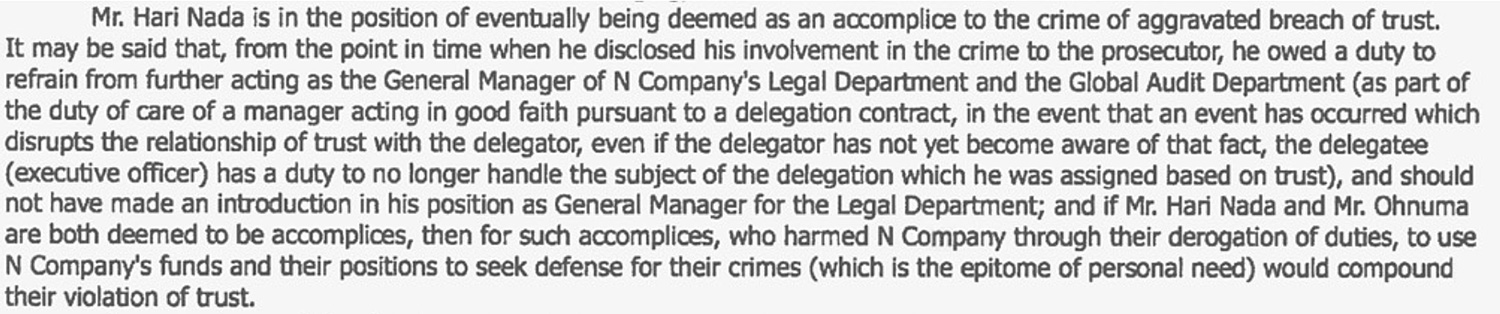
They also knew that Nada, who had orchestrated every step of the Ghosn and Kelly takedown, was interfering heavily in their investigation. That realization drove Passi and Murray to bring in outside counsel of their own, and it drove Passi, once he learned Nagai intended to bury his warning about Nada, to hand it directly to the board on September 9.
Epilogue
Passi lost his job. Murray lost her job. Bolloré lost his job. Others in management quit rather than risk offering information and face interrogation by the Tokyo prosecutor’s office. The Kali-10 report was never released publicly and was only summarized to the board by the same Latham lawyers Bolloré had accused of working against the company's interests. Other key documents have not been made available to the public.
The Passi and Bolloré memos remain the record from which any accurate accounting of Nissan’s cover-up has to be built.
Roger Schreffler is a veteran business and technology journalist and former president of the FCCJ. He has been covering the Carlos Ghosn story since his arrest in 2018 and has travelled to Lebanon to interview the former Nissan boss and his wife, Carol.
