


Issue:
September 2026
On the anniversary of Japan’s official surrender in World War 2, Mark Schreiber uncovers a story of compassion while visiting the battleship USS Missouri in Pearl Harbor
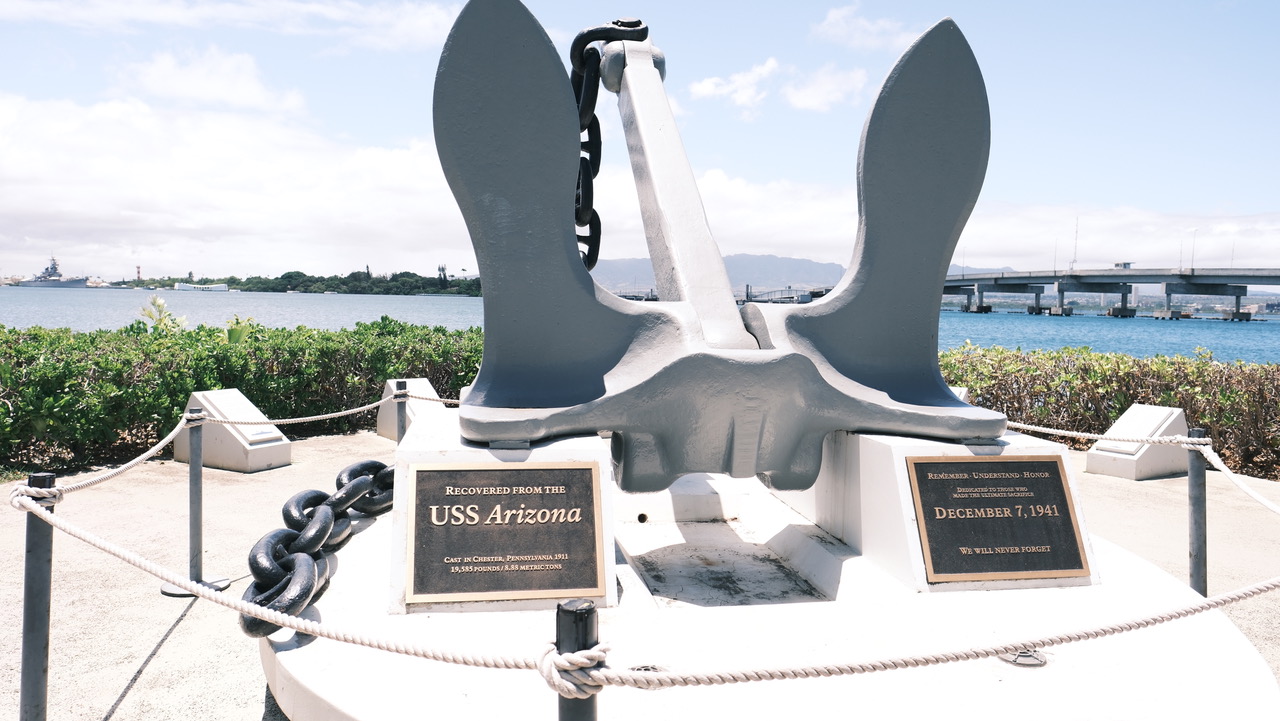
Since 1999, the USS Missouri (BB63) – the Iowa-class battleship on whose deck World War 2 officially came to an end on September 2, 1945 – has been moored at the U.S. naval base at Pearl Harbor. It presently serves as a floating museum that has attracted over well over 10 million visitors.
Launched in January 1944 the "Mighty Mo," at 270 meters long and weighing 57,540 tons, is situated at what was formerly Battleship Row on Ford Island, at the very spot where the ill-fated USS Oklahoma was struck by multiple torpedoes and capsized on December 7, 1941, with the loss of 429 men. Its bow points toward the USS Arizona Memorial 300 meters away – the grave of over 1,000 men – thus articulating the beginning and end of America’s involvement in the war.
Visitors to the Missouri will first encounter a statue of Fleet Admiral Chester W. Nimitz, who shared command in the Pacific theater with army General Douglas MacArthur. Visitors then cross a short bridge flanked by U.S. flags and pass a gift shop and several food concessions. After presenting an admission ticket and undergoing a security check, visitors ascend a flight of stairs and cross the gangway to the ship's main deck.
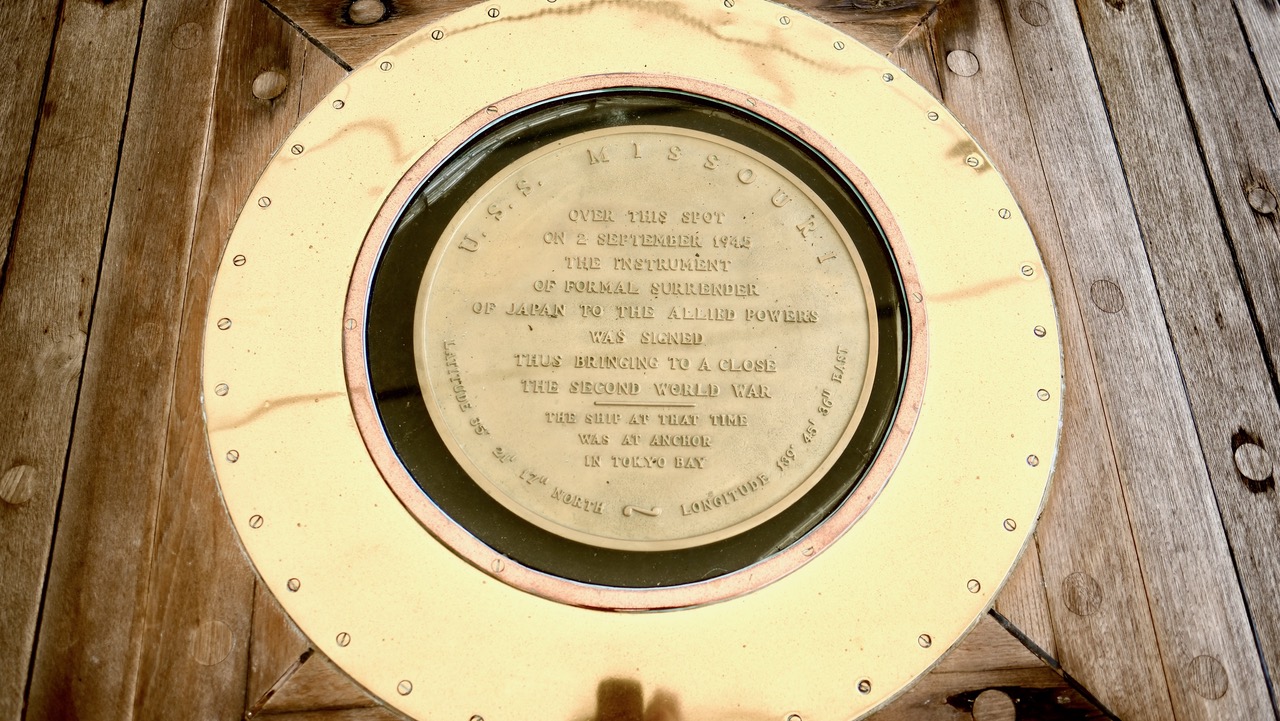
Once passing beneath the massive 16-inch main battery turret, many visitors make a beeline for the surrender deck, where an impressive array of panels and photographs retell the story of the surrender ceremony at Tokyo Bay on September 2, 1945.
It was another event, little noted in 1945, that ultimately drew me to the ship this time.
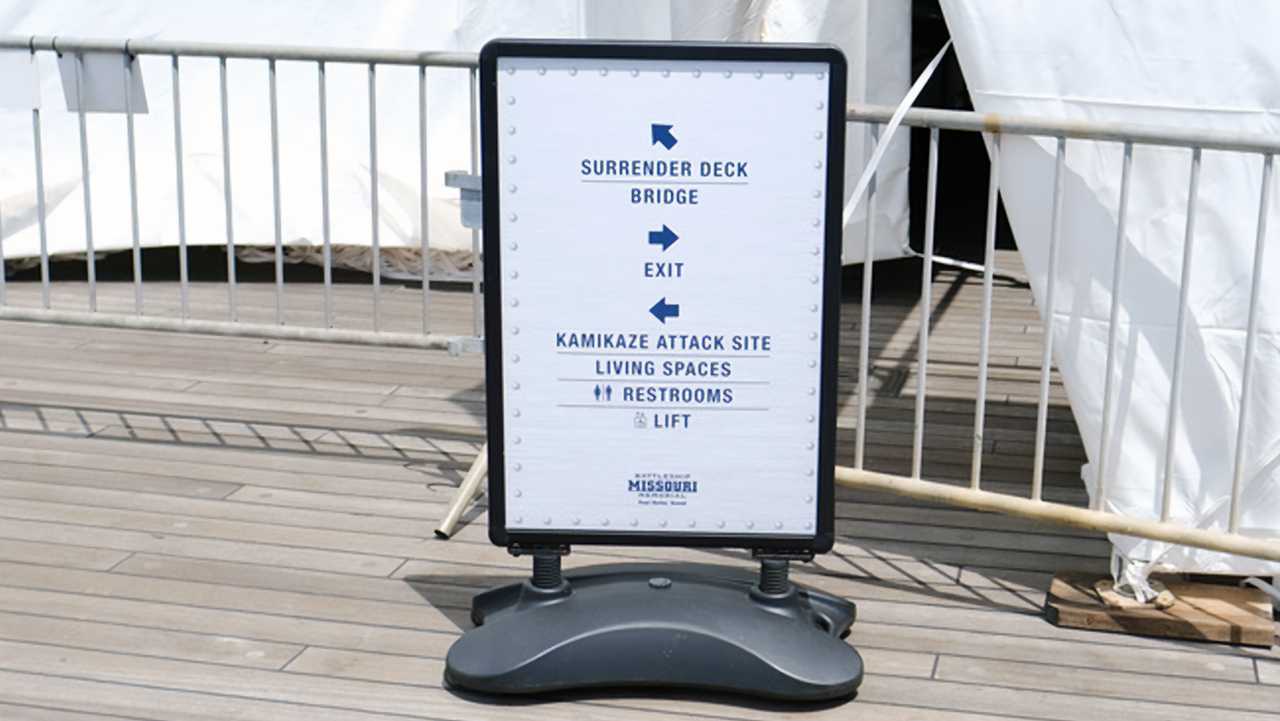
The story, of the kamikaze attack on the Missouri on April 11, 1945, continues to attract new visitors, including tourists from Japan who can learn the details from Japanese-speaking guides.
After over three years of war in the Pacific, many of Japan's experienced naval aviators had been killed off by attrition, and its outdated Mitsubishi Zero fighters were no match for the powerful new F6F Hellcats and F4U Corsairs flown from U.S. Navy carriers.
In desperation, the Japanese military turned to what is referred to as "aerial ramming." The first organized suicide tactics took place at the Battle of Leyte Gulf in the Philippines in October 1944. But it was during the Battle of Okinawa the following year that kamikaze units (officially called Shimpu Tokubetsu Kogekitai or Divine Wind Special Attack Squads) took a fearsome toll on Allied ships in what was named Operation Kikusui.
While the Allied ships’ bolstered anti-aircraft measures were able to stave off a majority of the attacks, the kamikaze fliers also refined their tactics. Between March and July 1945, they sank or severely damaged 147 allied naval vessels, resulting in some 4,900 naval officers and seamen killed and 4,824 wounded or missing.
Over 60 destroyers and destroyer escorts, which functioned as a warning screen for the fleet, received the brunt of the damage. While no capital ships were sunk, on May 11 the Essex-class aircraft carrier USS Bunker Hill was hit by two kamikaze planes in quick succession, killing 396 (including 43 missing and never found), and wounding 264.
The planners of Operation Olympic, the invasion of Kyushu scheduled for November 1945, felt a growing sense of dread over the likelihood that Allied amphibious landings would be met with even fiercer resistance.
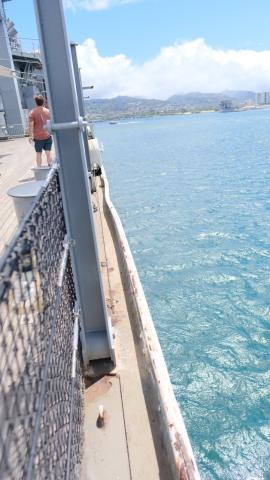
At 2:42 pm on April 11, the Missouri was cruising off Kikaijima Island, Kagoshima Prefecture, when its radar detected approaching aircraft. Flying as low as six meters above the water, a Zero fighter crashed into the ship's starboard side just below the main deck. For some reason, the plane's 250-kilogram bomb failed to detonate, and the crew suffered no casualties.
The account below appears in the Missouri's log:
ZONE TIME -9
11 April 1945 (continued)
1442 Commenced firing on a low flying Zeke coming directly in on starboard quarter, bearing 150 (degrees) T, distance 7,000 yards, altitude 100 feet.
1443 Jap Zeke crashed ship at frame 169 starboard about 3 feet below main deck level. The ship was sprayed with parts of the plane and the plane's starboard wing was thrown forward to the first superstructure level, frame 102, inboard of "5 mount #3. A gasoline fire resulted at this point. The mutilated body of the pilot landed on after main deck.
1446 Fires were reported under control. No casualties, damage only superficial caused by fire. Minor damage to 40mm quad #17 and bulwark area.
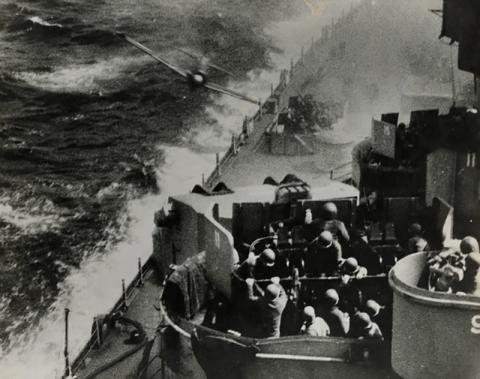
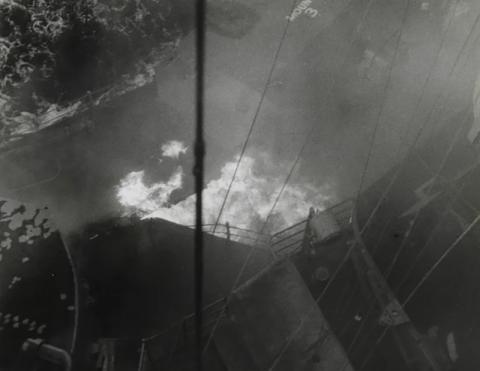
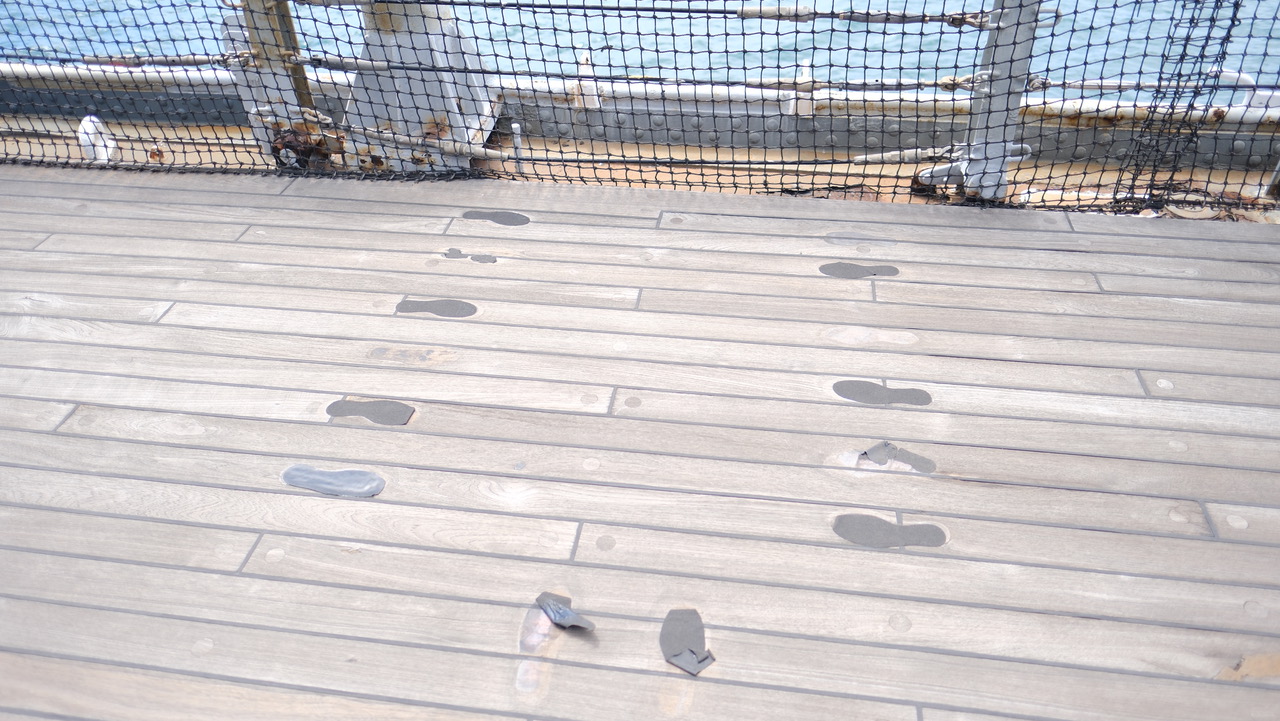
Parts of the plane’s wreckage and the top half of the pilot’s body landed on the Missouri's deck. After extinguishing the fires, some crew members picked up fragments of the plane's wing for souvenirs.
What happened next came as a surprise. "I was able to recover his body and I called up to the bridge to ask if I should throw it overboard," Pharmacist Mate First Class Stephen Cromwell, a medical corpsman from Chicago who became a physician after the war, was quoted by the Voice of America. “Captain Callaghan said, ‘No, when we secure, take it down to the sick bay, and we'll have a burial for him tomorrow.’”
The pilot’s mangled body was brought to sick bay for examination, and various crew took souvenirs from his clothing, including the helmet, scarf, and jacket.
Following examination, the remains were placed in a canvas bag with dummy shell casings to weigh it down.
The Missouri's log contains the following entry:
The funeral service to be conducted for the Japanese pilot is not a religious service but is strictly a military service of burial dictated by military courtesy.
SCHEDULE:
0845 Station firing squad of 6 Marines, sergeant and bugler abaft [sic] quad mount No. 17.
0900 Pass the word "Bury the Dead".
(a) Body bearers bring the body aft from Sick Bay.
(b) Fire three volleys (Hand salute at committal).
(c) Taps
(d) Encasing of the colors (attention).
(e) Attendance is optional for officers and men not on watch – uniform of the day.
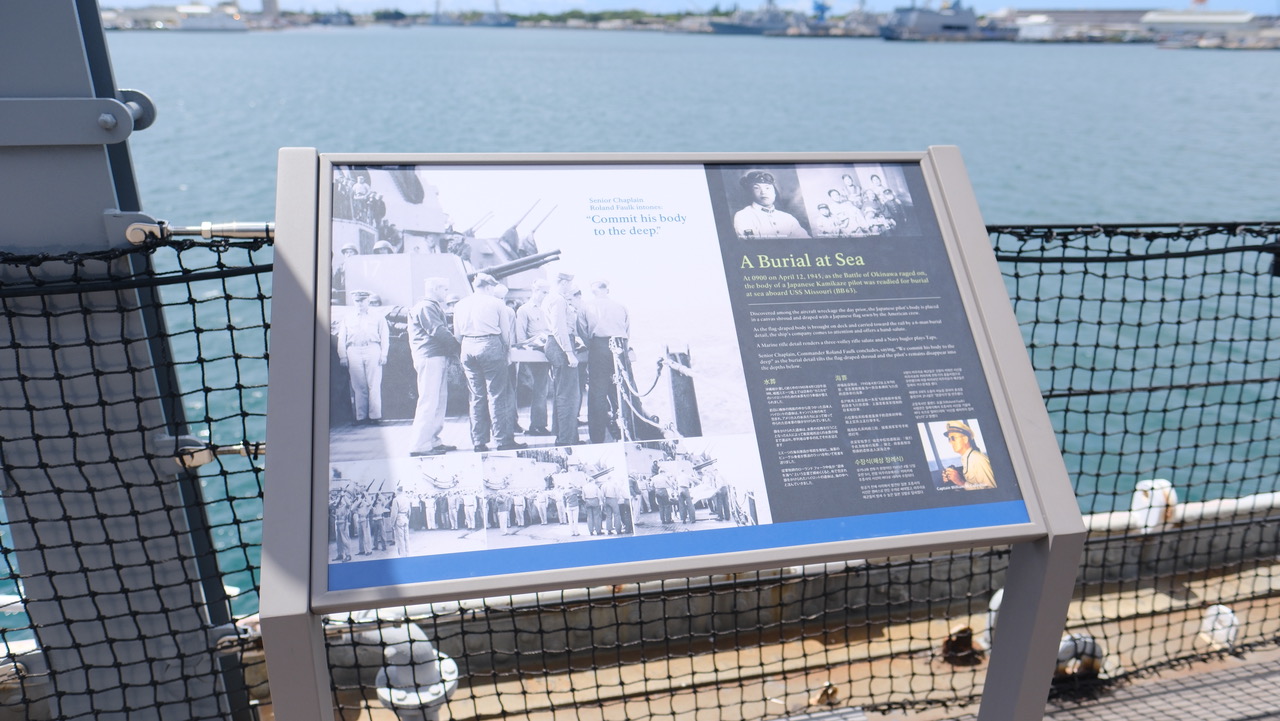
The morning of April 12 – coincidentally the same day President Franklin Delano Roosevelt died in Warm Springs, Georgia – the Japanese pilot was accorded a military burial at sea. The ceremony was held after breakfast, with hospital corpsmen as pallbearers. A Japanese naval flag, improvised from white and red cloth, had been stitched the previous evening by one of the ship’s bosun’s mates and was draped over the bag holding the man’s remains.
The Missouri's chaplain, Roland W. Faulk, intoned, “We commit this body to the deep,” and the pallbearers let it slide overboard, accompanied by a volley of rifle fire by U.S. Marines.
Five months later Chaplain Faulk, a Methodist minister, would deliver the invocation just prior to the surrender ceremony.
Some Missouri crew members were heard to grumble over the honors accorded the pilot, who after all had been trying to kill them, but Callaghan insisted that the young Japanese airman had done his job to the best of his ability, with honor, and deserved a military burial.
Considering that Captain Callaghan had lost his elder brother, Rear Admiral Daniel Callaghan, during an engagement with the Imperial Japanese Navy off Guadalcanal three years earlier, his treatment of the enemy pilot can be viewed as a remarkable show of magnanimity.
Subsequent research disclosed new findings, and on August 4, 2001, NHK broadcast an hourlong documentary titled Senkan Mizuuri ni totsunyu shita Zero-sen (The Zero fighter that plunged into the battleship Missouri).
A perusal of IJN records determined the pilot was Setsuo Ishino, a 19-year-old petty officer 2nd class. As a part of Operation Kikusui, he took off from Kanoya Air Field in southeast Kagoshima Prefecture with 15 others as part of the No. 5 Kenmu Squadron. Three planes malfunctioned and turned back. Most of the remaining planes failed to hit their targets and crashed into the ocean.
Ishino's elder brother Takafumi survived the war. He had been fighting in China and had not known of his brother's death until he returned home to Okayama.
"I remember a conversation with our parents," Ishino, at the time 80 years old, told the Washington Post in 2001. "Before Setsuo made the final decision to join the kamikaze corps, he said to them: 'I have two older brothers. So I would like to sacrifice my life for my country. Please allow me to do so.'
“Our parents said yes. We were brought up like that...”
“I learned later that my mother cried continuously," Ishino recalled. "Her tears did not stop for one month."
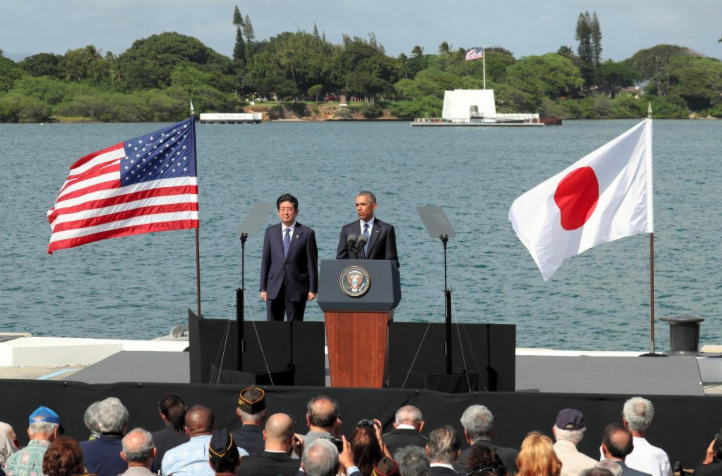
On December 27, 2016, Prime Minister Shinzo Abe became the second sitting Japanese prime minister to visit Pearl Harbor after Shigeru Yoshida in 1951. Speaking before Abe, the assembled guests and media, President Barack Obama, who earlier that year had paid a conciliatory visit to Hiroshima, touched on the kamikaze incident, which he framed by saying, "The most bitter of adversaries can become the strongest of allies. The fruits of peace always outweigh the plunder of war. This is the enduring truth of this hallowed harbor...
"The sacrifice made here, the anguish of war, reminds us to seek the divine spark that is common to all humanity. It insists that we strive to be what our Japanese friends call otagai no tame ni – 'with and for each other.'
“That’s the lesson of Captain William Callaghan of the Missouri. Even after an attack on his ship, he ordered that the Japanese pilot be laid to rest with military honors, wrapped in a Japanese flag sewn by American sailors....”
M.G. Sheftall, professor of modern Japanese cultural history and communication at Shizuoka University and author of “Blossoms in the Wind: Human Legacies of the Kamikaze,” was closely involved in arranging the Missouri's kamikaze exhibits. He underscored the importance of the captain's decision, saying, “Callaghan's order for the kamikaze pilot’s formal burial at sea shows that the best of us can preserve the capacity for decency and compassion even under circumstances – which the Pacific Theater in general, and the Battle of Okinawa certainly had in spades – that pressure us to regard a culturally alien enemy as something less than human and thus deserving of not only disdain, but extermination.”
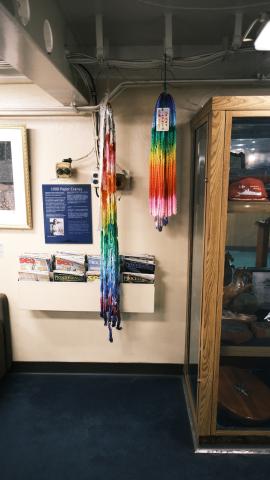
Mark Schreiber writes, "Even though I was born in 1947, my entire life, and certainly the past 61 years since coming to Japan, has revolved around World War 2."
