


Issue:
September 2026

It’s a sweltering August day in Yokohama’s Kannai area, and the customer line at Starbucks snakes outside the shop. Among drinks for sale, the priciest is a 30g can of Teavana Stone Ground Matcha from Kyoto at nearly 5,500 yen.
Making Kyoto’s finest involves processing tea leaves into tencha, the raw material for matcha, then grinding at a low temperature in stone mills. Valued for its health and wellness properties, as well as taste, aroma and “Cool Japan” cachet, global demand for matcha has sparked a rush of fakes with Japanese regional names. Competition from cheaper imports has also put domestic tea prices on the boil.
In response, in July the Ministry of Agriculture, Forestry and Fisheries registered “Nihon Cha” (Japanese tea) as a under the Geographical Indication (GI) system, allowing authorities to crack down on unauthorized labels and ask online shopping sites to remove phonies. Starbucks’ matcha will soon bear GI labelling as a sign of authenticity.
Counterfeits are not the only challenge. Japan’s tea industry also faces declining domestic tea acreage and an aging, shrinking workforce of farmers.
Tea cultivation in Japan declined from 49,000 hectares in 2002 to 33,000 hectares last year, as total output fell 25% to 75,000 tons, according to the The Asahi Shimbun. The newspaper added that the number of tea farmers in prefectures such as Kagoshima and Shizuoka is now less than a quarter of their levels in 2000. The average age of tea farmers is 69 years, according to industry analysts.
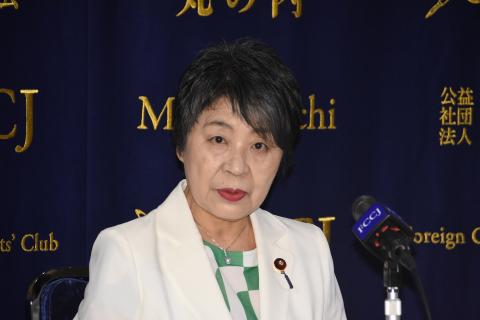
Yoko Kamikawa 
Sadami Suzuki
To discuss these issues, the FCCJ recently hosted Yoko Kamikawa, a Liberal Democratic Party member of the House of Representatives and former foreign minister, and Sadami Suzuki, executive director of the Japan Tea Central Association, whose group applied for GI status. Both said the designation was just a first step for Japan’s “cuppa.”
“It’s a starting point for our marketing worldwide,” said Kamikawa, who also serves as president of the Japan Tea Central Association. “Interest in Japanese tea, especially matcha, is rapidly growing.”
Japan’s year-on-year production in 2025 grew 98.2%, with exports jumping 43.4%, a record. Kamikawa’s home prefecture of Shizuoka, where tea-growing began with a 13th-century monk who brought seeds from China, is one of Japan’s top producers.
The industry’s kettle remains hot. In the first six months of 2026, green tea exports rocketed 83.5% to 48.2 billion yen, while the prices of domestic tea leaves sold at auction hit 180,000 yen per kilogram in Shiga Prefecture, nine times last year’s level, according to The Yomiuri Shimbun.
Yet some industry observers fret that the matcha boom could see younger consumers seek cheaper alternatives
According to Global Information Inc., the global matcha market will grow at an annual rate of 7.9% to reach $7.43 billion by 2030, but the market is seeing a change based on price and demand.
Sencha, a loose-leaf green tea, and matcha, a finely ground powder made from shade-grown tea leaves, require different methods of cultivation and production. Because of the boom, Japanese farmers in key tea-producing regions are increasingly switching to tencha production. It is made with shade-grown, unrolled green tea leaves used for matcha, but these take more time and resources to produce.
“The switch from sencha to tencha for matcha takes several years,” said Suzuki. “A decrease in the volume of sencha and an increase in tencha means less supply that (could lead) to a doubling in price, creating challenges in domestic consumption, as some in Japan may think, ‘If sencha is so expensive, then I’ll just buy mugicha (barley tea) instead.’”
Producers are trying to temper higher costs for Japanese consumers by capping price increases at 30% and offering regional teas at different quality levels and price points. Areas renowned for higher production are at the top end of pricing, while farms with more mechanized output are at the bottom.
“Farmers in the region face the aging issue as a main challenge, as well as the difficult task of having to farm year-round,” Kamikawa said. “We are working with the national government to ensure there is long-term support, including for younger farmers.”
So what’s next for Japanese tea, renowned for its ceremonial values of harmony, respect, purity and tranquility? Kamikawa says it’s essential to make matcha sustainable.
“Japanese tea is more than just a beverage. Its value is rapidly expanding from culture and regional products to world brands,” she said. “It is our responsibility not to end this opportunity as a temporary boom, but to convey the value of Japanese tea and pass it on to the future.”
Dan Sloan is president of the FCCJ
