


Issue:
September 2026
Former Justice Minister Masako Mori takes a stand against prosecutorial misconduct
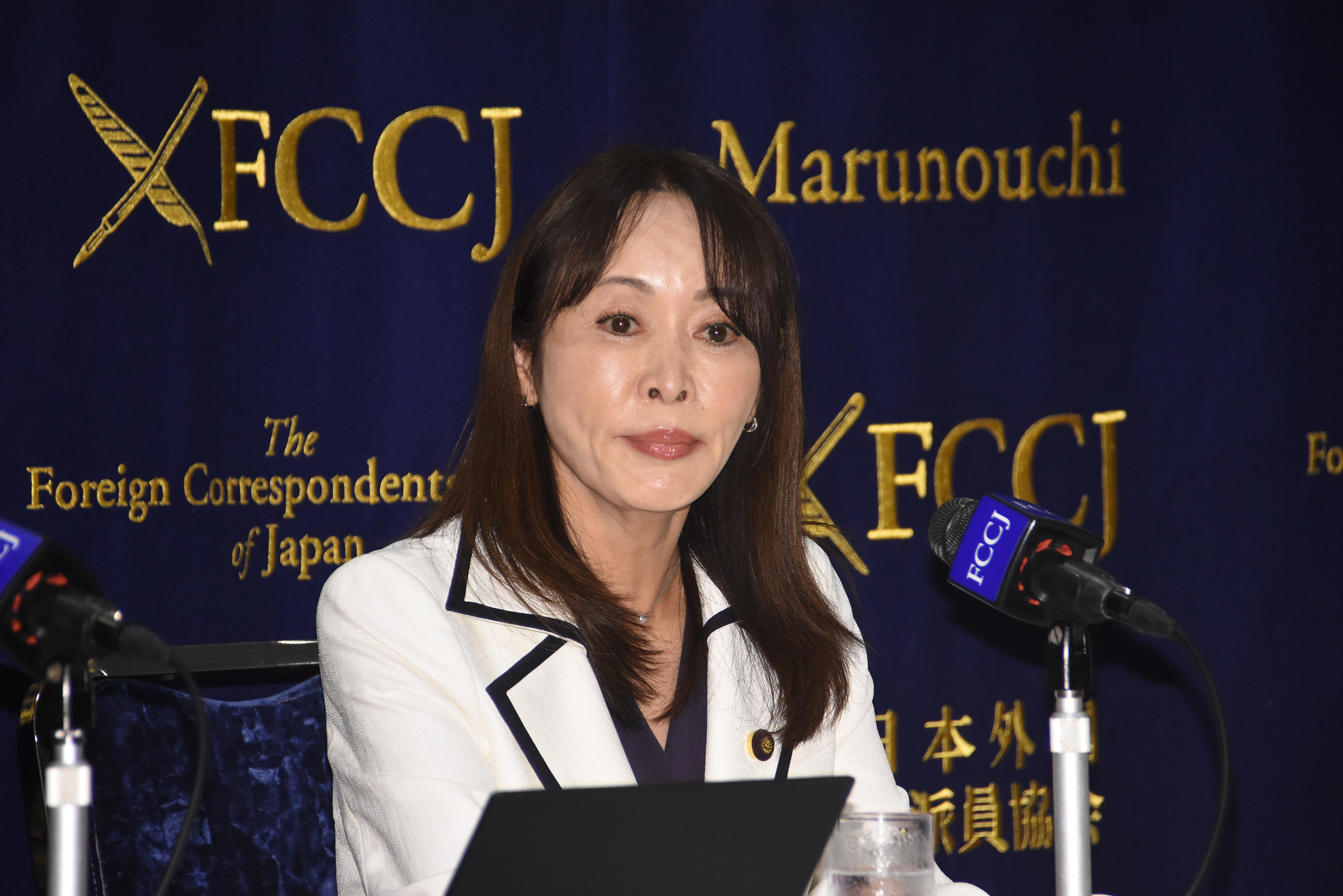
Despite multiple scandals, judiciary misconduct continues in Japan, along with prolonged pretrial detention and unwarranted pressure on suspects, said former Minister of Justice Masako Mori.
Speaking at the FCCJ on August 3, Mori pressed for third-party monitoring of the justice system to restore public confidence.
“In a private company, management would face accountability. The Public Prosecutor’s Office, however, is shielding itself as a quasi-judicial agency by monopolizing its authority to indict and retaining state authority over criminal punishment.”
A parliamentary group headed by Mori at the Diet has recently prepared a formal proposal to the justice minister and the Public Prosecutor’s Office to consider establishing an external and independent body to investigate allegations of misconduct.
Mori cited the case of “Runa”, a 16-year-old girl who was arrested and detained for 18 days in Hyogo Prefecture without access to a lawyer or her family, including her mother.
Runa worked at a welfare facility for people with disabilities owned by her mother. In February 2025, she intervened when a facility user appeared to be trying to bite another person. Her family says she was trying to stop the incident. In June 2025, police arrested her on suspicion of assault based on a report by another resident, which was later withdrawn.
Her family argues that Runa’s treatment by police and prosecutors amounted to unlawful detention and coercive interrogation. Though she was not prosecuted, she later died after developing severe psychological and an eating disorder.
Japanese prosecutors possess extraordinary state powers, such as arrest and prosecution, detention requests, interrogation, access to evidence and control over criminal investigations.
Japan’s so-called “hostage justice” system, under which prolonged detention can be used to put pressure on a suspect to confess or otherwise cooperate, has long been criticized nationally and internationally.
Having served as the justice minister between 2019 and 2020, Mori's position is particularly significant. She had previously defended the system against criticism of hostage justice. In her current position as a member of the Senate, she takes issue with aspects of that system and is calling for reform.
In a committee hearing on July 9, Mori argued that recording interrogations does not in itself prevent unlawful treatment or interrogation techniques. She added that institutional safeguards must prevent misconduct rather than merely document it afterward, and called for lawyers to be present during interrogations. During Runa’s 18-day interrogation, she was without a lawyer.
Another case of alleged hostage justice, unlawful detention and prosecution involves Chris Payne, an American who was convicted of sexual assault after questionable DNA testing in 2020. He has since been fighting for his release from solitary confinement at the Tokyo Detention House.
More recently, Murat Çiçek, a Kurdish actor and asylum seeker, died in Japanese police custody after a minor traffic stop, leaving behind many questions about use of police power and the way his deteriorating health was handled during his detention.
One case Mori specifically mentioned during her press conference involves “Hikari”, a female prosecutor who claims she was sexually assaulted by a former chief prosecutor of the Osaka District Public Prosecutors Office. Mori said she could not allow Hikari, who had exhausted all the avenues to seek justice, to suffer alone.
“My experience shows that unless reform occurs, the prosecution won’t change and new victims will emerge,” she said.
Pointing to an organizational problem rather than a single employee behaving improperly, Mori warned that the integrity of the prosecution system is under threat, and an external investigation is needed immediately.
The Justice Ministry has rejected that demand, saying an internal investigation should take place first and that an external investigation could create problems, such as violations of privacy rights and affect ongoing criminal proceedings. Mori’s argument is that privacy can be protected and institutional reform cannot wait for individual criminal proceedings to end.
Third-party investigations into serious organizational misconduct are not new in Japan. In the past, the Defense Ministry established such probes even while criminal or civil proceedings were underway.
The Justice Ministry itself established an external committee to probe a 2022 scandal at Nagoya Prison, involving 22 correctional officers, mostly young and inexperienced, who repeatedly assaulted and verbally abused three inmates over 400 times between November 2021 and August 2022. Guards justified the abuse by claiming the inmates disobeyed orders. The probe led to criminal referrals, major institutional reforms and new human rights policies.
In answering a question from a reporter, Mori reflected on her own difficult experience as a female justice minister, recalling, “I was often alone and isolated in my office. I used to walk the ministry’s stairs up to the 19th floor to my office every day, reminding myself that I would persevere.” She also said the cases of Hikari and Runa resonated with her as a mother.
In conclusion, Mori said Japan should not wait until another prosecutor is sexually harassed, a suspect is unlawfully interrogated, an innocent person is detained or a family loses a child.
“To ensure that innocent people no longer suffer ugly interrogations by the prosecutors," she said, "we will continue fighting so that Japan’s public prosecution [system] will transform into genuine representatives of our nation’s interests, aiding victims and protecting the weak."
Ilgin Yorulmaz is a freelance journalist. She served as the 2nd Vice-President and co-chair of the Freedom of Press Committee at FCCJ.
