


Issue:
May 2026
An extract from Japanese Rebels: Non-conformists in a Conformist Society
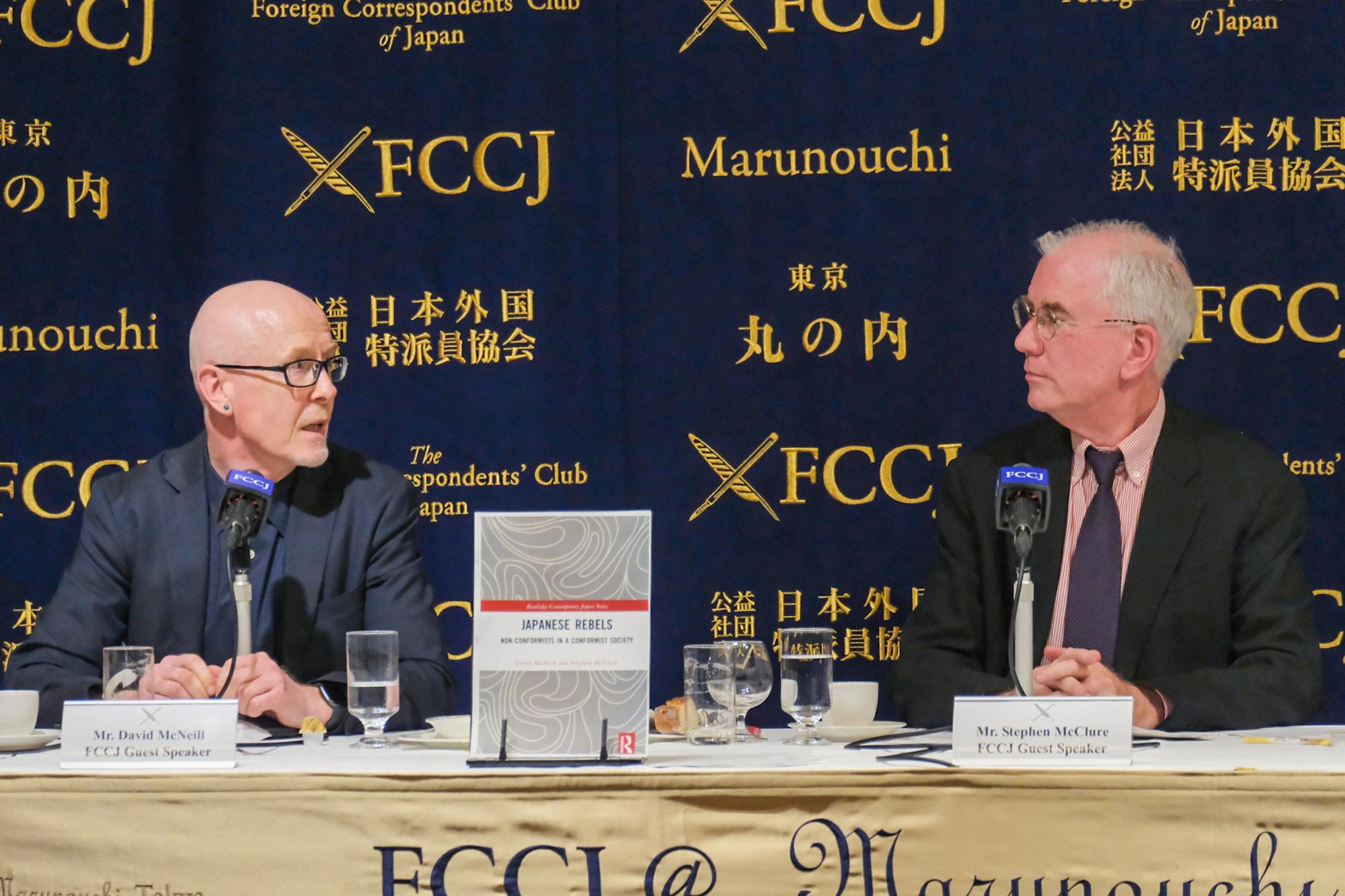
Japanese Rebels by David McNeill (left) and Stephen McClure (Routledge, April 2026).
Introduction
What is new is always rebellion.
Tokutomi Roka
Every country has rebels: fighters, malcontents, gadflies, deviants and misfits who resist and chafe against social rules out of a sense of justice, or simply to make their mark and stand out. Japan is no exception, although that may surprise those blindsided by its image of harmony and conformity.
This collection profiles people who, in various ways, have refused to accept Japan’s status quo. In a country where aggressive individualism is supposedly frowned on, they often recklessly and magnificently fly solo. And when people in Japan buck the conformist tide, their rebellion is often all the more colourful and spectacular, just because it is so difficult.
As we were writing this book, two major scandals rumbled on in the background. One was the fallout from the revelation that pop Svengali Johnny Kitagawa had abused hundreds of children, going back to at least the 1970s, all under the eyes of the mainstream media (McNeill, 2023). The second involved the rape of journalist Ito Shiori by an older reporter with connections to the prime minister’s office. Ito, too, found her path to justice blocked by a mix of media indifference and a hostile establishment (Ito, 2021).
In both these cases and in many others, Japanese culture’s tendency to put pressure on the individual to bend to some collective will was cited as a key factor. Ikeuchi Saori, a former lawmaker who is now a gender diversity activist, says pressure to conform discourages women like Ito from speaking out or saying “no” to many things – including unwanted sex (Yamaguchi, 2018). Similar pressures helped maintain the code of silence surrounding Kitagawa’s abuse until his death in 2019.
It might be asked how conformist Japan actually is, given the many contrarians, subversives and agitators we profile in this book. It’s a theme often taken up by Japanese commentators. Murakami Haruki once described his hatred of the petty rules and group-mindedness of postwar Japanese society as “the submission of individual desires to collective, familial duties” (Michaud, 2011). The writings of Oe Kenzaburo, winner of the 1994 Nobel Prize in Literature, unflatteringly portray his countrymen as an unthinking mass, with their insularity and stubborn allegiance to the emperor system (Sakurai, 1984).
Donald Richie (2001), one of the best-known Western commentators on Japan, famously observed about his adopted home:
There is a way to pay calls, a way to go shopping, a way to drink tea, a way to arrange flowers, a way to owe money. A formal absolute exists and is aspired to: social form must be satisfied if social chaos is to be avoided.
Anthropologists and sociologists, too, have long noted the strong pressure to conform in Japan, especially to social norms and nationalism. In her classic work The Chrysanthemum and the Sword, Ruth Benedict argued that Japanese culture is based on a shame-based system that motivates people to behave in ways that maintain harmony and avoid bringing dishonour to them-selves and the community in which they live. This contrasts with guilt-based cultures that emphasize personal morality.
Japanese society has profoundly changed since Benedict’s book was published in 1946, and the “shame/guilt” dichotomy is considered by many as outdated and simplistic. Yet, many Japanese note being overly conscious of how their actions are perceived by others. Shame is still crucial for maintaining harmony, as it encourages people to conform to social norms and avoid behaviour that might disrupt group cohesion.
So why is Japan so conformist? One explanation is that it is historically a society based on wet-rice cultivation, which requires a high level of cooperative community activity. The well-known expression describing ostracism, mura hachibu, stems from people being shut out of village activities for transgressions against the all-important wa (harmony) that defines social relationships in Japan. And in the samurai ethos of bushido (“the way of the warrior”), the concept of honour was closely tied to the avoidance of shame, making it essential for maintaining one’s reputation and standing in society.
There are countless academic and popular papers in Japan exploring, questioning or praising its cultural, racial and linguistic homogeneity, and the stability, social collectivism and groupthink that is supposedly its flipside. See, for example, Benedict (1946), Nakane (1970), Honda (1993), Burgess, (2007), Weiner (2008), Takano (2024). Anyone who has lived or worked in Japan knows that the pressure to avoid open conflict and encourage cooperation in schools and workplaces is not just a Western cliché.
Many Japanese cite clichés like Japan being an island nation where harmony is valued, and where the nail that sticks out gets hammered down. Similar observations have been made about other societies, of course. The Nordic countries, for example, have the informal rules known as the Law of Jante, which enforce conformity and social cohesion.
Psychiatrist Izumiya Kanji (2018) argues that in Japan conformity begins at home and is reinforced in schools, which play lip service to individuality, but pressure children into a hierarchy in which their positions are defined relative to others. Izumiya says membership of a group means having essentially uniform views, while order is maintained by unwritten rules and displays of individuality are unwelcome. Anthropologist Muroga Chie Jex (2011) argues that the “thoughts and attitudes of Japanese are profoundly correlated with pressure to conform to social norms and nationalism, which are not usually discussed or apparent to outsiders.”
A collective desire for harmony, of course, is not always a bad thing, and helps make Japan a pleasant place to live. The problem with conformity is that it can stifle individual expression and initiative, consign sexual and other minorities to permanent outsider status, and ultimately make Japan less able to cope with the challenges posed by an increasingly diverse, multipolar world. This is the context in which to view rebels profiled in this book, such as Togo Ken and Miwa Akihiro, who set their face against these restrictions.
A natural outgrowth of the pressure to conform is self-deprecation. People are encouraged to downplay their achievements and avoid drawing attention to themselves. This promotes a sense of belonging and collective identity, and can create goodwill and build relationships. But too much modesty can foster an almost morbid extolment of mediocrity. One example of this unfortunate tendency is that Japan, a country with a much-vaunted education system, consistently performs poorly in international English-fluency rankings (The Mainichi, 2024).
Author Tsunemura Fumizuki notes that preventing individuals from fully asserting themselves by stepping outside societal expectations can lead to personal challenges. This is certainly the dominant view, expressed not just in academic essays but in countless popular sources. Think of those newspaper photographs trotted out regularly showing herds of unsmiling black-suited salarymen silently and inscrutably enduring the crush on rush hour trains, or the stories of schoolchildren being told to dye their hair black, or women being forced to wear high heels and makeup in the work- place (BBC, 2019).
There are dissenters from such views, of course. American author David Matsumoto (2002) says Japanese collectivism is as much myth as reality. He says that while any society is a collection of individuals, individuality comes with a set of collective responsibilities and pressure to fit in. The question is whether Japan exerts more pressure than other societies.
As we write, Japan has rebounded from the Covid-19 pandemic, yet millions of Japanese wear flu masks just about everywhere, even alone in cars, oblivious to the bitter culture wars that were fought over face-coverings in the United States. Crowded Japan survived the pandemic with one of the world’s lowest death tolls, achieved without the aid of compulsory lockdowns or mandates: most people wore masks and stayed isolated voluntarily (Wingfield-Hayes, 2020).
This emphasis on group solidarity can make people work together in pursuit of a common goal. Hence the extraordinary transformation of Japan from a feudal backwater to a modern industrial power in the late 19th century and the country’s spectacular recovery from the devastation of the Second World War. It helps explain Japan’s remarkable social cohesion, but also why so few voices were raised against the suicidal militarism that led to Japan’s wars in the 1930s and 1940s.
We’ve deliberately cast a wide net in coming up with our list of rebels. It includes colourful eccentrics like Miwa Akihiro, champions of the avant-garde like Ono Yoko, and political activists like Kitahara Koji. Most of them are more than mere misfits: they have an agenda aimed at achieving some kind of meaningful social change. Some, of course, are dedicated eccentrics: rebels without a cause. That’s not to say they’re hardcore revolutionaries dedicated to transforming Japan into some kind of non-conformist utopia. Their main quality for us is that they’re not afraid to stand out from the crowd.
Some people who read early drafts of this book objected to our including Asahara Shoko, the leader of the Aum Shinrikyo doomsday cult. They say that insults the many reformers and non-conformists we have profiled. A similar argument could be made regarding Shigenobu Fusako, whom many people consider a terrorist.
But our basic criterion for deciding whom to include in Japanese Rebels is that they have rejected the prevailing orthodoxy in a specific field, be it politics, religion, art or whatever, and that as a result they have achieved fame – or, in Asahara’s case, infamy. Not all rebels are heroes.
Readers will also note that most of our profile subjects are male. In our defence, we should point out that Japan has long been an overwhelmingly patriarchal society. Only in the 20th and 21st centuries have women started to take leading roles in the struggle for social change.
One of the inspirations for this book is The Nobility of Failure, in which Ivan Morris (1975) recalls tragic heroes from Japanese history and folklore who fought against society’s existing parameters out of a sense of honour or duty, despite knowing that their efforts were doomed to fail. In this book we look at historical rebels, whose struggles against authority provide unique and telling insights into Japanese history, as well as their contemporary successors.
We leave it to the reader to decide whether Japan’s 21st-century upstarts have any hope of fomenting social change. Regardless of whatever success they may or may not achieve in that regard, their stories are fascinating and inspiring. As Morris noted:
In a tight-knit, conformist society like Japan’s, in which the greatest value is attached to achieving success within a conventional and care- fully defined framework, there is a special fascination about an individual whose idiosyncratic personality and commitment to a set of abstract ideals impel him to break out the “web society” and confront the overwhelming force of established authority.
(Morris, 1975)
Labeling these brave souls as “rebels” perhaps shows some bias on our part. We are veteran foreign (Irish and Canadian) journalists who, between us, have covered Japan for close to a total of 60 years. We come from cultures where rebels are usually the good guys, and are well aware of the peril of imposing our Western world-view on a society that places a higher premium on fitting in than the more individualistic societies of Ireland and Canada. The word “rebel” itself is problematic. Ambiguity about the concept behind the word is hard-wired into the Japanese language. The usual translation for “rebel” is hangyakusha (反逆者), which can mean rebel – or traitor. Perhaps a better translation is hankosha (反抗者), which has more of a connotation of resistance or defiance.
Linguistic nuances aside, our aim is to share the stories of Japan’s rebels without falling into the “weird Japan” clichés beloved of some Western writers. We hope our readers will gain a better understanding of Japan by reading our book and be entertained in the process. We want to show that even in this highly conformist society, there are some brave “nails” that refuse to be hammered down. By looking at outsiders, we want to give our readers a look inside Japan, a country that is endlessly intriguing and inspiring.
Igarashi Megumi: the pussy rioter
Like many young women growing up, Igarashi Megumi began to wonder about her vulva. Was it too big or small, too hairy or misshapen? What was the purpose of the clitoris? The problem was that there was nothing to compare it to. Women often covered up their nether regions in private, and few of her generation talked about what was going on down there. While young women were heavily sexualized in popular media, porn blurred the genitalia with mosaic-like censorship. Despite its apparent ubiquity, the vagina seemed to be oddly stigmatized.
Male tackle did not seem to suffer the same social restrictions. For a start, the penis and testicles hung outside the body, visible for all to see in Japan’s ubiquitous public baths. The penis seemed to be rampant: mass-market magazines, sold in convenience stores, contained images of incest, underage sex and gang rapes. A popular annual fertility festival near Tokyo featured giant wooden phalluses and penis-shaped candy. Possession of child pornography, almost exclusively for male consumption, was only made illegal in 2014 (BBC, 2014).
Igarashi was hardly the first to feel how unfair this was or to resent the grip of patriarchy, but her reaction was novel: she made her genitalia into an art object. It began simply enough with a plaster cast of her vagina. Why stop there, she wondered. She sculpted small models of landscapes and golf courses from the shape of her vulva, then vagina lampshades, phone cases and remote-controlled cars. She drew a manga character called Manko Chan, a pussy on legs, and made small plastic models. “Is my body obscene?” she asked rhetorically, smiling sweetly from the cover of books (Rokudenashiko, 2015).
It was all good, clean fun, but there was a serious point, she insisted: mocking outdated social and legal taboos. The authorities did not get the point. In 2014, the police made history by arresting her after she emailed 3-D data of a kayak in the shape of her vagina to supporters who crowdfunded her – making her the first Japanese woman detained on obscenity charges. Her work was “salacious,” the authorities said, as quoted in the media (Osaki, 2014). After she was released, instead of indulging in the usual rituals of public contrition, she satirized the cops in a manga comic (see Rokudenashiko, 2016).
When her work was displayed at a Tokyo sex shop a few months later, the authorities pounced again. Ten police officers confiscated her belongings and
marched her away in handcuffs. She was interrogated for 23 days (The Economist, 2015). Cops searched her room and confiscated her art, oblivious to criticism that singling out Igarashi’s art in a sex shop that sold dildos and cock-rings was daft (McNeill, 2015a). “A certain limit is necessary to maintain public morals,” said a spokesman for the Metropolitan Police Department. Detectives went across the country to interview her supporters. “They didn’t seem to under- stand what crowdfunding was,” recalls Igarashi (McNeill, 2015b).
The subsequent trial on obscenity, which played like a digital rerun of the 1960 controversy over Lady Chatterley’s Lover, made Igarashi a global celebrity, which she gleefully embraced. Journalists who turned up to meet her in her lawyer’s office were handed a pink business card in the shape of her vagina. Before interviews began, Igarashi, who goes by the professional name “Rokudenashiko,” roughly meaning “bad girl,” scrawled the word manko (“pussy” or “cunt”) in huge writing on a blackboard and placed plastic figu- rines of her genitalia on the table.
In a country where first meetings are often deeply formal, these conversational openers suggested a playful, rebellious sense of humour, but prosecutors missed the joke. Poker-faced lawyers earnestly stumbled over the word manko, insisting that Igarashi violated Japan’s obscenity laws, which punish material that maliciously stimulates sexual desire or violates “the sense of shame in an average person.” The Tokyo District Court agreed, ruling that the 3D printer data “realistically reproduced the shape of (female genitalia) and stimulated the viewers’ sexual desire” (Churchin, 2017). In 2017, the Tokyo High Court upheld the decision that the data was titillating – not art – and fined her 400,000 yen. The Supreme Court rejected her appeal in 2020.
The ruling showed that Japan was deeply inconsistent, Igarashi said. “If you ride the train you’re confronted with advertisements with sexual images and you cannot avoid looking at them. All these notions are based on the men’s viewpoint and there is a lack of empowerment of women” (McNeill, 2015a). Far from aiming to arouse men, the purpose of her art was to make the object of their lust look “ridiculous,” she insisted – why else would she put a vagina on legs. Even feminists disliked her art because they misunderstood the humour and thought she was making fun of the female body, she lamented. “That’s a sign, I think, that the image of the vagina as something dirty has seeped deep into society,” she said.
Igarashi’s work upset the authorities not because it’s sexual, but because it disrupted the norm, concluded political scientist Miura Mari. It is acceptable for men to express sexual desire but not women. Prosecutors couldn’t care less about the cultural context, or whether it is comical or erotic, she said. “All they see is a woman showing her vagina” (McNeill, 2015a). Her decision to fight was not without cost. Igarashi received scads of hate mail for not admitting guilt and causing “trouble.” “Most people would admit the charges just because it takes so much time to prove the authorities wrong,” said her lawyer. “Nobody has bothered to fight which is why it goes on.”
Her newfound fame had one unintended effect: she caught the attention of Mike Scott, lead singer of the British rock band The Waterboys. Scott wrote a song for her, praising her as a brave artist fighting censorship. “She’s also great fun,” he noted. A 21st-century John and Yoko, the two bonded, married and in 2017, aged 45, Igarashi gave birth to a healthy baby boy. “I’m so grateful to the police for broadcasting the news of my case around the world” (Igarashi, 2016). Defiant as ever, she invited the cops and prosecutors to her wedding.
