


Issue:
May 2026
Sohei Kamiya denies xenophobia and claims Sanseito is the party of the disenfranchised
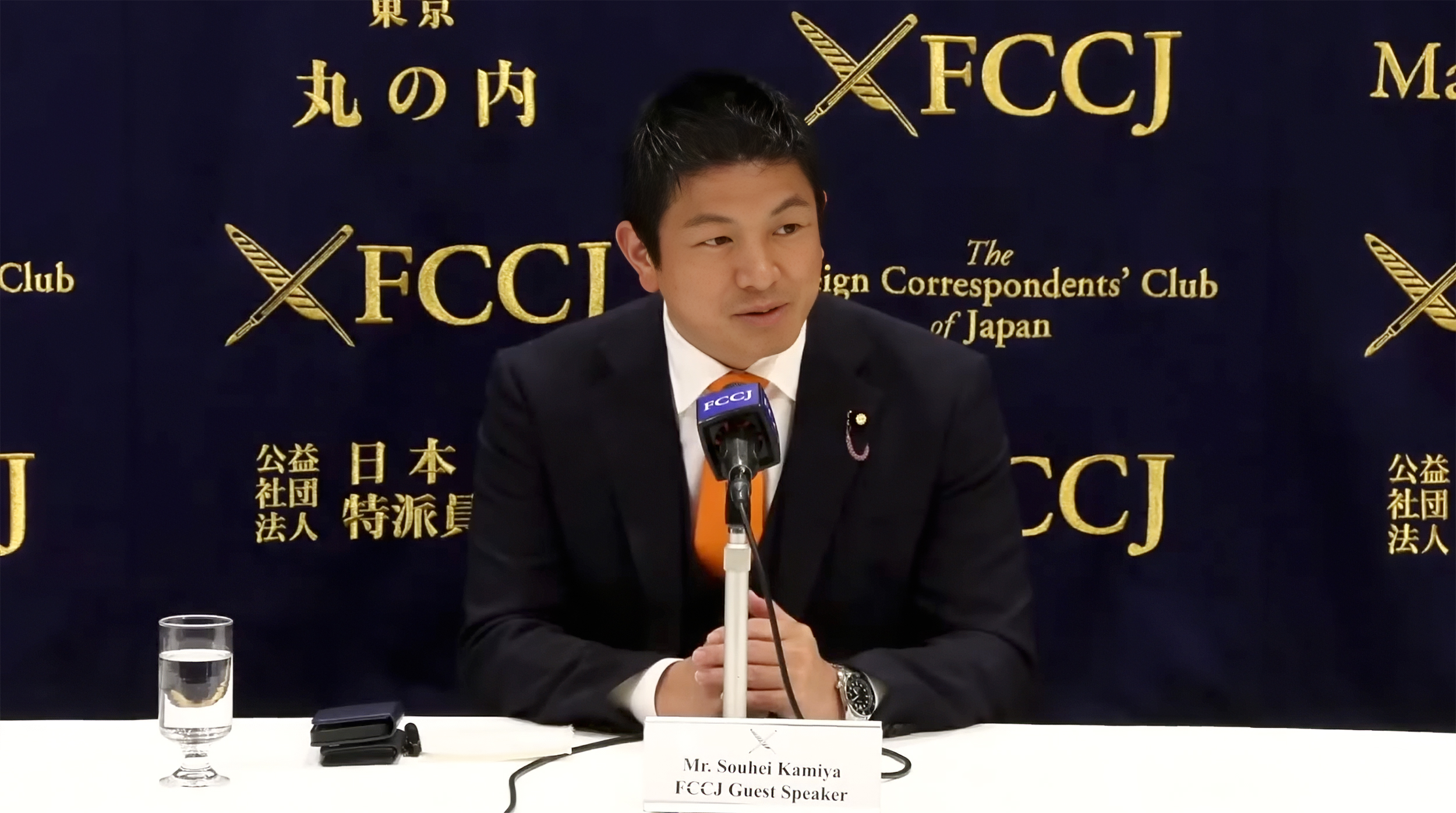
The lower house elections in February saw Sanseito gain 11 Diet seats, pushing the representation of the ultra-conservatives to 13 members. But the party’s leader, Sohei Kamiya, called it only a 75% victory, and anticipated even more wins.
That may have been based on significant gains in last July’s upper house election, when Sanseito’s presence soared from one seat – Kamiya’s - to 15, lifting the party out of Nagatacho obscurity to a place at the table of Japan’s political nerve center.
Sanseito, which initially ran under a "Japanese First" banner and then adopted the slogan “I am Japan”, ran 190 candidates, an astounding number for a political organization founded only six years ago.
Kamiya has made headlines since the party’s launch with controversial comments on a range of issues: vaccination, imperial succession, the “deep state”, tax cuts, defense and the Battle of Okinawa, DEI and gender equality, antisemitism, and, of course, immigration and foreign residents’ rights.
“The biggest leap was the upper house vote when we had the ‘Japanese First’ slogan, looking at our efforts as an anti-globalist movement. Unfortunately, the Japanese media took this as our party being xenophobic, and we faced quite significant bashing,” Kamiya said in a recent appearance at the FCCJ.
“We look to bring more order to immigration in Japan … and hold as our goal civilization and (cementing) what is Japan.”
Kamiya, wearing his trademark suit and orange tie, contended that his party is not anti-foreigner. On this, his second visit to the Club, he was on his best behavior, smiling even at tricky questions.
“We have seen data from the West showing when there is an increase in foreigners there is also an increase in crime, and so we are watching for the potential same trend in Japan,” he said. “We are particularly looking at those countries bringing in foreigners as cheap labor … We are not proposing revocation of the system or permanent residency, but are focused on the foreigner proportion … We should set limits.”
Kamiya raised only a few eyebrows when he suggested that Japan should consider possessing nuclear weapons. "Japan's defense capabilities would be undermined by declaring that we would never possess nuclear weapons," he said. "If we were to see a situation where the United States would say that it would no longer protect Japan or the military would completely withdraw, then our nation would not have enough defense capabilities."
It is a possibility that many Japanese conservatives are also now mulling, as ties with the U.S., its senior security partner, are less than robust, while saber rattling in Northeast Asia is growing impossible to ignore.
Kamiya’s message has resonated with some Japanese who don’t see their opinions represented in national policy. Some of that anger has been directed at the nation’s rising foreign population, which Sanseito has presented as a problem in terms of rising crime and welfare costs.
Its populism draws on the nationalist playbook seen in other countries, and appears to be having an effect. Sanseito is now eyeing gains in local assembly elections, in which it is fielding around 600 candidates. It hopes to win 500 seats – more than double its current number.
Kamiya, a 48-year old relative newcomer to politics, says he wants to be the voice of the disenfranchised. Born in rural Fukui Prefecture, he initially worked in the family business and as a teacher of English and history. He earned a doctorate in Philosophy of Law, and served as a Self-Defense Force reservist with the rank of sergeant. He ran in Osaka local elections in 2007, joined the LDP in 2012, but left the party to form Sanseito, and was first elected to the upper house in 2022.
Kamiya has focused on reawakening the Yamato-damashii, or Japanese spirit, using social media to expand Sanseito’s reach. The party’s YouTube channel boasts about 570,000 subscribers, while its choice of orange as its trademark color is aimed at differentiating it from the bland greys and blacks of traditional politics.
“We need to look at how Japan can build its own military and its own intelligence - by Japan and by the Japanese,” Kamiya said.
Dan Sloan is President of the FCCJ.
