


Issue:
April 2026 | Obituary
Former FCCJ correspondents pay tribute to Masaaki Ogushi, a longtime regular member of the Club and former soundman and cameraman for ABC News Tokyo, who has died at the age of 79
Brother in arms
By John Lower
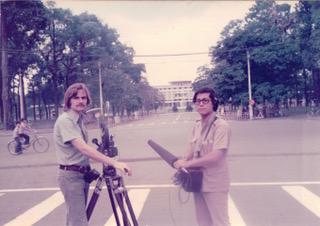
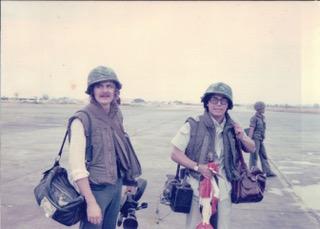
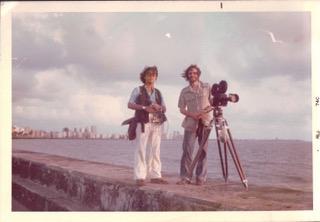
Masaaki Ogushi san was the last of a trio of Japanese news cameramen who had a profound impact on my life and my career.
Ogu-san, as I called him, was the youngest of this incredible group of photo journalists. There was Kaku Kurita san who passed away in 2020; my sensei, Tony Hirashiki, died in 2024 and now Ogu-san has left us. All totally dedicated to the calling. All the epitome of friendship. Loyal, caring, self-effacing, generous. A finer group you will never find.
Masaaki Ogushi and I hooked up when I moved to Tokyo in 1973 and became the ABC News Tokyo cameraman. He was assigned to be my soundman. We were bound together by the umbilical cable that tie a cameraman to his soundman. But we were also bound together by our budding friendship. Ogu-san helped guide my trip of discovery in Japan. In turn, I helped him understand America through our many, many hours of discussions. East meets West. Japan meets America.
In the three years we were a team, I spent more time with Ogu-san than with my then wife, Susan. We travelled extensively in Japan, shooting stories that highlighted both the modern and the traditional. Our assignments also took us to war-torn Vietnam, Cambodia and Laos, Thailand and India, the Philippines and Taiwan, Singapore and Malaysia.
Once, we were assigned to film an Issues and Answers report in far-away Tanzania. And after we finished up, the ABC News New York assignment desk informed us that on our way back to Tokyo we should stop off for a month or so in Beirut. It was 1976, and Lebanon was being ripped apart by a violent civil war. I remember vividly how together we dodged bullets, mortars and once even tank rounds fired at us trying to cover the firefights.
On another occasion in Phnom Penh, when the Khmer Rouge were rocketing the road right in front of our hotel at night, Ogu-san was so frightened he asked if he could sleep in my room. I too was relieved to not be alone. You get to know someone under that kind of stress.
I left Tokyo in 1977, but during the following 25 years I was frequently assigned to produce stories there. Ogu-san had become the bureau cameraman. He was a real joy to work with. He had also become the backbone of the ABC News bureau. He was not just a “shooter” but a first-class journalist and producer as well.
I will remember Ogu-san as a fun-loving, bon vivant. As someone who loved his country so deeply that he wanted to share it with his colleagues. As a generous person who cared deeply about his friendships. Humble, faithful, witty, honest, courageous, jovial, kind.
Honestly, one couldn’t wish for more from a human being. I am grateful to have known him.
Rest in Peace, tomodachi.
John Lower
Vence, France
Tough guy and teacher
By Mark Litke
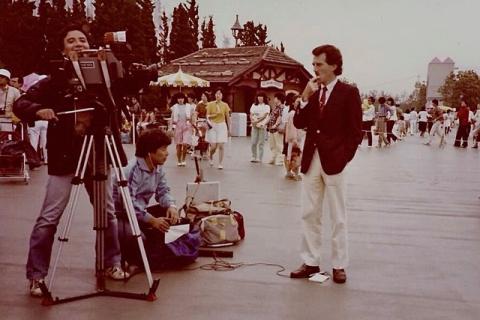
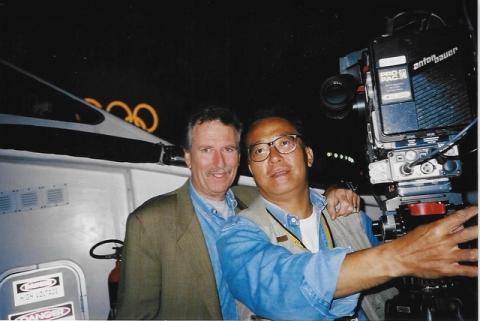
There are many words for tough in the Japanese language. And as I came to know and love Masaaki Ogushi over nearly a half century, I learned that he embodied nearly every definition of the word.
Tairyoku – his physical strength and stamina
Gambaru – his tenacious tough-it-out spirit while on the job.
Gaman – his endurance and patience in challenging times.
Seishinryoku – his mental and emotional toughness during exhausting and dangerous news assignments.
Ogushi-san was the Tokyo bureau soundman when I arrived in Japan as the new ABC News Asia producer in 1978. He was only a year older than me, but he already had a world of experience under his belt. And he would be my Asia sensei in many ways.
It was an intense era of news coverage in Asia. The US had just announced the normalization of relations with China, Korea was rocked by student protests and a presidential assassination, Southeast Asia was struggling in the aftermath of the Vietnam war - Vietnamese refugees, the horrors of the Khmer Rouge coming to light, and multiple military coups in Thailand. And aside from the constant pressure of world-shaking news events, I was in the midst of a transition from producer to on-air correspondent, Ogushi was transitioning from soundman to cameraman, and the entire broadcast news industry from shifting from film to electronic news gathering. It was a constant struggle and challenge for both of us. But it would lead to a professional and personal bond that would last for decades.
In broadcast journalism, the names of cameramen are often overshadowed by the names of correspondents or by the very news events they are recording. But the camera work of Masaaki Ogushi was so broad and extensive, it really became the first draft of Asian history from the 1970s and into the 21st century. From his earliest days as a soundman in Vietnam and Cambodia, to his last big assignment with ABC News covering the catastrophic Tohoku earthquake and tsunami.
In 1983 it was Ogushi-san who filmed the last moments of Filipino opposition leader Benigno Aquino’s life as police led him off a plane in Manila, seconds later he was assassinated. That video would become a spark that helped ignite a people power revolution that led to the fall of the Marcos dictatorship in the Philippines.
In 1984 Ogushi was with me during the deadly riots in India that followed the assassination of Prime Minister Indira Gandhi. One frightening night we were attacked by an angry mob. As we fell to the ground, pummeled by dozens of attackers, Ogushi’s first instinct was to fall on and protect his camera. Thankfully, a squad of Indian police came to our rescue and proceeded to arrest us for creating a disturbance. The camera was saved. Ogushi was tough!
We often endured many sleepless days and nights together covering overlapping stories like the Great Hanshin Earthquake in Kobe and the Aum Shinrikyo sarin gas attack in Tokyo in early 1995. Those grueling days left us sick with flu and something the doctor’s called “the hundred-day cough”. Ogushi toughed it out.
Ogushi-san’s work would also lead to multiple Emmy and Overseas Press Club nominations and awards that too often gave only a polite nod to the work of the cameraman. He deserved to be the direct recipient of many more accolades.
We did win a National Emmy Award together covering the fall of Indonesia’s Suharto regime in in 1999. One night we were chased for blocks by a furious machete-wielding mob (we were often mob magnets). Ogushi saved the camera once again, this time when we crashed into a Jakarta McDonald’s and hid behind the counter until the danger passed. I was in awe of how fast Ogushi could run with the 25 pounds of equipment he was lugging. He was tough!
But for all the years of extraordinary news coverage, all the dangers, all the joyful feature stories (Ogushi especially loved shooting features on Japanese baseball), it wasn’t until after we both had retired from ABC News that I realized how all those shared experiences had created an unshakable lifelong friendship.
Over the past few years, we tried to meet in Tokyo every October to celebrate our mutual birthdays by taking road trips to visit remote Japanese ryokan and historic onsen. At his home, Ogushi delighted in preparing annual sukiyaki dinners for me and our old veteran news cameraman colleagues Tomoo Itoh and Jiro Mishina. Those evenings would be filled wine, beer, laughter, tall tales, and relentless competition to see who could take the best group picture with our latest mobile phones.
This past October, Ogushi-san had never seemed happier. He still religiously adhered to his daily 10,000-step walk. He boasted about his latest batch of homemade umeboshi. We talked about a future ryokan trip to Hokkaido. And he confessed that his greatest dream was still a trip to the United States to attend a Shohei Ohtani game.
You left us too soon, my friend. But the memory of all we shared over the years is a blessing.
Rest in peace, Ogushi-san.
Mark Litke
New York, NY
