


Issue:
April 2026
American and Soviet correspondents were crucial in documenting Japan’s postwar descent into illiberalism
By late 1945, the nascent Foreign Correspondents' Club of Japan had at least three journalists from the Soviet Union among its membership. One of them, Oskar Kurganov (born Yakov Ieremeevich Esterkin, 1907–1997), would achieve prominence as a journalist, writer, and screenwriter. In 1947 Kurganov published a book in Russian titled The Americans in Japan: The diary of a Soviet journalist, and in 1952 a Japanese translation, published by Satsuki Shobo, appeared as Nihon ni iru Amerikajin.
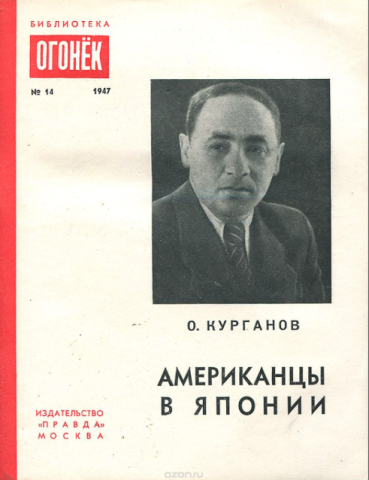
Oskar Kurganov's Russian-language book, The Americans in Japan, published in 1947 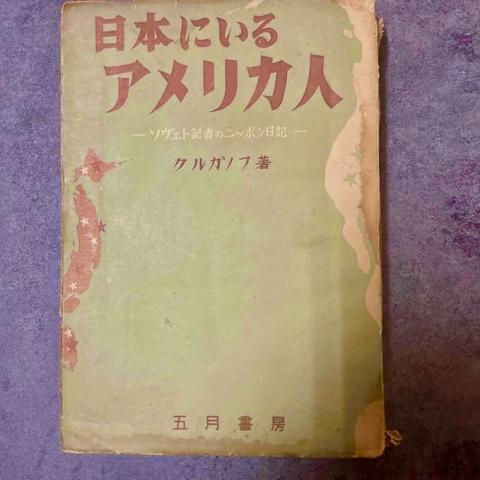
Kurganov's book in Japanese translation came out in 1952.
Kurganov devoted one chapter in his book to the activities of Mark Gayn, correspondent for the Chicago Sun, who in 1948 would publish his much acclaimed Japan Diary.
Gayn (1909 – 1981) was born in Manchuria as Mark Julius Ginsbourg to Russian-Jewish emigre parents. After university and graduate school in the U.S., he became a naturalized American citizen, but moved to Canada when the U.S. government denied resident status to his Hungarian-born wife, actress Suzanne Lengvary (1921-2020). At the time of his death, he was senior foreign affairs correspondent for the Toronto Star.
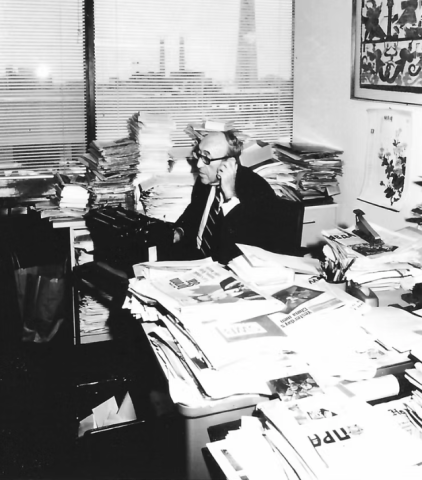
Gayn seated in his cluttered workspace at the Toronto Star. 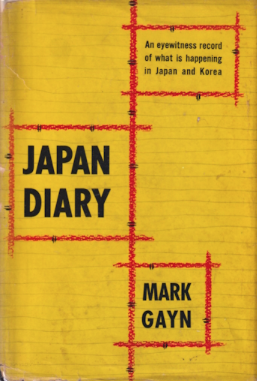
Gayn's Japan Diary, published in 1948, includes a fascinating account of events leading up to the Korean War. 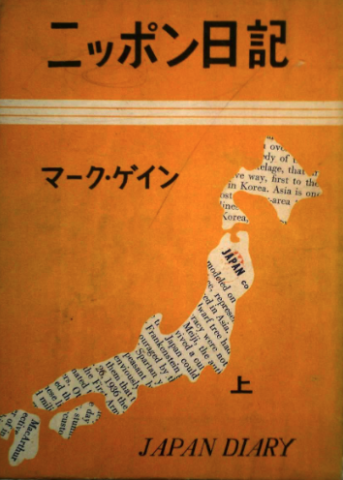
Nippon Nikki, the Japanese translation of Japan Diary, was published in two volumes in 1951
Within weeks after Japan's surrender, occupation authorities began tracking down and apprehending members of the military suspected of war crimes. They also quickly instituted sweeping purges aimed at rooting out ultranationalists and militarists from Japan's civilian government and educational system, and also drew up plans to break up the zaibatsu – powerful family-run conglomerates such as Mitsubishi, Mitsui, Sumitomo and Yasuda – that had heavily influenced Japan's politics and supported its military from the 19th century onwards.
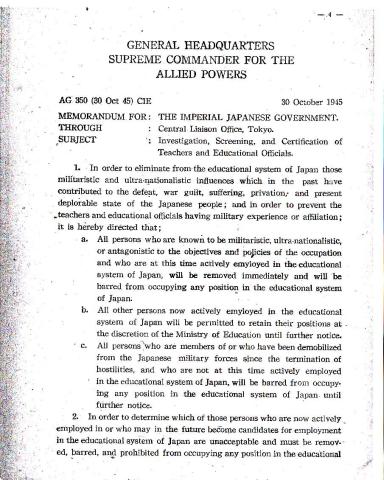
Within a year, however, the occupiers became concerned that their support for labor unions and other policies aimed at democratization were inviting chaos, and that without "guidance" by discredited members of the old order, Japan faced economic collapse. SCAP thus shifted its policy 180 degrees, in what became known as the Reverse Course. The new policy was said to have come into full force with the order to prohibit a general strike scheduled for February 1, 1947.
Gayn had been closely covering a labor dispute at the Yomiuri Shimbun. In October 1945, a post-war "democratization group" called for owner Matsutaro Shoriki's removal, as he had supported Imperial Japan's policies during World War II. When Shoriki responded by firing five leading members of the group, the Yomiuri's writers and editors launched the first "production control" strike on October 27, 1945. This method of striking would become an important union tactic in the coal, railroad, and other industries during the early postwar period.
Gayn's articles that showed sympathy for populist causes soon got him into trouble with SCAP, which Kurganov touches on in his chapter entitled "The Mark Gayn Incident."
Kurganov wrote:
On that day, we heard about an incident that put us on our guard throughout the city of Tokyo. Our colleague Joe Fromme, an American working for U.S. News and World Report, emerged under a spray of steaming water in the shower, and shouted to me, "Hello! How was your trip? Did you guys hear about the run-in with the Yomiuri?"
My other colleague, an American radio commentator named Bill Costello, was a serious and deep thinker. He told us, "Go to the bar downstairs. You can hear all about the run-in. Oh, and did he [Gayn] manage to make a good escape from that G.2 officer?"
On that day, the "Mark Gayn Incident" and his clash over the Yomiuri Shimbun was on everyone's lips.
Six months earlier Gayn had been assigned to Tokyo by the progressive newspaper, the Chicago Sun. He had been critical of the activities of SCAP, and had written a number of incisive articles about the zaibatsu and ultranationalism.
Gayn's critical coverage of MacArthur's activities … had created a dispute of unprecedented proportions. Gayn had a clear understanding of the positions of the Japanese government. He had previously reported on such topics as MacArthur's veto of a plan to dissolve Japan's zaibatsu, and how Americans in Japan had increasingly begun to favor Japan's right wing, which had generated strong reactions by both Japanese and Americans who favored democracy.
To eradicate ultranationalism among public servants, irrespective of how few Japanese were purged, the U.S. military had argued that such an action would wreak chaos in Japan's political and economic life.
Gayn had identified key three individuals by name – George Whittemore (chief of the Civil Communications Section and a vice-president of the Chase Bank), Max W. Bishop (a State Department official), and Colonel (H.I.T.) Creswell, chief of the Counter Intelligence Corps. He asserted that through their purging of Japan's public servants, the three of them would drive the Japanese public into resisting the U.S. When the subject of the Potsdam declaration was raised, these men had reportedly held their sides and chortled with laughter.
Max Bishop of the Office of the Political Adviser in Japan was supposedly said to have remarked to the U.S. Secretary of State: ”If the Potsdam declaration were to be issued today, it would be different. As far as we are concerned, the time may come when we would like to have a strong Japan."
Gayn's Japan Diary entry
May 28, 1946
The meeting was heated enough ... At least half a dozen people have come to give me indignant glimpses of the conference. It is easy enough to understand the indignation. It was bad enough that the meeting hesitated to purge the men who subsidized aggression. What is worse is that the conference climaxes the re-emergence of the "Japan-is-our-bulwark" and "Let's-not-kill-off-our-best allies" school of thought. One of the many corpses left on the conference table was the pledge of the Potsdam Declaration to eliminate "for all time the authority and influence of those who have deceived and misled the people of Japan into embarking on world conquest."
Kurganov wrote:
Gayn had been summoned by Brigadier General (Frayne) Baker of the Public Relations Office. The general's job at SCAP related to publishing, and he was infuriated over the articles Gayn had run in the Chicago Sun. As a skilled reporter, Gayn had managed to penetrate SCAP's walls and learn what was transpiring at meetings held in room number 506 of the Ministry of Forestry building, the details of which he had published.
That particular article by Gayn managed to infuriate SCAP even more than his previous writings. So Gayn was summoned to general Baker's office and threatened with arrest on the charge of disclosing secret information. Confronting Gayn, Baker demanded that he reveal his source of the details of what had transpired at the meeting. Gayn refused.
So on that day, the American reporters were engrossed in stories of the misfortune that had befallen their colleague. Gayn had been summoned to MacArthur's headquarters for the third time, and finally the correspondents came to his rescue. Twelve reporters from major U.S. newspapers fired off inquiries to General Baker. They told the general that any "intimidating treatment" of Gayn would constitute a blow to press freedom and democracy.
"What is your stance on the whole world becoming aware of SCAP's new views on American democracy and freedom of the press?" they pressed Baker
Baker reluctantly gave in.
"All right," he said, "we won't keep Gayn confined."
That evening, at the press club, Bill Costello proposed organizing a "newspaper reporter defense committee". The foreign reporters in Tokyo were divided into right-wing and left-wing camps. Walter Simmons, correspondent for the Chicago Tribune and club president, opposed Costello. Simmons' reactionary newspaper, owned by Robert R. McCormick and his cousin Joseph Medill Patterson, placed no importance on the "Gayn Incident". but others took Costello's side, and set up a committee.
Gayn: October 14, 1946
I was told that I could inform no one – not even my editor – of the summons, and that I was not entitled to legal counsel. General [A. P.] Fox [Deputy Chief of Staff] also told me I could not leave Tokyo. I refused to answer any questions without guidance from the Sun, and promptly filed a long report to Chicago. The next morning, the Sun notified me it had taken action with the War Department. And yesterday morning thirteen correspondents, led by Russell Brines of the Associated Press, and (Burton) Crane of the New York Times, filed into General Baker's office, and demanded an explanation. The right to protect one's sources of information is one of the basic elements of a free press, and no correspondent is willing to make any concessions on it. Ten minutes after the group left Baker's presence, General Fox telephoned to tell me I would "no longer be required in this investigation."
It is possible that General Baker singled out Gayn for his earlier involvement in the "Amerasia Affair". In June 1945, Gayn had been implicated, but never charged, when Amerasia, a New York-based magazine to which he contributed, was the target of an FBI investigation into wartime espionage. In any event, this confrontation between Gayn and Baker moved Gayn's colleagues to make a show of solidarity and push back against efforts by SCAP to muzzle their reporting.
Some American advisors brought to Japan to oversee the occupation were also confounded by the decision to reverse course. Kurganov relates Gayn's account of the following exchange with an unnamed American officer who was about to return to Virginia.
"In my hometown, there are a number of fairly well known business leaders. I was employed by the Chamber of Commerce. I am no longer young, but Chamber of Commerce specialists were needed by the military so I was assigned to Japan.
"To put it bluntly, however, I have no idea what's going on here. I know this is a very obvious thing to say, but I have two sons, and when they grow up, I don't want them to be at war with Japan again.
"However, there are many things that are being said here that I cannot accept. I've tried to grapple with them. Do we actually want to democratize Japan? It now seems rather ridiculous to even dare to ask such a question. I've been thinking about this a lot recently. I am a conservative; but what is happening in Japan is completely different from the type of conservatism that I support.”
Gayn, May 27, 1946
One by one the dreamers were eliminated. Some went home because they had grown lonely for their families, or the smells and sounds of a native town. Others left in frustration. Still others were forced out. Their places were taken by "reliable" officers. There was much talk of surrendering the job of governing Japan to civilian experts. But the civilians hired in the United States, to their dismay, have been put under the absolute control of colonels and generals. With the Brass firmly in the saddle, the spirit of reform died. Only the pretty verbiage remained.
The Japanese themselves were quick to grasp the change. The other day, a Japanese publisher told his staff that early in the Occupation he felt the U.S. Army was ready to alter the entire social and political fabric of Japan. "Now," he said, "I have come to see that General MacArthur is interested mainly in fighting communism."
Japan's first postwar election was held in April 1946, but as the Liberal Party's leader Ichiro Hatoyama had been purged, Hatoyama asked that his old friend Shigeru Yoshida, a former minister of foreign affairs, assume the post of prime minister. Although considered a hawk on China, Yoshida had opposed war with the U.S. and Great Britain, and during the war had aligned himself with the peace faction. Yoshida became prime minister in May 1946.
Gayn, however, was no great fan of Yoshida. In July 1927, while consul general of Mukden, Yoshida had taken part in drawing up the memorandum entitled Basic Japanese Policy toward China.
"Its theme," Gayn wrote, "was expressed in two sentences: 'Manchuria and Mongolia are to be considered as separate from China because of Japan's special interests,' and 'It is Japan's duty to see to the maintenance of peace, economic development, and social stability in these two areas.'"
Yoshida, Gayn asserted, was "one of the earliest spokesmen of the predatory policy which convulsed and seared Asia in the next 18 years".
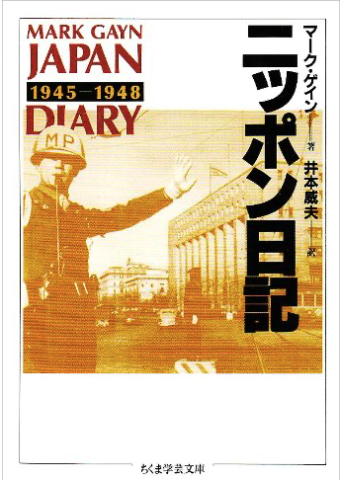
In his diary entry on May 16, 1946, Gayn offered this bold and thought-provoking prediction:
... fifty years from now, and possibly less, a nationalist Japan will remember Yoshida gratefully as the man who, together with another "moderate," Shidehara, circumvented the will of the alien conqueror, sabotaged his orders for drastic changes in the fabric of old Japan, and fought skillfully and well to preserve the feudal system.
And some American historians at about the same time might raise a curious eyebrow, wondering why and how this champion of feudal Japan was singled out by the American command as the molder of a new democracy. For it is no secret that Yoshida has been the liaison man between the Japanese government and Genera MacArthur, and that he has devoted admirers in American Headquarters.
Japan Diary is available as an ebook from Amazon.com. It comes highly recommended.
A newspaper columnist, translator, author and collector of mystery fiction, Mark Schreiber has lived in Tokyo since 1966.
