


Issue:
December 2025
Star Trek icon George Takei beams down to the FCCJ with a blunt warning about today’s world
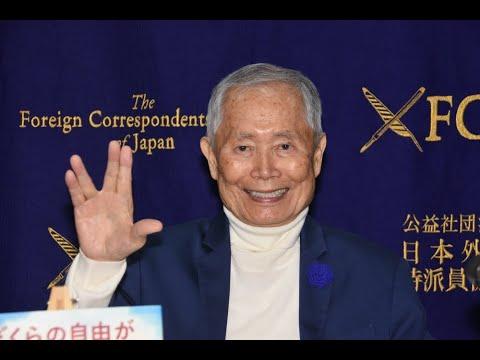
The beloved Japanese American icon sailed into the FCCJ under steady impulse power. Within moments, the room locked on his signal. The journalists were like the crew of the Enterprise awaiting his orders. He steered the room full of diverse strangers into an audience that listened hard and laughed often. Sulu was on the bridge.
George Takei was in Tokyo to promote the Japanese edition of his illustrated children’s book My Lost Freedom. It recounts his family’s wartime incarceration in the United States from the vantage point of his five-year-old self.
But the press conference ranged far beyond Star Trek nostalgia and Hollywood tales. Drawing on his past, the 88-year-old actor, author and activist gave an ominous warning that the world is echoing the worst instincts of the past. “Democracy can only be as good or as strong or as true as the people who make it so,” he said.
Takei recounted the morning in May 1942, when soldiers with bayonets forced his family out of their Los Angeles home. His nation cast him in a role he hadn’t auditioned for. It was a shameful episode unknown to most who later watched him on television and in film.
He described the stench of the horse stalls at Santa Anita racetrack where they first slept. He also recalled the barbed-wire camps in Arkansas and northern California where Japanese Americans were held as “enemy aliens” under wartime suspicion. He called their internment a horror story built on war hysteria, racial prejudice and a failure of political leadership in Washington. Those same three forces were identified decades later by the government’s redress commission, which concluded the incarceration had no military justification.
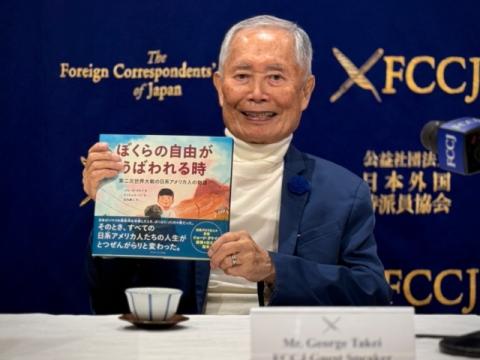
My Lost Freedom is a children’s book with a message squarely for adults. “I wrote it because there are still people in the United States who don’t know American history,” Takei said, including the internment of 120,000 people of Japanese ancestry. He wants today’s five-year-olds to understand what happened to someone their age, and their parents to be pushed to learn more.
Takei’s story crosses deep into my own orbit. As a Trekkie tot, I handed out Star Trek roles to my family so we could stage our own missions at home. My grandfather drew “Sulu” and kept the moniker for life. The Star Trek I grew up with imagined a future where all were respected for what they were, even pointy-eared, hyperlogical aliens. Witnessing the man who portrayed Mr. Sulu speak about freedom, fear, and political abuse in our countries was surreal. He describes the present as if the world had veered into a mirror universe, a harsher reality run by the unscrupulous.
The Star Trek vet was clear that he sees a parallel between the wartime incarceration he experienced and current US immigration actions. “I hear a deeply resonant sound being repeated in our times now: more hysteria, racism, and the failure of political leadership,” he said. Takei described scenes of Latino-looking people forced to the ground by armed officers. He noted the current ICE raids across the United States, where officers detain people in large sweeps that many families now fear. “It’s a terrifying time, not too different from what we went through in the 1940s.”
One couldn’t avoid seeing the mirror universe in Japan’s current moment. The pacifist nation now has a hawkish prime minister, Sanae Takaichi. “I’m happy to see that women are making progress, but it’s not progressive when one’s gender is just a mask for retrogressive thinking,” Takei said. Japan, he argued, is in a unique position to lead the effort toward a more peaceful future, not drift away from it.
On LGBTQ+ rights, Takei said Japan remains “way behind” the United States. He pointed to local partnership systems that offer recognition to same-sex couples but still leave many legal protections out of reach.
Still, the man who once helmed the Starship Enterprise offered cautious optimism. Invoking the Star Trek principle of IDIC, or infinite diversity in infinite combinations, he praised the mix of nationalities and perspectives in the FCCJ audience. When asked what lies on the next frontier, he pointed to the young Japanese he meets who are “passionately pro-peace” and wary of repeating their country’s past mistakes.
“Our ideals can be strong when they are true,” Takei said. “But it is up to us, all of us, to make them so.”
Anthony Trotter is a multi-role journalist, cameraman and producer for ABC News in Tokyo.
