


Issue:
December 2025 | Review of the year
Election losses, scandal and infighting made for a chastening 2025 for the LDP
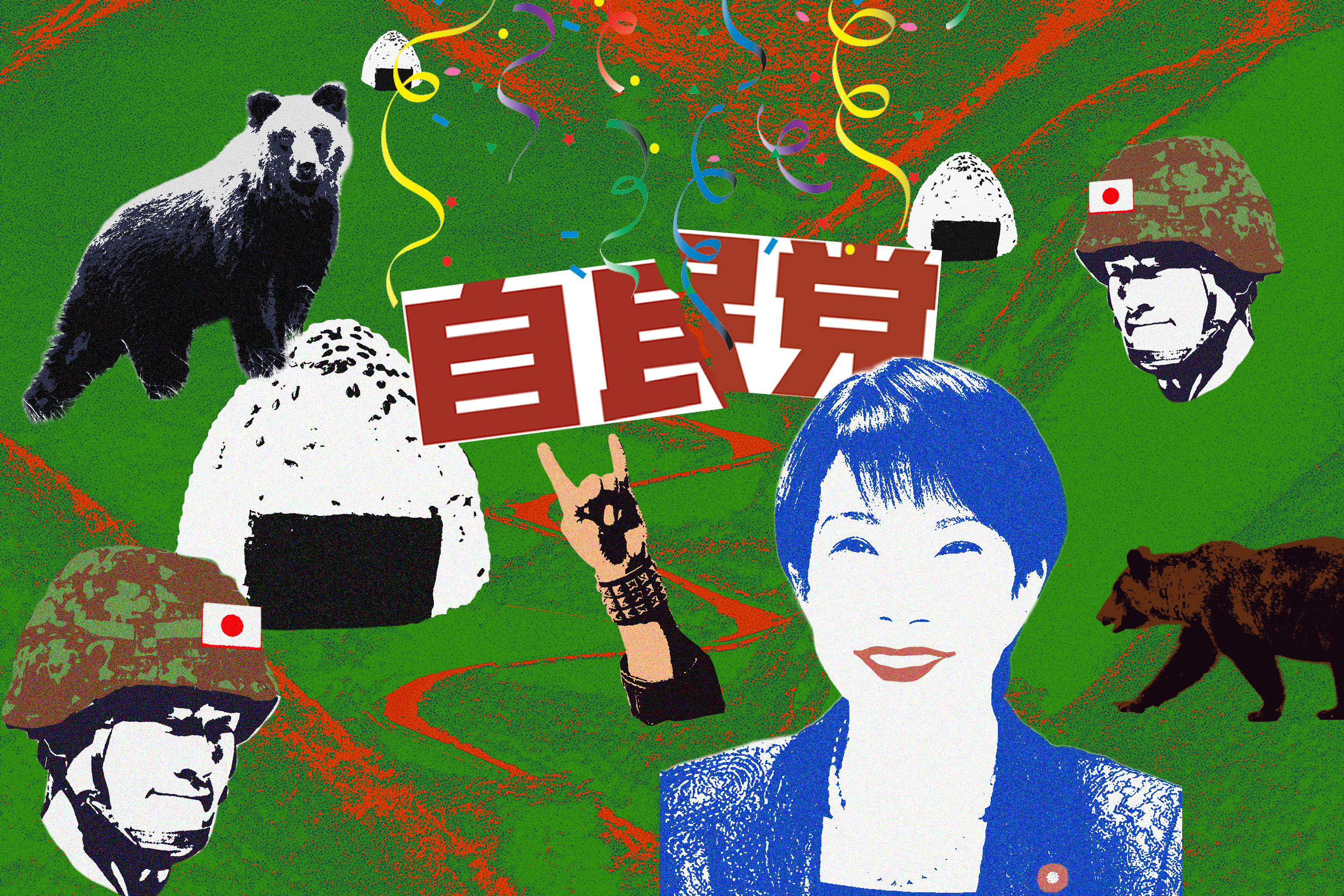
Against the grain
The rising cost of living affected tens of thousands of items on supermarket shelves, but concern bordered on panic when it came to spiralling rice prices. By the spring, the staple had doubled in price from the previous year, and consumers were angry.
The unprecedented release of stockpiled grain had little effect. By the second half of May, the average retail price of rice sold at supermarkets was an eye-watering ¥4,285 for 5 kilograms.
In the space of a few months, the “Reiwa rice crisis” became about much more than pressure on household finances. It led to the resignation of the agriculture minister, Taku Etō, who, to his wife’s horror, boasted that his household never went without rice thanks to donations from supporters. His replacement, Shinjiro Koizumi, fared better, approving the release of older – and many said inferior – stockpiled rice to create a two-tier market that at least brought some relief to cash-strapped consumers.
Supplies had already suffered amid record-breaking temperatures that affected the 2023 crop, and shrank again in 2024, partly due to demand from record numbers of tourists.
Inevitably, suppliers eventually turned to overseas markets such as South Korea, Thailand and Vietnam, as pressure mounted on the LDP weeks away from upper house elections in which the cost of living was a key issue.
The signs are that next year's crop will be better than in the past two years. But even favorable weather will struggle to conceal the structural and environmental challenges that could one day pose an existential threat to our beloved japonica.
Hear her roar
Was 2025 the year when Japan’s glass ceiling finally fractured? Although Japan is still ranked a lowly 118th out of 148 countries in the latest Gender Gap Report, its biggest labor union, largest airline, public prosecutors office and capital city are all led by women. In September, Sanae Takaichi joined this small but growing club when she became the country’s first female prime minister, propelled into office after some messy political maneuvering inside the Liberal Democratic Party. International media outlets hailed it as a historic moment for a country with precious few women in parliament, let alone in the upper echelons of government.
Takaichi seems machine-tooled to refute the idea that she represents the sisterhood. She has long been framed in the media not as a feminist but as a nationalist pitbull (her predecessor, Fumio Kishida, nicknamed her “Taliban Takaichi”). She earned her first international headlines by cheering “like a rock star” in front of U.S. military personnel aboard the USS George Washington, beside a beaming President Donald Trump. Asked about her plans to tackle Japan’s notorious work culture, she claimed to sleep just two to four hours a night, and expected other officials to get by on minimal shuteye. As if to prove her point, she ordered her bleary-eyed aides into the office for a 3am meeting.
In November, she perhaps unwittingly outflanked her hawkish mentor Shinzo Abe by dropping Japan’s strategic ambiguity on Taiwan. Going off script, Takaichi said that any attempt by China to use force against the self-governing island would likely constitute a “survival-threatening situation”, compelling Japan to respond with the deployment of its Self-Defense Forces. Abe had carefully avoided making such a statement. The reaction from China was a full-blown diplomatic tantrum, including an inflammatory online post from China’s consul general in Osaka, who said that “the dirty head that sticks itself in must be cut off.” Though there are signs that Takaichi regretted her Taiwan remarks, she made no public attempt to walk it back.
It was something of a baptism of fire for the new prime minister, although given her political record, not an unexpected one. She has been vocal about wanting to scrap Article 9, the so-called pacifist clause of Japan’s postwar constitution, and to remake the SDF into a formal army. Among her more concrete proposals was the creation of a law punishing people who damage the Japanese flag. All this suggests that in common with her heroine, Margaret Thatcher, Takaichi’s gender may be the least important thing about her as she finds her political feet as prime minister.
Oh, the humidity
It has become an annual ritual for Japan’s weather records to tumble between June and August, but this year’s summary from the meteorological agency was sobering, nonetheless. The average summer temperature was 2.36C higher than normal, making it the hottest summer since records began in 1898. An unbearable 41.8C was recorded in the city of Isesaki in Gunma Prefecture in early August – another record. The previous two hottest summers were … you guess it, in 2023 and 2024.
The humid heat, settling like a heavy wet blanket over Japanese cities for several months, had real consequences. More than 100,000 people were hospitalized with heat stroke, and dozens died. Rice prices remained high because of poor harvests. Media pundits were discussing the uncomfortable weather well into late September, when Donald Trump called the climate change issue a “hoax” and the “greatest con job ever” in a speech to the United Nations. According to the World Health Organization, there were almost half a million heat-related deaths annually around the world between 2000 and 2019.
Like most advanced countries, Japan is fiddling while the world burns, environmental scientists said. Its government launched another decarbonization initiative at November’s COP30 summit in Brazil, but it wasn’t enough for it to again avoid the Fossil of the Day award, given to countries “deemed to be backward-looking in their efforts to decarbonize. The NGO that hands out the award said it has chosen Japan “because the nation’s stance is to extend fossil fuel life, not end it”.
In The Dream of a Summer Day, Lafcadio Hearn (1850-1904) transports himself back to Japan in the eighth century. “Summer days were then as now,” he writes, “all drowsy and tender blue, with only some light pure white clouds hanging over the mirror of the sea. Then, too, the hills were the same – far blue soft shapes melting into the blue sky. And the winds were lazy.” As we drift into what looks increasingly like runaway climate change, the comforting thought comes that whatever wreckage humans do, the hills, sea and sky will still be here long after we’re gone.
The party’s over
If the lower house elections in October 2024 suggested that the LDP had drifted into choppy waters, upper house elections held less than a year later confirmed that arguably the most effective political machine in the history of liberal democracy had hit the rocks.
For the second time in the space of months, the ruling coalition, comprising the LDP and its junior partner of 25 years, Komeito, was stripped of a parliamentary majority.
A year after Shigeru Ishiba was elected LDP president – to the fury of the right of his party – the mild-mannered plastic modelling enthusiast was on his way out, the victim of rising prices and a lingering slush fund scandal, and of concerted attempts to undermine his leadership by Taro Aso and his band of vengeful MPs.
After Ishiba announced his resignation in September, the expectation was that he would be replaced by the then agriculture minister, Shinjiro Koizumi, who had done his prospects no harm with his competent handling of the rice crisis.
In the end, the right of the LDP, led by a scheming Aso, got its way when Sanae Takaichi became Japan’s first female prime minister. That achievement, though, was quickly overshadowed by Komeito’s decision to abandon the coalition in protest at the LDP’s failure to properly address the funding scandal and Takaichi’s hawkish views on China – which would land her in trouble just weeks into her premiership.
After a fortnight of horse-trading, Takaichi secured the support of Ishin no Kai, the mavericks from Osaka who largely sympathize with her political outlook, but who will be expecting something in return, not least a controversial reduction in lower house seats that will boost the minor party’s influence on national politics.
Dire straits
After barely a month in office, Takaichi found herself on the wrong side of China over – what else? – Taiwan. Responding to a parliamentary question on November 7, Takaichi said that a military attack on the island could be a “survival-threatening situation” for Japan that could trigger its own military response.
China’s reaction was predictably vitriolic. Japanese tour operators reported plummeting tourist bookings from China. Hundreds of cultural events were suspended or cancelled. China dispatched armed ships and zones to buzz disputed territories and demanded that Takaichi retract her remarks, saying she had crossed a red line.
For years, China has threatened, cajoled and squeezed Taiwan in an attempt to force it to fold without a costly war across the Taiwan Strait. Japan has mostly toed the U.S. line of “strategic ambiguity”, rarely speaking out and officially saying that the dispute can be resolved through dialogue. As China’s economic and military heft has expanded, however, the Japanese right has become less tightlipped. In 2021, the then deputy prime minister, Taro Aso, said unambiguously that Japan would have to “defend Taiwan” alongside U.S. forces if China invaded.
It doesn’t help that both Takaichi and Aso are widely criticized in the Chinese media as historical revisionists who deny or downplay Japan’s wartime crimes in China. As November drew to a close, Takaichi was just about weathering the diplomatic storm, and her domestic approval ratings were high. But time is not on her side. The Chinese boycott could result in a loss of around ¥2.2 trillion ($14.23 billion) to Japan annually, according to Nomura Research Institute, a think tank. Beijing controls the supply of many critical minerals used in Japan’s car industry. And Unlike Xi Jinping, Takaichi is accountable to voters who may eventually lose patience.
Ursine panic
As the Number 1 Shimbun went to press, Japan was reeling from bear attacks that have become as much a fixture of autumn as crimson leaves and roasted chestnuts.
Encounters between bears and humans are no longer a rarity – the result of rural depopulation and the climate crisis. A record 13 people have died in bear attacks since April – more than double the previous high – and around 200 have been injured, according to the environment ministry. About 20,000 bear sightings were reported nationwide between April and September, 7,000 more than in the same period in 2024.
Akita Prefecture has reported attacks on 60 people this year – four of which were fatal – prompting its “desperate” governor, Kenta Suzuki, to ask for help from the Self-Defense Forces. Soldiers deployed to the region are helping set traps and transport licensed hunters, but are not permitted shoot the animals themselves.
The attacks are no longer limited to mountain forests. Recent incidents have been reported in private homes and a public toilet, while bears have been spotted near schools and shops, sometimes devouring the fruit from garden persimmon trees amid poor crops of their staple diet of acorns and beech nuts.
Inevitably, mischievous social media users have exploited public fear with AI-generated video clips purporting to show bears in proximity to humans. Some of the fake clips are easy to spot, but others have fooled even local authorities.
The municipal government in Onagawa, Miyagi Prefecture, apologized in late November after it discovered that an image it had posted on social media to promote awareness of bear attacks had been AI-generated.
The image, uploaded to the X account of the Onagawa municipal government, showed a huge bear standing on a road at night. Officials deleted the post after the image’s creator, who had seen the photo spreading online, contacted them to explain that it was fake.
“We have caused anxiety and inconvenience to the town’s residents,” the Mainichi Shimbun quoted an Onagawa official as saying.
David McNeill is professor of communications and English at University of the Sacred Heart in Tokyo, and co-chair of the FCCJ’s Freedom of the Press Committee. He was previously a correspondent for the Independent, the Economist and the Chronicle of Higher Education.
Justin McCurry is Japan and Korea correspondent for the Guardian. He is the author of War On Wheels: Inside Keirin and Japan’s Cycling Subculture (Pursuit Books, June 2021), published in Japanese as Keirin: Sharin no Ue no Samurai Wārudo (Hayakawa, July 2023).
