

Issue:
December 2025
U.S. peace plan would leave Ukraine languishing like a ‘tethered goat’
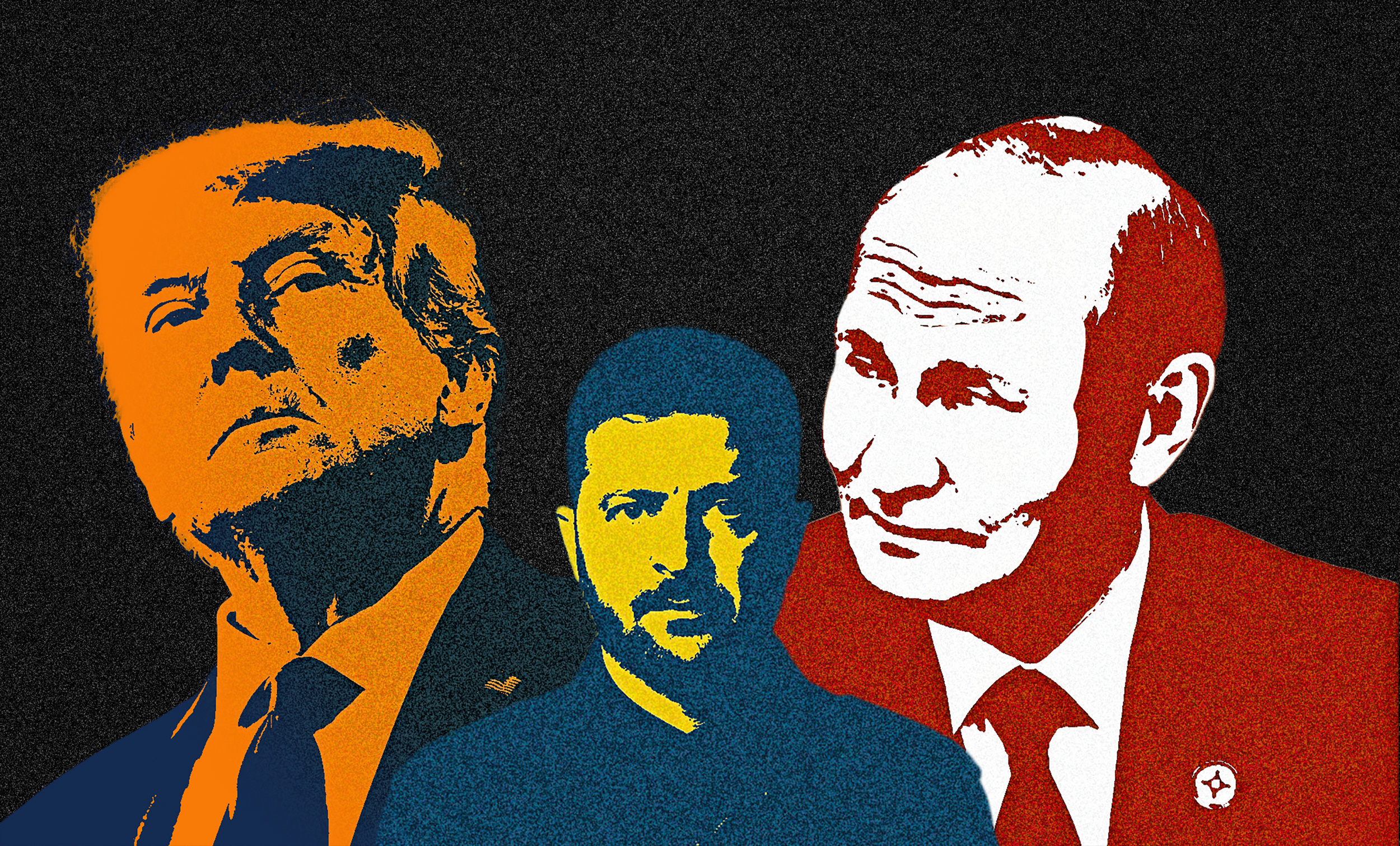
Trump diplomacy: fleecing friends, appeasing adversaries
As I write, allies of the United States are in crisis talks over Donald Trump’s 28-point peace plan for Ukraine that is so heavily slanted towards the Russian aggressor that some believe it was written by the Kremlin.
The proposals not only would let Russia keep Ukrainian territory it has invaded, but hand over additional Ukrainian land. Ukraine’s sovereignty would be further curbed by forbidding it to join NATO and capping its army at 600,000 troops, in exchange for unspecified security guarantees and an “expectation” that Russia will not invade its neighbours.
Alex Younger, a former head of Britain’s MI6, said the draft recommended by the Trump administration would “render Ukraine a tethered goat and juicy target with little chance of defending itself. We can almost guarantee that the war would restart.”
Plums would be divided between Russia and the United States.
Russia will be “re-integrated into the world economy,” invited back into a Group of Eight, and the U.S. and Russia will sign a long-term agreement on “mutually beneficial corporate opportunities.”
Frozen Russian assets, of which the U.S. controls only about $5 billion, with the great bulk sitting in the European Union, are to be used for U.S. commercial benefit. “$100bn in frozen Russian assets will be invested in U.S.-led efforts to rebuild and invest in Ukraine. The U.S. will receive 50 per cent of the profits from this venture,” the text states. Europe will “add” another $100 billion of the frozen assets for Ukraine’s reconstruction. The “remainder,” perhaps totalling almost another $100 billion, some of it held by Japan, “will be invested in a separate U.S.-Russian investment vehicle.” Orysia Lutsevich of the Chatham House foreign affairs think tank in London likened it to a “1990s-style mafia deal”.
The proposals followed meetings between a Russian envoy, who is still sanctioned by the U.S., with Trump’s real estate and golfing buddy Steve Witkoff. Trump’s son-in-law Jared Kushner also attended. Allies of the United States were not consulted.
Trump has threatened to cut-off sales of U.S. weaponry and the supply of military intelligence to Ukraine if it refuses to cooperate. Ukraine remains dependent on U.S. satellite intelligence for real-time reporting of Russia’s battlefield position, and at present, the EU cannot backfill that capability.
It is perhaps the bluntest demonstration yet of Trump’s contempt for traditional alliances and his paramount use of diplomacy to extract economic wins for the United States, often coupled with financial gains for his own family, friends and associates.
Japan and South Korea, two of the most important security partners of the United States, both recently had bitter taste of Trump’s coercive raw diplomacy. In return for reducing tariffs that he had unilaterally imposed to “only” 15%, Trump demanded, and received, agreements to funnel gigantic sums of private and public-sector investment into the United States.
Sanae Takaichi is often bracketed as an Iron Lady and Japanese nationalist, yet no sooner had she become prime minister than she capitulated before Trump. A “new golden age” of relations began with a Japanese promise to invest $550 billion in the United States. That is four times the size of a domestic stimulus package agreed in November to help spur Japan’s economy and relieve the impact of inflation. Japanese media stayed remarkably restrained throughout the national humiliation. If there was much Japanese gnashing of teeth it was inaudible.
Lee Jae Myung pandered to Trump’s vanity and love of gold, presenting him with a replica of a gold crown from the ancient Silla kingdom, but the South Korean president was acutely sensitive to national honour and dignity. Lee’s team could not budge Trump from demanding $350 billion in investment, but within that ceiling, they haggled hard for the best terms and were applauded for their effort by a watchful South Korean public.
Two important nuclear agreements were eventually added. The U.S. will provide South Korea with technology to build nuclear-powered attack submarines - which Japan lacks - and allow South Korea to enrich and reprocess nuclear fuel. The nuclear submarines are welcomed by Washington as helping deter Chinese expansion in the Yellow Sea. The subs will also lessen South Korea’s dependence on the United States. This is even more true of the concession on nuclear fuel, which makes it much easier for South Korea to assemble a nuclear weapon, as Park Chun Hee tried covertly to do in the 1970s until the Americans intervened.
According to Evan Medeiros, a former top adviser to Barack Obama on Asia-Pacific, both Japan and South Korea have no choice but to satisfy Trump’s demands. “The reality is – and we don’t like to talk about this publicly, because they are our allies and our friends – there really is no Plan B,” he told a November webinar of the Centre for Strategic and International Studies in Washington DC. “Why you are seeing such extraordinary accommodation, prostration, lighting up Tokyo Tower red, white and blue, these expansive commitments to invest in the United States … is simply because there is no Plan B,” he added.
At present, only the EU has the heft to act as a real counterweight to the Unites States and China. The EU’s latent power can be achingly slow to mobilise when consensus is needed among 27 member states but nonetheless is a model that others are keen to emulate.
South Korea is proving more eager than Japan to propose alternatives to perpetual dependency on the United States.
Chey Tae Won chairs SK Group, South Korea’s second-biggest chaebol by revenue after Samsung, as well as the Korea Chamber of Commerce and Industry. Chey advocates that South Korea and Japan form an economic bloc, like the one which evolved into the EU. In November, he proposed that the two neighbours, both heavily reliant on imported energy, “store, share and manage energy together,” and thereby “significantly reduce costs.” Another of his ideas is to allow elderly Japanese and South Koreans “use each other's medical and nursing services, greatly reducing the social burden."
Japanese have given Chey’s suggestions a polite but con-committal hearing, which is a pity. His approach is preferable to Trump’s fleecing of allies and appeasement of adversaries.
Hong Kong’s grim warning to Taiwan
Anyone interested in what awaits Taiwan after “reunification” with China has only to look at Hong Kong.
The Basic Law promised to protect Hong Kong’s way of life for 50 years after the British colony was handed back in 1997. Protected freedoms in Hong Kong were supposed to include those of assembly and freedom of speech, both denied to mainland citizens, but violent clashes in Hong Kong between pro-democracy protesters and police in 2019 gave Beijing the perfect pretext for a crackdown.
A National Security Law that criminalises any act of secession, subversion, terrorism or collusion with foreign powers has been used to stifle political dissent, and only “patriots” - in practice pro-Beijing loyalists - are allowed to run in elections for Hong Kong’s chief executive and the Legislative Council. Since the law took effect in 2020, there have been more than 300 arrests for national security offences, and at least 32 political parties, activist groups and media outlets have shut down.
A chilling BBC World Service documentary shows how political repression is supported by a culture of informers and surveillance.
Former banker Innes Tang set up a hotline for the public to inform on their fellow citizens. “We're in every corner of society, watching, to see if there is anything suspicious which could infringe on the national security law," he tells the BBC. "If we find these things, we go and report it to the police."
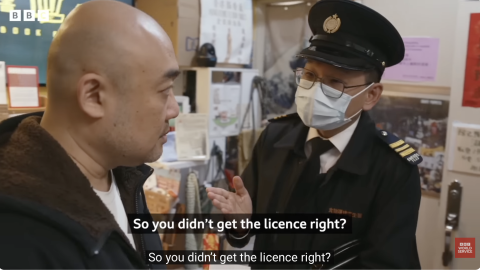
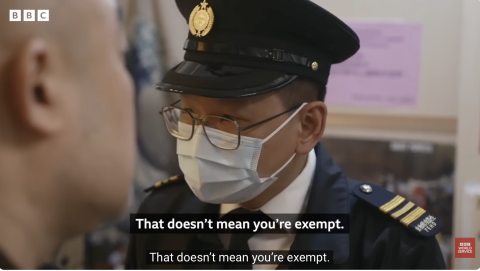
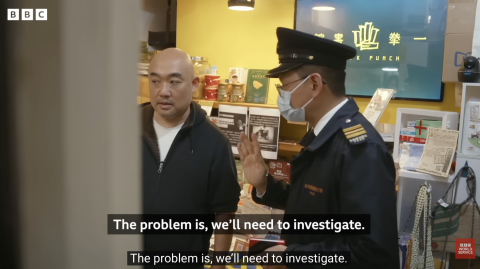
An independent bookshop in Kowloon is visited by a Hong Kong policeman during BBC filming. Book Punch is hosting a discussion about the war in Ukraine, in which China is officially neutral while maintaining warm relations with the aggressor, Russia.
“We’ve received a complaint,” the policeman tells the owner of Book Punch, Pong Yat-ming. “You didn’t receive a licence, right?” Pong replies that it is a private closed-door event, with registered participants. “That doesn’t mean you’re exempt. I need to see how the event goes.”
The policeman stays for 15 minutes before leaving, then returns two more times that evening. Pong is told he might be prosecuted for hosting a public event without an entertainment licence. Pong tells the BBC he has been inspected 10 times in 16 days by various departments of the Hong Kong government.
Pong is also accused of breaching the city’s Education Ordinance by managing an unregistered school for Spanish lessons at Book Punch and appeared before Kowloon magistrates in November.
Wen Wei Po, a state-owned pro-Beijing newspaper in Hong Kong, in May denounced a local book fair for spreading “soft resistance” by promoting books that “oppose China and disturb Hong Kong.”
Schoolchildren in Hong Kong are indoctrinated to love China. The BBC films a choir of children waving flags of the People’s Republic, and singing “My dearest Motherland, you are an ocean that will never run dry.”
More than 300,000 people have permanently left Hong Kong in the last few years.
Peter McGill was based in Japan as a journalist for 19 years and was the youngest-ever president of the FCCJ.
