


Issue:
July 2026
How a pair of Vigilante YouTubers Ended Up as the Villains
Americans love vigilante stories. Those stories about the man who puts on a badge he was never issued and goes looking for the bad guy nobody else will catch. They play differently depending on who’s telling and where the stories play out. Hollywood tells them as a triumph. The cops tell them as a headache. The prosecutor tells them, eventually, as case files. Japan, it turns out, has been running its own version of this vigilante story for the last several years on YouTube, in real time, with ad revenue encouraging people to wear a badge — and the ending has been bad every time the cameras kept rolling long enough.
Start with a premise that was not - in itself - insane. Japanese law allows what’s called shijin taiho — citizen’s arrest — under a narrow provision of the criminal code covering the genkohan, the offender caught in the act. The logic is old and sound: if a crime is happening in front of you and no officer is within shouting distance, you are permitted to lay hands on the person and hold them until one arrives. It is meant for the subway platform at rush hour, the grab in the dark alley, when waiting for due process is a luxury the time and situation don’t allow. It was never meant to be a business model.
But somewhere around the back half of 2023, a cohort of young men in Japan figured out that the law’s narrow exception could be turned into a wide and profitable channel strategy. They called themselves shijin-taiho-kei (“citizen's-arrest type”) or sometimes yonaoshi-kei, “world-fixing type.”
The pitch was simple and, to a certain hungry audience, irresistible: catch the molester on the train, catch the upskirt photographer at the station, catch the poacher pulling abalone off rocks that don’t belong to him. Then on film, you slap him around verbally, march him to the koban (police box), post the video, and watch the numbers climb. One of the earliest and biggest of them, a young man going by the moniker Shinjuku 109 KENZO, built his following hunting multi-level-marketing grifters and ticket scalpers. Inside of four months, his subscriber count supposedly went from 56,000 to 200,000, and the money followed the audience the way money always does. But KENZO didn’t perform citizens arrests. He stopped at confrontation.
This is where the story stops being about justice and starts being about arithmetic. A man named Sugita Kazuaki, who performed under the name Rengoku Koroaki and built a channel around chasing after ticket scalpers and men soliciting prostitutes in Kabukicho, was pulling in up to two million yen a month (about $12,640) for the work of confrontation and editing. When YouTube finally pulled his channel down over a defamation allegation, he didn’t go quiet about the loss of income. He posted to social media demanding someone give him back his “passive income,” which is a strange thing to call money earned by cornering strangers on camera, but accurately describes how he'd come to think of it.
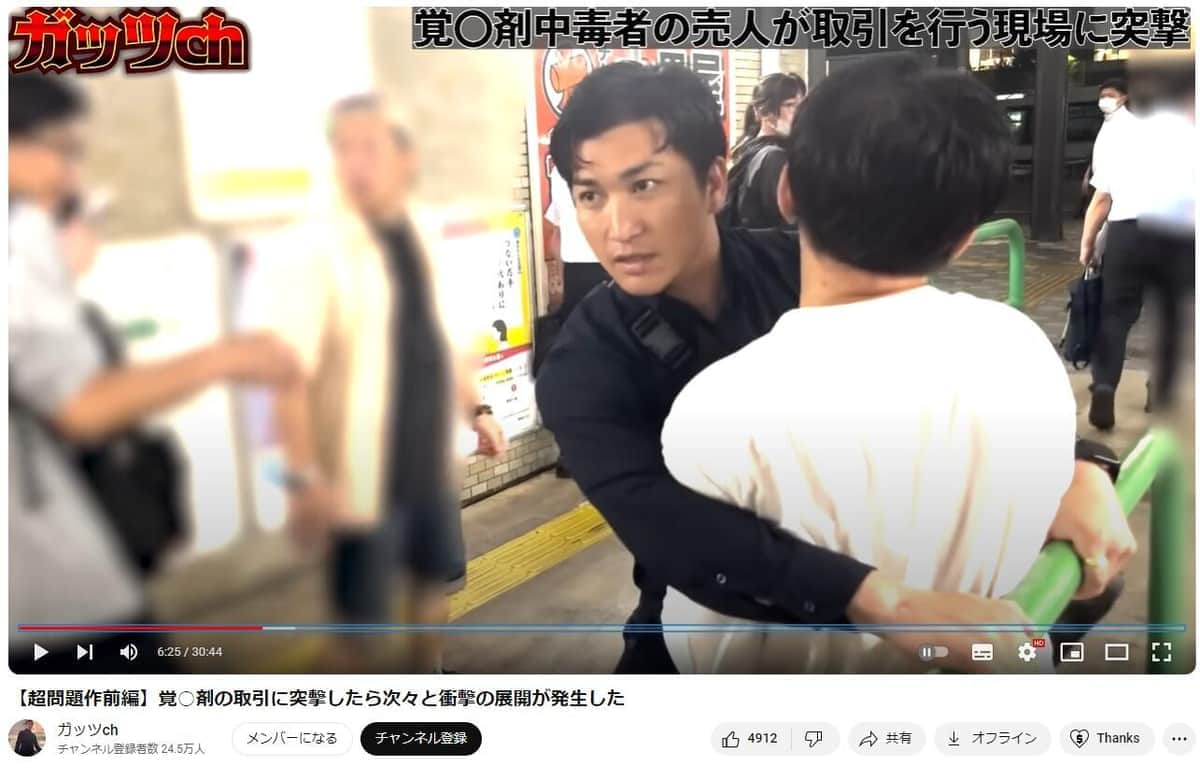
But the most infamous of the YouTube vigilantes is Konno Ren, who performed as Nakajima Ren. Konno had once been associated with an organized crime group in Kyushu but had changed his ways. He ran a channel called Guts ch, alongside his cameraman and partner Okumura Michitake. His case is the one that finally went to court and therefore the one we know best, because court records don’t lie the way a YouTube description box does.

Guts ch launched in January 2023, selling itself as an anti-groping, anti-voyeurism patrol. By September, it had 228,000 subscribers and, in a single five-month stretch, earned roughly sixty thousand dollars in revenue. Konno when interviewed certainly sounded like a man who believed his own copy. He told a television reporter that his single goal was the eradication of crime, that he was scrupulous about avoiding false accusations, and that when he laid hands on a man for groping or filming, he did so with total confidence.
Their downfall began when they decided to escalate and expand their business model to go after drug users. Whether shabu-using malcontents are really the worst people in society depends on your opinions about drug laws or your libertarian views.
Konno and Okumura went looking on social media for a man who’d posted about wanting methamphetamine (shabu--in Japanese slang. Because meth makes you thirsty, you tend to suck on candies or drink soda which is ‘shaburu’ in Japanese. Or it’s a reference to the fact that the drug will suck everything out of you).
After searching for junkies long enough, they found one, and had Konno pose online as a woman named “Yu” who wanted to use the drug during sex.
Why shabu and sex? Supposedly, and according to Japanese urban legends, meth makes sex better. They talked their mark into believing it, fed him enough insider slang about the drug to seem credible, and got him to go out and actually acquire 0.925 grams he hadn’t previously possessed—purely so he’d be holding it when he showed up to meet “Yu” on a Shinjuku street.
When the target arrived, Konno had already phoned the police. The arrest itself, captured on fourteen minutes of video so graphic the courtroom played it on a monitor turned away from the gallery, showed Konno and Okumura more interested in directing the responding officers—"do the search first,” they kept insisting—than answering the questions those officers were asking about what, exactly, they’d just walked into.
But guess what? Inciting people to buy drugs is itself a crime. Technically speaking, it constitutes kakuseizai torishimari-hō ihan (shoji no kyōsa), or “violation of the Stimulants Control Act (incitement to possession).” So, while the underlying offense was methamphetamine possession, Konno and Okumura weren’t charged with possessing it themselves—they were charged with inciting the sucker to possess it by tricking him into believing he needed to bring it to a meeting with “Yu.” That’s the inciting element: they didn't touch the drug, but they engineered the situation that caused someone else to break the law.
A Tokyo court convicted both men of inciting drug possession in February. For violating the Stimulants Control Act, Konno was sentenced to 1 year and 4 months imprisonment, suspended for three years. His accomplice and camera operator, Okumura Michitake, 29, received 10 months’ imprisonment, suspended for three years.
A month later, before the ink on that judgment had any chance to dry, Tokyo’s organized-crime unit arrested Konno (AKA Nakajima) again. This time, it was for tsutsumotase—the classic badger game. Konno and company, which allegedly included yakuza members, opened a fake massage-parlor operation where customers were made to sign waivers promising 1,000,000-yen fines for touching the scantily clad female staff. The staff would actively encourage the customers to touch them, and the victims were then strong-armed into paying when an accomplice burst into the room claiming they’d broken the rules.
Police say that scheme, which was run before Guts ch ever existed and which Konno had apparently never fully retired from, had scammed something like 80 million yen—over half a million dollars —from roughly 240 victims. According to media reports, Konno had been pinched for similar crimes once before but walked. He’d reportedly told his partners in the new round not to worry, that getting arrested didn’t mean you’d actually get charged.
Thus, Konno had been making a living entrapping people before launching his channel. He knew exactly how much room there is in the system between getting arrested and getting convicted. He built a YouTube career on the opposite premise—total certainty about other people’s guilt. He never said a word about what he knew regarding his own. And there's a possibility that he framed some of the chikan (gropers) on his channel.
However, his partner and cameraman, Okumura, 30, really believed he was one of the good guys. He now expresses remorse. We spoke at length on the streets of Kabukicho on June 15th.
“We were catching sleazy photographers, chikan, and bad guys,” Okumura told me. “But now that I look back on it, going after drug dealers—or rather, drug users—maybe that was a bridge too far. I didn’t think that the ‘incitement to possess drugs’ charge would be proven in court. Nor did my lawyer, but we were both wrong.”
Okumura went from having a quarter of a million followers and a lavish lifestyle to being banned from YouTube for life. He lost his income, his apartment, and spent a few months living homeless among the runaways and outcasts that make up Kabukicho's “Toyoko” kids. His hair is longer purplish pink. Today, he has a regular job in housing reform. On the weekends, he buys bags of onigiri (rice balls) and distributes them to the kids who are still homeless, trying to atone for the mistakes of his past.
As for his partner, Konno?
“He really made us go from vigilantes to villains,” Okumura said. “I’m pretty sure his suspended sentence is no longer suspended, and he’s serving time.”
What was the lesson learned?
“If you're seeking justice, you'd probably better be sure you're not breaking the law. There’s a thin line between vigilante and villain sometimes.”
Jake Adelstein has been an investigative journalist in Japan since 1993. He co-hosted and co-wrote the award-winning podcast about missing people in Japan, The Evaporated: Gone With The Gods. He is the author of Tokyo Vice: An American Reporter on the Police Beat in Japan (Vintage) which is a series on (HBO) Max and also The Last Yakuza: Life and Death In The Japanese Underworld (2023) and Tokyo Noir (2024).
