


Issue:
July 2026 | Japan Media Review
Japan's food self-sufficiency rate is around 9 percent, not the 37 percent normally cited, say experts, a problem highlighted in the media by America’s war with Iran
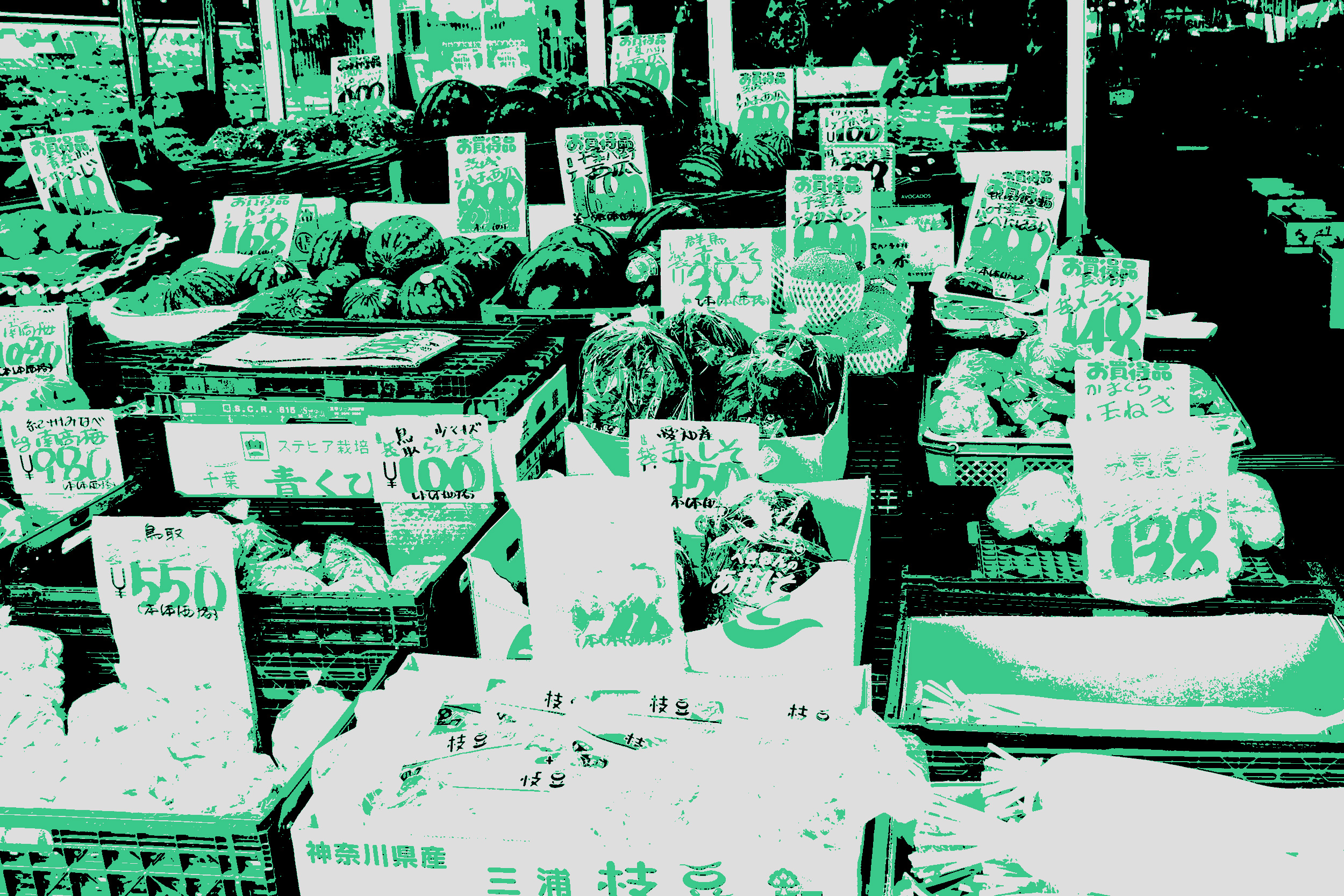
A country's food self-sufficiency rate is the percentage of food the country consumes that is produced in the country itself. Japan's official food self-sufficiency rate at the moment is listed as 37 percent based on calories consumed, which is the lowest rate among so-called developed countries. However, food self-sufficiency relies on factors other than the food that is available. Self-sufficiency also depends on needed production materials, much of which Japan has to import, such as seeds for crops other than rice. When this statistic and others, such as imported fertilizers and livestock feed, are factored into the equation, Japan's self-sufficiency rate drops considerably.
This has been the situation in Japan for many years, but the recent war with Iran and the resulting shipping bottleneck in the Strait of Hormuz has refocused media attention. The March 4 online edition of the economic magazine President ponders a worst case scenario wherein all imports to Japan having to do with food and food production are cut off.
President says that the agricultural ministry has already made a plan for such a scenario. Though Japan is supposedly self-sufficient in terms of rice, there would probably not be enough to maintain the minimum caloric standard for survival, so the ministry would change the staple food from rice to sweet potatoes, as it did during World War II when food was scarce. In 2023 the ministry came up with a menu that would allow sufficient calories if imports were cut off. For breakfast, they would recommend half a slice of white bread, two grilled sweet potatoes, a bowl of green salad, and one-fifth of an apple. Lunch: two sweet potatoes, two regular potatoes, stir fry vegetables. Dinner: one bowl of white rice, two sweet potatoes, pickles, a slice of grilled fish. In addition: 1 glass of milk every 4 days; 1 egg every 45 days; a serving of meat every 23 days.
Nobuhiro Suzuki, an honorary professor of agricultural economics at the University of Tokyo who was interviewed for the President article, went into more detail in May on the video website Seikei Platform, which explains current political and economic affairs in Japan. In describing the effects of the Iran war on Japanese agriculture he started with Japan's notoriously low energy self-sufficiency rate, which is only 11 percent. Heavy oil, he says, is essential to the running of Japanese farms, especially those that rely on greenhouses. Thirty percent of greenhouse production costs go to energy that's petroleum based. The higher energy costs due to the Middle East conflict alone are enough to bankrupt many farmers in Japan, but even if they manage to survive, the farm sector is aging even faster than other economic sectors, so any prolonged conflict that keeps energy prices high would hasten these farmers' retirement, and there is no one to take their place.
More significantly, all fertilizer used in Japan is imported, and without proper fertilizer, Japan's agricultural output would be halved, thus reducing the nominal self-sufficiency rate to 20 percent. In addition, 90 percent of seeds and seed vegetables used in Japan are imported. The problem as Suzuki sees it is that the government does not factor energy, fertilizer, and seed costs into food production calculations, and so the 37 percent self-sufficiency rate is just not viable. He estimates it to be around 9 percent.
So far, the government has tried to assure the public that there is no problem because the resources Japan needs from the Middle East can be sourced anew from Southeast Asia. But that means competition for these resources will also shift to Southeast Asia, thus driving up prices even further. One month after the war started, the world price for fertilizer, 40 percent of which is manufactured in the Middle East, rose by 50 percent. This is not the first time that fertilizer prices were driven higher by a conflict. After Russia invaded Ukraine in 2022, it cut off its supply of natural gas to many countries, and natural gas is the essential nitrogen source for fertilizer.
Farmers also rely on the production of packaging, like cardboard boxes, and lots of vinyl for greenhouses. When the price of oil goes up, so does the cost of these materials, and transporting them.
The government could subsidize the agricultural sector to help allay these costs, but according to Suzuki the finance ministry, still stung by sharp rice price increases two years ago, believes the agriculture budget is too high and must be further reduced so that Japan can pay for security. It has pledged to buy ¥100 trillion worth of weapons from the U.S. The ministry's solution is to demand that rice farmers, who they think receive too much in subsidies, reduce waste and change to other crops, like soybeans. The government is also encouraging farmers to consolidate in order to create larger farms, which is difficult in Japan because of its mountainous topography and land ownership situation.
Following World War II, the occupying U.S. military broke up the large farms and granted small plots to tenant farmers, land these farmers are loath to give up. Rice became the crop of choice for these farmers, meaning that most other crops had to be imported. Once Japan became a manufacturing powerhouse by the late 1970s, it was forced to import more from the West for trade purposes, mainly the U.S. At first it was wheat, but now the U.S. is insisting that Japan import more rice. And when President Donald Trump set tariffs on Japanese imports at 25 percent at the start of his second term, the Japanese government indicated it would do anything to lower the rate. The only thing they have to negotiate with is rice, because all other agricultural products are covered. Presently, Japan imports 610,000 tons of rice a year from the U.S., the equivalent of 10 percent of Japanese rice production—Niigata alone produces 590,000 tons a year.
The tariff has since been lowered to 15 percent, but the U.S. keeps rice as a future bargaining chip, thus placing Japanese rice farmers in a bind. The price of rice is now dropping as production costs skyrocket. The foreign ministry tells farmers that they have to change their way of operating—improve efficiency, expand scale—without helping them do so.
The government stockpile of emergency rice is currently only 15 days' worth. Suzuki says that if the predicted "emergency action" between China and Taiwan happens, thus pulling Japan into the conflict, Japan could be starved because it would be cut off from Chinese agricultural products. China itself has 1.5 years of rice stockpiled, not to mention crops from all over the world that it has bought and stored for years. Now that the price of rice in Japan is finally going down, the government is asking farmers to grow less even as stockpiles decrease, since the rice that Japan imports is going straight onto the market.
According to Suzuki, the government must mandate that private companies, which are in charge of stockpiling foodstuffs, including rice, increase their input no matter what. The government must also allow farmers to independently decide production volume by removing subsidies and restrictions. In addition, the distribution of rice must be liberalized so that stockpiled rice can easily be released onto the market in the case of an emergency. As long as Japan has to rely on imported food, it should import as much as possible, like China, and keep non-perishable foods in storage.
Suzuki predicts that at the current rate, some farming areas in Japan will completely vanish, so the only solution is to allow farmers to grow as much food as they are capable of growing, which will keep prices low for consumers and help add to stockpiles. The government should decide on a tolerable price for consumers that will also provide profits for farmers, and spend government funds to maintain that balance. Suzuki calculates that ¥2,500 for 5 kg of rice is a reasonable retail price while ¥3,300 is reasonable for farmers. The government should cover the difference, which it can do as long as it maintains the 8 percent consumption tax for food.
What people need to understand is that a country's food self-sufficiency rate is an integral part of its national security policy. The government is now pledged to spend up to 3 percent of its GDP on weapons, but if a party in a conflict cuts off shipping to Japan, as the U.S. and its allies did in World War II, all the weapons in the world wouldn't be able to feed the Japanese people considering how reliant Japan is on imports.
Another important consideration is Japan's immigration policy. Right now, some 50,000 foreign nationals work in the agricultural sector. The media is not interested in these workers as subjects for coverage unless they cause trouble or are being exploited, and so they tend to become the objects of resentment fueled by nationalists. According to a Mainichi Shimbun feature published last December, "unauthorized" foreign workers, meaning those who do not have work visas, have become essential to Japanese agriculture since the 1980s. Though farms try to hire Japanese workers first, they don't pay enough to compete with other employers.
Japan has had a technical training program in effect since 1993 that allows foreign workers to enter Japan to work in agriculture, but there are many requirements and restrictions, so farmers tend to hire unauthorized foreigners when they need workers in an emergency. Without them, these farmers say they couldn't survive. Nihon Keizai Shimbun reported last year that many foreigners help to sustain Japanese agriculture by running their own farms. The amount of farmland these foreigners owned in 2024 was almost double the amount they owned in 2023. Mostly they provide ingredients for compatriots who live in Japan and need them for their own businesses, like restaurants and specialty grocery stores, but it's not difficult to imagine that these people, who clearly want to remain in Japan and raise families, could be the future of Japanese agriculture since not enough young Japanese people are willing to replace all the Japanese farmers who will retire soon.
As it stands, more and more farmland is being lost to overgrowth and neglect every year. According to the agriculture ministry, 257,000 hectares of once fertile farmland lies unused in Japan, an area that in terms of overall land usage isn't that much. But every year this amount increases, and the cost of renovating such land for farming purposes also increases. That doesn't even cover the amount of farmland that is rezoned every year for other purposes, including residences. It used to be very difficult to rezone farmland, but now it is relatively easy.
The point that Suzuki and others are trying to make is that Japan, which was a predominantly agricultural country not that long ago, has moved away from farming without carefully considering that, as a mountainous archipelago with a large population, it is giving up much of its independence and autonomy by relying on foreign countries for its food. In an ideal world without conflict this wouldn't be a problem, but the war in the Middle East has shown that it will always be an issue.
Philip Brasor is a Tokyo-based writer who covers entertainment, the Japanese media, and money issues. He writes the Japan Media Watch column for the Number 1 Shimbun.
Sources
https://www.japantimes.co.jp/news/2026/06/15/japan/society/fertilizer-iran-war/?
