


Issue:
March 2026
Japan’s boom in all things feline is an opportunity to learn from these most Zen-like of animals
“I have lived with several Zen masters - all of them cats.”
– Eckhart Tolle
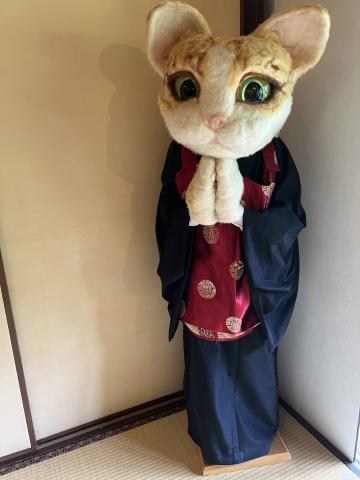
A cat monk at the Nyan Nayan-ji Temple, just outside Kyoto. 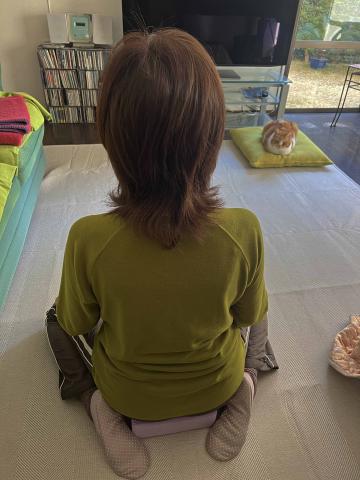
Experts at the practice themselves, cats are fine meditation partners. 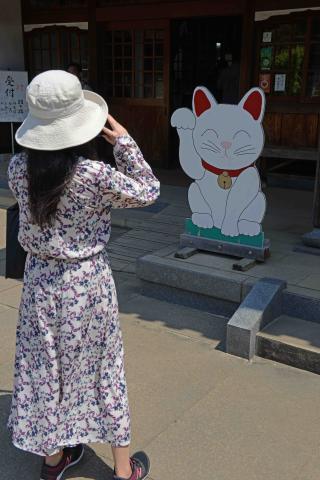
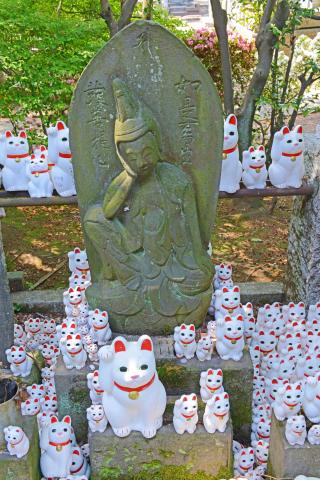
Visitor to Gotoku-ji, a Tokyo temple with strong cat associations.
The over-application of the term Zen to describe everything from interior designs, gardens, supposedly Zen inspired restaurant menus poured over by celebrities and fashionistas, even expressions like “a Zen moment,” can be tiresome. With a huge feline boom in Japan, a look at the connection between the supposed affinity between cats and Zen seems timely.
Cats are believed to have been introduced into Japan during the Nara period (710-794) via Kentoshi, Japanese envoys returning from Tang China. One cat of note was a black creature brought back from China in the eighth century by the priest Ganjin, the feline respectfully installed in a repository at Todaiji temple in Nara. It was a simple connection to make between employing cats to protect sutras and other precious scriptures from rodents, to seeing black cats in particular, as auspicious animals capable of offering spiritual protection.
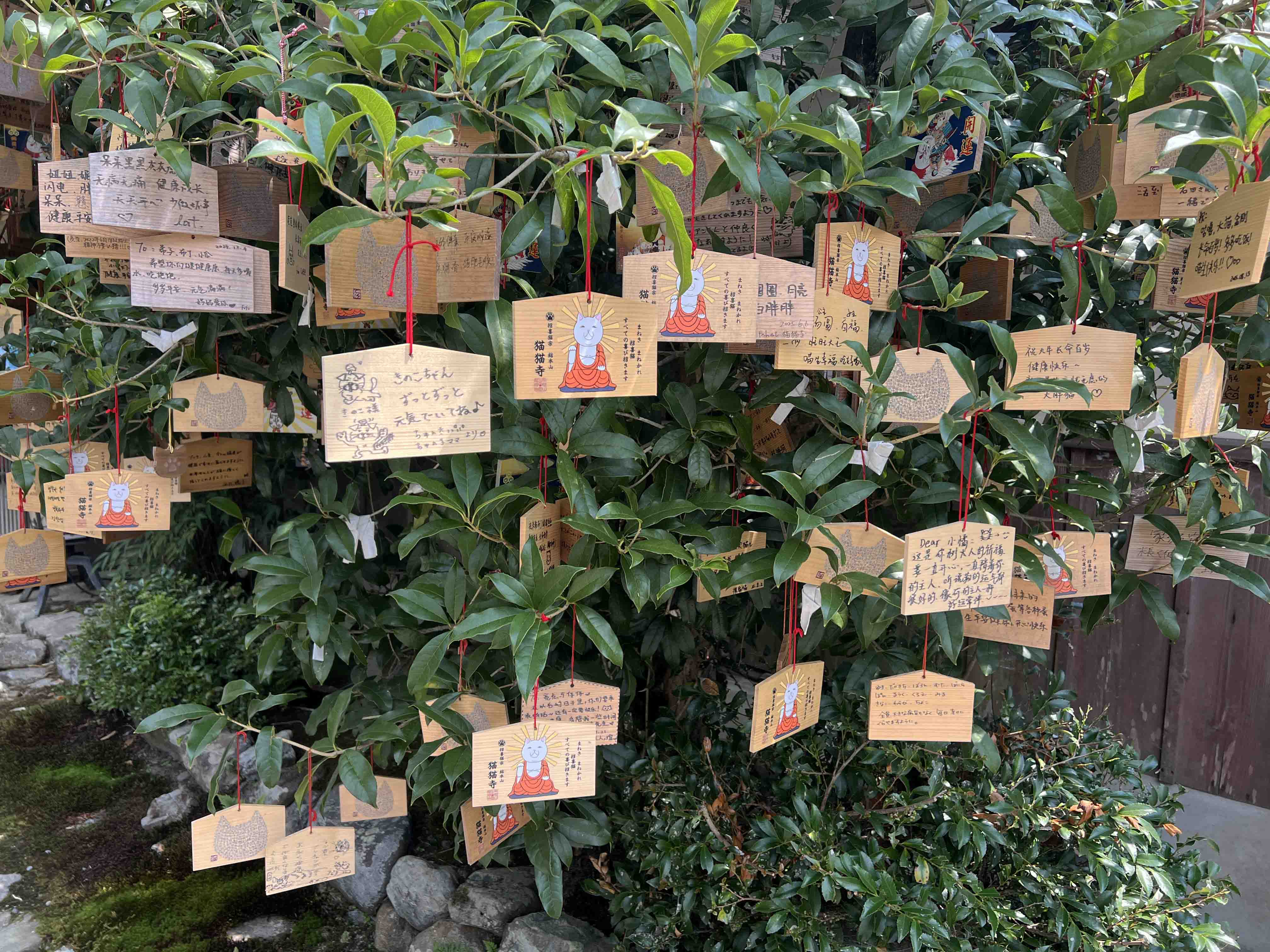
Housed at shrines, cats became objects of worship. Neko omamori (cat talismans), symbols of good fortune, were also sold at temples. Some religious establishments continue to do a brisk trade in charms, wood carvings of felines, and cat themed votive pictures. The link between cats, Buddhist temples, good fortune, and even the dark forces of the supernatural underworld, does not necessarily presume a link to Zen, but there are parallels between the principles and aspirations of the Zen practitioner and cat behavior. A significant difference, however, is that Zen followers can spend a lifetime striving to attain its ideals, while cats seem naturally endowed with them. Cats don’t struggle, for example, to achieve seijaku, a Japanese word referring to the profound stillness and silence in nature and the mind, one of the goals of Zen. It’s an innate state.
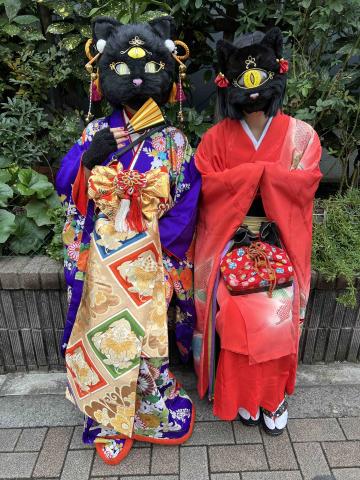
Participants at the Bakaneko Matsuri, a festival in Tokyo’s Kagurazaka district. 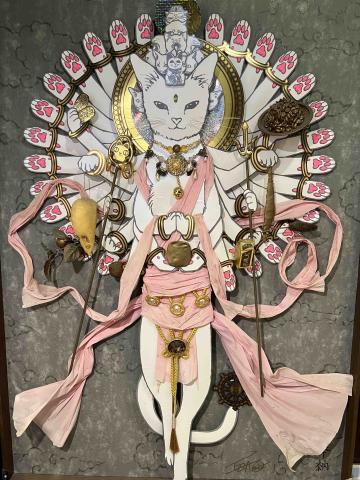
A striking ornamented painting of a kittenish Kannon, the Goddess of Mercy. 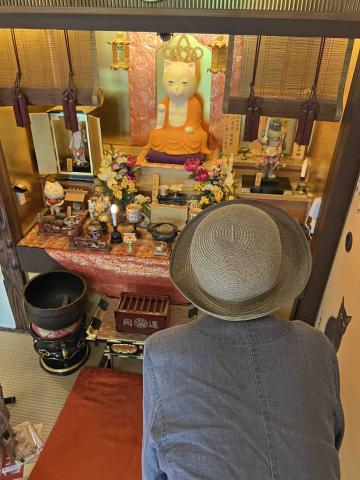
A supplicant praying before a cat altar in the Nyan Nyan-ji temple.
Cats teach us how to live in the present, how to slow down. Although their moods can change at lightning speed, cats are, when they choose, masters of inactivity, embodying the Taoist idea of wu-wei, translated as effortless action. Living in the eternal present, cats do not experience time in the same way that we do. In their company we learn to decompress, to decelerate. To tear ourselves away from our computer screens and look outside the window.
It might be a stretch, but a cat’s mindful inertia has often been compared to the state we experience when practicing transcendental meditation. If it’s simply a question of being in the here and now, then cats exemplify this much sought-after state. They certainly have the perfect posture for za-zen, or seated meditation. Acutely mindful of their surroundings, you won’t find a calmer or more composed animal.
Cats don’t live for the moment; they live in the moment. Dwelling neither in the past or future, their minds are likely a lot less cluttered than ours. I sometimes wonder, as a cat owner - some people prefer the word guardian – if their habit of pushing things off shelves is less play, more tidying up? Cats are highly mindful of their surroundings. They may appear calm, even zonked out by sleep - the average cat will sleep for sixteen hours a day – but a part of their mind is always on full alert. Witness the way an apparently snoozing cat will spring into action if it hears the sound of a bird, scuttling mouse, or movement of a gecko as its padded feet cross the wall.
We can no longer understand the interior life of a cat than we can grasp another person’s scrupulously concealed thoughts. We do know that their senses are sharper, their attention easily distracted, their minds never clouded or addled by fantasies. Their detachment from the self, or at least of a self-image, their single mindedness, suggests their experiences are more intense than ours. The Zen condition of “no-mind” may correlate with a cat’s state of selflessness.
Cats are good at letting go of things, at attaining a Zen-like state of detachment, something we struggle to achieve for any significant duration of time. Without a strong desire for a large number of possessions, cats may be the ultimate minimalists. Content with the hand they are dealt, the anxiety and disquiet that characterize the human condition is largely unknown to cats, except those threatened or suffering deprivation. The extinction of the ego, an exalted goal of Zen, hardly applies to cats, who embody the oxymoron of being egoists, that is, self-centered creatures, without exhibiting vanity, without, in fact, possessing anything akin to an ego. Cats do not yearn or pine for a life they might have had, opting to live fully and appreciatively in the one given them. Surely there is a lesson there for us.
Matching a cat’s rapid reflexes, limber physiques and piercing eyesight is their mental acuity, an ability to focus and balance the senses. It’s little wonder yoga practitioners often feel a filiation with cats. As the philosopher, John Gray put it, “Instead of being a sign of their inferiority, the lack of abstract thinking among cats is a mark of their freedom of mind.” Sitting perfectly erect, motionless, but fully alert, cats can achieve a state of being and poise the Zen devotee spends years trying to attain. Cats are often viewed as smug and self-satisfied. Self-possessed, comfortable with themselves, this might better be understood as a natural form of mindfulness. Cats do not have a strong image of themselves, one that they endlessly analyze and obsess over as we do. Driven by self-preservation and the pursuit of wellbeing in the present, an absence of ego is replaced by a concern to stay in good shape, to maintain a healthy physique, to eat and sleep regularly.
Intelligent, alert, for the most part silent, cats exude an aura of wisdom, which may be imagined, a case of wish fulfillment on our part, but I’m convinced cats have a rich inner life, perhaps even a spiritual one. More introspective than dogs and other pets, it makes them more difficult to read. Cats don’t have thought bubbles pasted next to them, so we have to use our imagination, be extra sensitive, to intuit what they are thinking. I don’t subscribe to the idea of a cat being an enigma wrapped inside an enigma, but there are tantalizing riddles to them. However much we think we know our cats, these mysteries remain. We know, for example, that domestic cats who are free to roam as they please, like to climb to the top of hills and watch the sunrise. How do you begin to explain that?
Zen has not, despite the efforts of early disseminators, writers and analysts, such as Shunryu Suzuki, Ruth Fuller Sasaki, and Alan Watts, been widely understood either outside or within Japan. Comprehending Zen, even achieving a small purchase on its steep rock face, can feel overwhelming, like trying to name every plant, flower and tree on the planet, a work of improbable scale, beyond the scope of a single life. Perhaps that is why Buddhism offers the hope of an infinite number of existences, a cat’s proverbial nine lives or more.
Part of being human, is enduring a state of torment, agonizing over our very existence. Having appointed ourselves supreme among all living creatures, keepers of the high moral ground of an ethical system of our own devising, we subject ourselves to impossibly high, often ambivalent standards, adversely comparing ourselves with other people, a behavioral flaw that, ultimately, makes us unhappy. To quote again from British philosopher John Gray, “While cats have nothing to learn from us, we can learn from them how to lighten the load that comes with being human.” If Man is a creature that has fallen from grace, cats, in their original innocence, are nothing short of saints. Or, you might say, Bodhisattvas, pending, or future Buddhas.
Being in the company of cats gives us a deep sense of calm and quietude, their presence creating a stillness in the air currents, not dissimilar to the state of comity Zen practitioners aspire to. The words of an anonymous ninth-century Irish monk still resonate:
Alone together, scholar and cat
Each has his own work to do daily.
For you it is hunting, for me study.
Fully engaged in their own pursuits, neither cat nor scholar hinders the other.
Working on this article at my desk in our book lined study, with its earth colored walls and dark red, cherry wood floor, our eight-year old apricot colored cat, adopted from a shelter, is curled up beside the window in a mellow pool of early spring sunlight. In this fleeting state of companionable silence, we are both, you might say, contentedly living in the moment.
Stephen Mansfield is a Japan-based writer and photographer whose work has appeared in more than 60 magazines, newspapers and journals worldwide. He is the author of 20 books.
