


Issue:
March 2026
Could the Aum Supreme Truth’s deadly attack on the Tokyo subway have been averted?
March 20 will mark the 31st anniversary of the nerve gas attack on Tokyo's subway system by members of the AUM Supreme Truth doomsday cult.
Around 9 a.m. on March 20, 1995, I was working at home when my phone rang. The caller was Bill Marsh, deputy editor of Intersect Japan magazine.
"Hey, Mark," he said dryly. "You, ah, might want to turn on your TV. There’s something happening on the subway downtown."
With a few jabs of the remote control, I scanned the channels from NHK to NTV, TBS, Fuji, ANN, and Channel 12. Coverage was total, which meant something very big was happening.
The streets of central Tokyo were flooded with police and emergency vehicles, as excited announcers reported the details in real time. Around 8:30 that morning, commuters on the Hibiya, Marunouchi and Chiyoda subway lines had been felled by an unknown substance. All three lines converged on Kasumigaseki, location of most government ministries and the National Police Agency. The substance appeared highly toxic and the number of victims continued to climb.
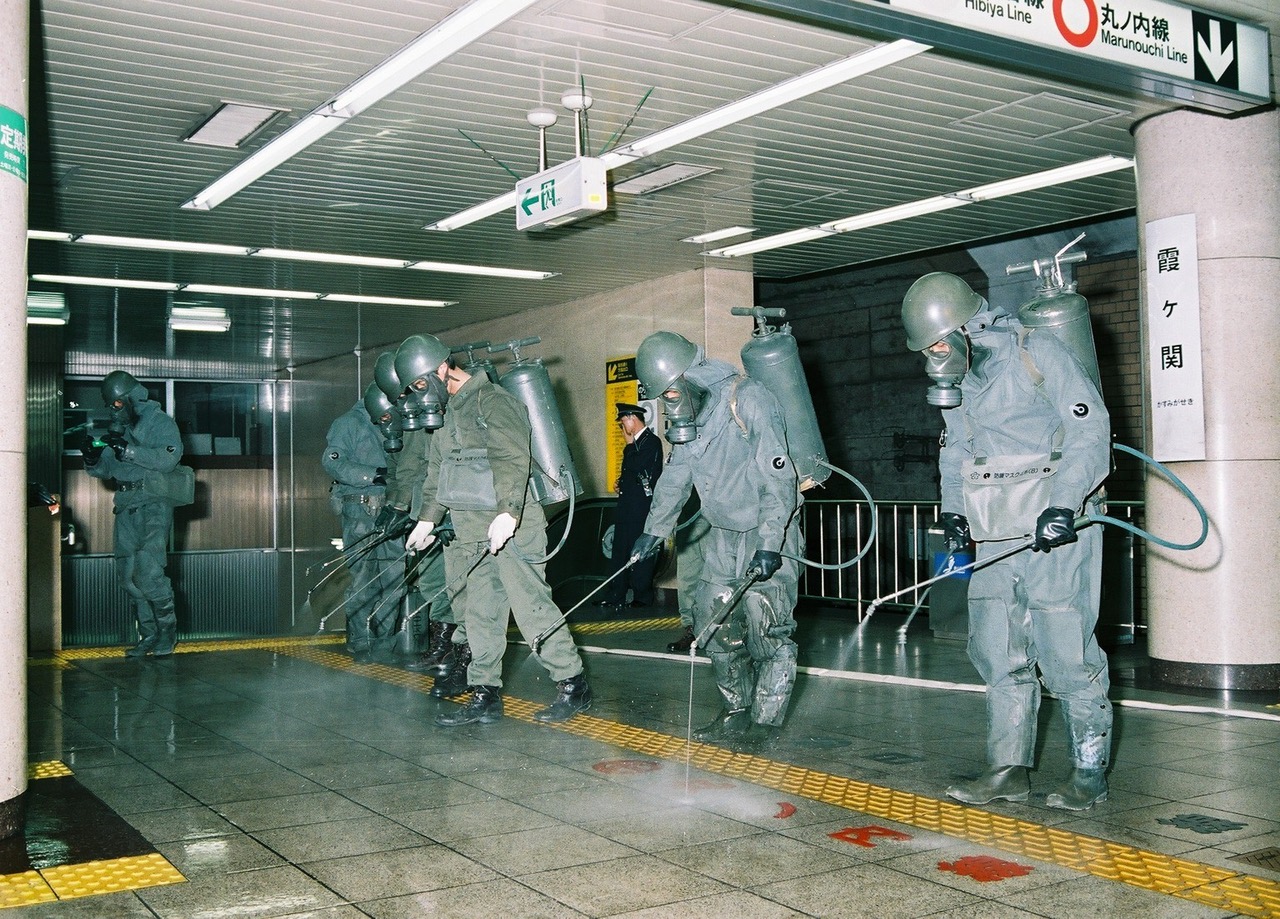
The first thing that entered my mind was "It's got to be AUM."
For reasons I will explain, I had already been collecting data about the cult from the beginning of the year.
The late Ernie Salomon, a longtime FCCJ member and president of the Jewish Community of Japan, had been born in Berlin. A Holocaust survivor, Ernie was deeply disturbed over the proliferation of Jewish conspiracy books and other antisemitic publications that had become so ubiquitous that major bookstores had set up "Jewish corners", where 20 or more titles could be seen on display. From the previous September, at Ernie's urging, I had agreed to monitor and translate excerpts from books and other materials suspected of being offensive or defamatory.
A diplomat at the Israeli embassy agreed that the problem was serious and proposed we share information. On January 6, a Friday, I was invited to Kojimachi to meet with the embassy's press officer.
"Schreiber-san, have you seen this?" he asked, holding up a magazine titled Vajrayana Sacca No 6. It was the latest issue of a monthly tract circulated by a religious group named AUM (pronounced "ohm") Shinrikyo, aka AUM Supreme Truth.
I had heard of AUM but my knowledge was rather tenuous. While shopping at Tokyo's electronics wholesale district Akihabara, I had often seen young AUM members soliciting pedestrians on the street, not to proselytize, but to pitch sales of homemade PCs at below-market prices.
But AUM's latest tract was seriously disturbing. Titled Manual of Fear, it devoted some 95 pages to attacking Jews, from the prophet Moses to Anne Frank. It began with a "declaration of war" on the Jewish enemy: "On behalf of the earth’s 5.5 billion people, Vajrayana Sacca hereby formally declares war on the 'world shadow government' that murders untold numbers of people and, while hiding behind sonorous phrases and high-sounding principles, plans to brainwash and control the rest. Japanese, awake! The enemy's plot has long since torn our lives to shreds."
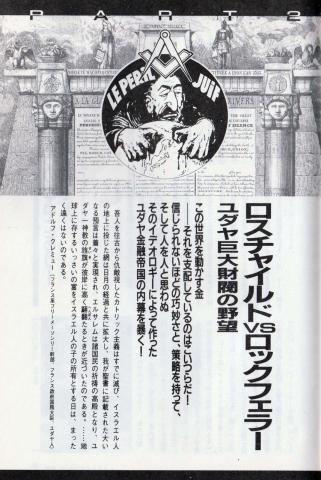
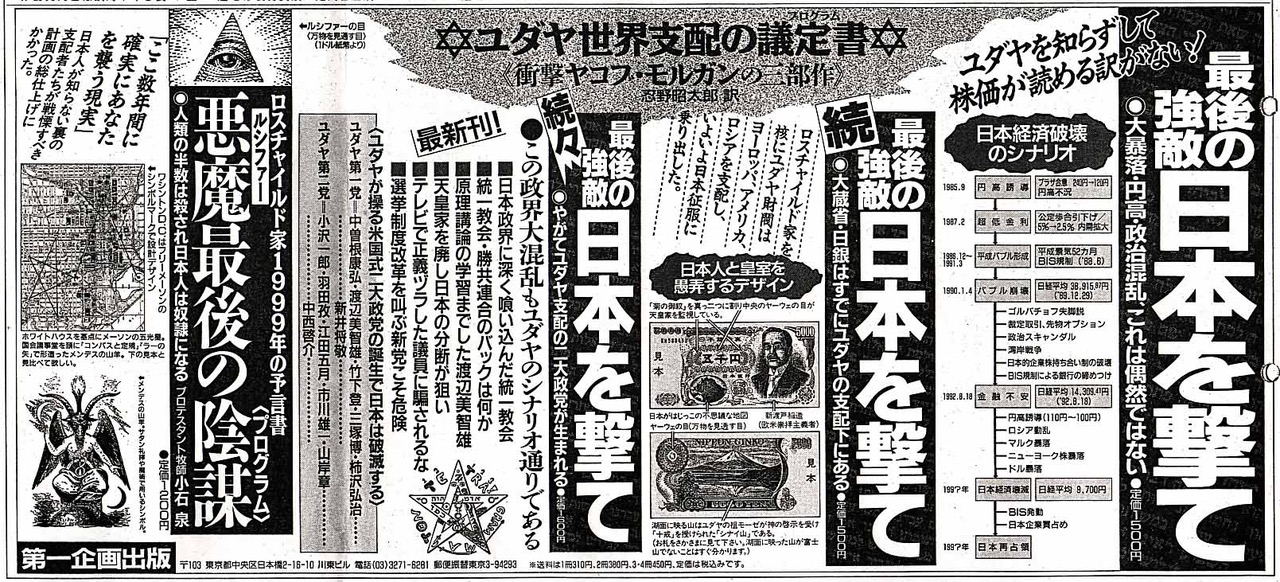
The tract's contents were basically a rehash of materials that could be found in any large bookstore. Books about Jews had been popular in Japan even before the beginning of the economic bubble in the 1980s, but seeking to make sense of the economic upheaval, a proliferation of new titles attributing Japan's skewed economy to the machinations of the Elders of Zion – by authors like by Ryu Ota and Masami Uno – had appeared. Some of the most bizarre, like the pseudonymous Jacob Morgan's Strike Japan! trilogy, were even advertised in national newspapers.
AUM's tract also contained a "wanted list" of "black aristocrats who had sold their souls to the devil". In addition to Emperor Akihito, Crown Princess Masako and two former prime ministers, the list included the Unification Church's Reverend Moon Soon Myong, Soka Gakkai International's Daisaku Ikeda and TV personality Dave Spector, who it maligned with the sobriquet Dempa Geisha (a geisha of the airwaves).
Spector would later recall: "There were 14 targets all together and I must say, I was in good company. At the time I was co-hosting a regular TV show at NHK (a music program) and one day I got there and my name was not on the door of the dressing room. I asked why and they said because of the assassination warning they thought it best to not identify the dressing room! Thought it was a nice gesture anyway."
I visited AUM Shuppan, the cult's publishing arm located in Setagaya Ward, and picked up some free literature to review at home. From these, I learned that Shoko Asahara, AUM's "guru," was a partially blind, bearded man from Kumamoto Prefecture who had founded AUM as a yoga school in 1984. He subsequently began promoting a mystical new faith derived from a potpourri of creeds, including Japanese and Tibetan Buddhism, Hinduism, Shamanism and New Age beliefs. Asahara went so far as to claim he had developed the power to levitate. He would spend the last 23 years of his life incarcerated in Tokyo's Kosuge Prison and, after his appeals were exhausted, was executed by hanging on July 6, 2018.
In media reports about AUM, the word jakyo, literally "evil teachings," popped up frequently. Neighborhood groups were organized to protest the presence of AUM facilities, with some communities even refusing to allow the children of cult members to enroll in local public schools. When the media reported on AUM's extreme behavior, they often found themselves in court. (Within 18 months of its recognition as a religious body in 1989, AUM had initiated over 60 lawsuits.) Some reporters attempting to investigate the cult were physically attacked.
From the previous autumn, kaibunsho (anonymous letters) began to be circulated among the media implicating AUM in an incident that occurred in Matsumoto City, Nagano Prefecture, on June 27, 1994, in which eight people died and over 600 were sickened by sarin, a nerve gas developed in Germany in the 1930s. The writer or writers of the kaibunsho were never identified, but were believed to have been familiar with chemistry and inside knowledge of the cult, perhaps as an ex-member.
As suspicions of AUM's involvement in the Matsumoto gassings grew, increasingly negative coverage began appearing from the start of 1995.
1. The Yomiuri Shimbun: The front page of its issue of January 1, 1995 reported that sarin residue had been detected in the soil outside of Satyam No. 7, an AUM facility in Kamikuishiki, Yamanashi Prefecture, near Mt. Fuji.
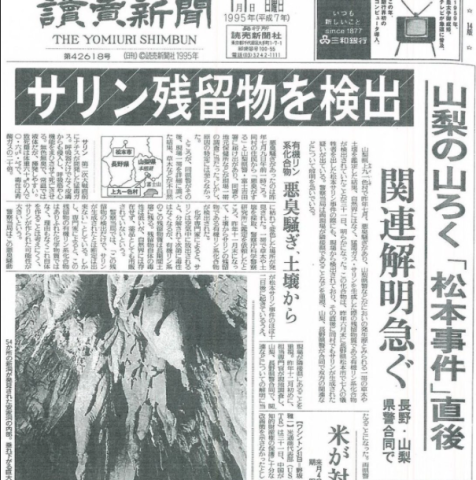
The Yomiuri article appeared under the byline of police reporter Akihiko Misawa. Subsequent to the gassing in Tokyo, the police were subjected to heavy criticism for its apparent inertia, but Misawa acknowledged the Nagano prefectural police for tracing the purchase of raw materials used to synthesize sarin to a front company owned by the cult. This became known within a month of the Matsumoto attack.
Then in early October 1994, a detective in the Nagano prefectural police, assuming the guise of a hiker picking wild vegetables, collected soil samples around the cult's facilities. By mid-November, chemists at the National Research Institute of Police Science reported that the soil contained sarin residue, which the Yomiuri scooped in its January 1 edition of 1995.
After a series of secret meetings held at the National Police Agency, police forces from Kanagawa, Nagano, Miyazaki and other prefectures had agreed to launch simultaneous searches of cult facilities.
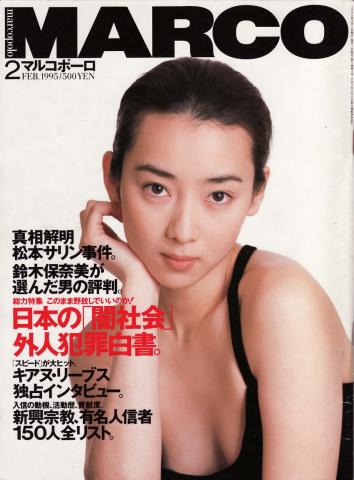
2. Marco Polo magazine: On January 17, 1995 – coincidentally the same day a catastrophic earthquake struck Japan's Hanshin region – the February issue of Bungeishunju-sha's monthly magazine Marco Polo went on sale. It contained a report on the Matsumoto sarin incident by Kyle B. Olson, an American authority on weapons of mass destruction and terrorism.
In words that were to prove tragically prophetic, Olson warned of the vulnerability of the Tokyo subway system to a poison gas attack. His article ended with this ominous prediction: “Next time the criminals will choose to act on a larger stage, and one that will result in a greater tragedy."
3. Shukan Shincho: The magazine's issue of February 19, which went on sale one week earlier, ran an article entitled "The judges in a lawsuit against AUM Shinrikyo were sarin victims." The article noted that AUM had purchased a tract of land in the city in June 1991. In May of the following year, the attorney for the former owner, charging that the cult had used a dummy company to make the transaction, petitioned the Matsumoto Branch of the Nagano District Court to invalidate the sale.
The court had been expected to hand down its ruling in late June or early July. The case was being tried by a panel of three judges who lived in dormitory quarters two buildings away from the home of Yoshiyuki Kono, the first person to report the gas incident. Two of the judges were only mildly affected by the gas, but the third, residing on the building’s third floor, had to be hospitalized and the ruling on the land dispute was postponed indefinitely.
4. Takarajima 30: In its March 1995 issue, monthly magazine Takarajima 30 raised suspicions that a chemical plant in AUM's Satyam No. 7 in Kamikuishiki was producing sarin. The now-defunct magazine would later dispatch a reporter to Asahara's hometown of Yatsushiro, Kumamoto Prefecture, to investigate rumors about Asahara's family background, as stories were being circulated suggesting that his malevolent behavior might be explained by foreign or outcaste roots. (The reporter found nothing out of the ordinary.)
5. Shukan Shincho: On March 16, five days before the subway attack, Shukan Shincho's March 23 issue quoted an "unnamed public security official" as saying that the Tokyo Metropolitan Police Department and National Police Agency's Security Bureau were gathering evidence against AUM in preparation for a major raid, expected to occur after upcoming elections, probably by early May. "A showdown between the police and AUM appears imminent", the article concluded.
From the above, it is clear that the cult made the decision to strike preemptively, targeting three subway lines that converged on Kasumigaseki, location of the government ministries. The casualties could have been far worse but for the fact that March 20, which fell between a Sunday and a national holiday (the spring equinox), saw many salaried workers take an extra day off, reducing congestion on the trains that morning. Even then, 14 died and over 600 were injured.
Coverage of AUM would dominate the domestic news through the remainder of 1995. Dacapo, a now-defunct biweekly magazine, noted that during the period of April 13-27, the eight largest circulated weekly magazines carried 22 stories about AUM (an average of three articles per magazine) whose contents totaled 183 pages – more than the next nine top stories combined.
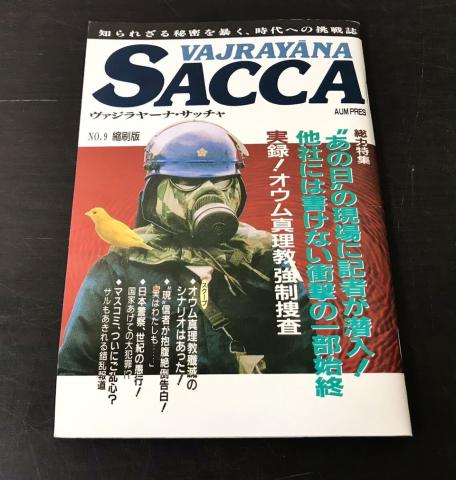
Aside from criticisms over the broadcast media's fascination with the occult and religion in general, reportage on the cult constantly harped on "mind control", in particular its ability to brainwash graduates of elite universities – who included chemists, a physician and an attorney – into blindly obeying the orders of its guru and engage in poa (altruistic murder).
Investigative journalist David Kaplan, who collaborated with Andrew Marshall on the book The Cult at the End of the World (Crown, 1996) did not mince his words when blaming Japan's police and other government authorities for failing to take action.
"It was disgraceful," he said emphatically. "AUM stands as a case study in what not do when investigating terrorist or organized crime groups.
“The authorities failed at almost every turn. Police didn't follow up complaints about fraud, intimidation, kidnapping, and even murder. Security officials didn't start a counterterrorism investigation. Health officials didn't check into AUM's chilling medical clinics and laboratories. Even after the cult was raided, Japanese authorities failed to share intelligence, infuriating American and Australian police." (It was later learned that in 1993, Aum had tested sarin on sheep at a ranch at Banjawarn Station, 800 kilometers northeast of Perth.)
The foreign press corps in search of the sarin link were just as dazed and confused as their Japanese counterparts. But Tokyo Journal, the monthly English city magazine, deserves recognition for a seven-page story in its April 1995 issue titled "Death in the Air: The attack of the Nazi nerve gas" by Andrew Marshall.
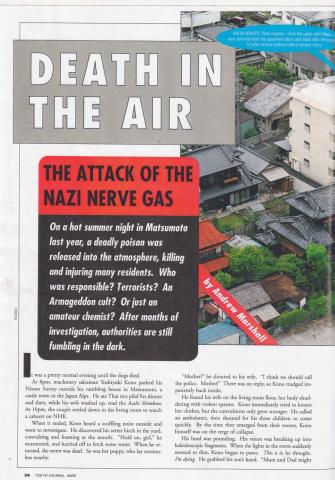
Considering that the article would have been nearing its final stages of proofing around the day of the subway gassing, March 20, Marshall's conclusions – that the evidence suggested Aum was the perpetrator of the attack in Matsumoto – are remarkably astute.
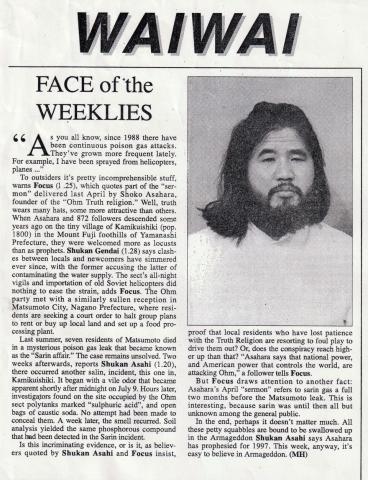
If anyone can solve the sarin mystery, His Holiness The Master Shoko Asahara's your man ... Prophets of Armageddon are a dime a dozen in this country's wacky gallery of fringe faiths. What sealed Aum's notoriety, however, was the disappearance in 1989 of a Tokyo lawyer, his wife and their baby son. Tsutsumi Sakamoto and his family remain missing today despite one of Japan's biggest manhunts, but Aum is still popularly linked with the case. Sakamoto had represented over 20 former cult members in claims against the sect, including one who had been tricked into paying a million yen for a vial of Asahara's blood. An Aum badge was found at the lawyer's home after the family vanished.”
The media was reinvigorated by the emergence of an Aum connection in Matsumoto. According to several reports … the press ... dug up an abstruse sermon that Shoko Asahara had reportedly given his followers. "There have been continuous poison gas attacks recently," he said. "Wherever I go I have been sprayed from helicopters or planes. The hour of my death has been foretold. The gas phenomenon has already happened. Next time it might be an atomic bomb." A bizarre coincidence? Nobody thought so, especially when the date of the sermon was taken into account: it had been delivered in April 1994 -- two months before the Matsumoto incident.
Tokyo Journal by Andrew Marshall
Marshall also interviewed the aforementioned Kyle Olson, who told him that the Matsumoto incident was a "preliminary" for an attack on a larger city, maybe Tokyo; or, now that the Japanese authorities understand sarin's potency, for an act of gross political extortion.
"Many parts of the case against Aum still don't add up," Marshall wrote. "They might have a siege mentality that rivals the Branch Davidians. But would they really commit mass murder ... just to change the verdict of a civil court case? And why would they use such an unpredictable method?
"The Aum theory was the media's best shot at solving the Matsumoto case, a shot which the cult has successfully deflected, at least for now. Not surprisingly, perhaps, new rumors are emerging among the restless press corps that Kamikuishiki's Aum-weary villagers made the sarin themselves to implicate the sect."
The author would like to add a special word of thanks to Norio Muroi of the FCCJ Library for his assistance in researching this story.
A resident of Tokyo since 1966, Mark Schreiber has authored two nonfiction works about historic crimes in Japan.
