


Issue:
March 2026 | Letter from Hokkaido
Hokkaido authorities are turning to technology to stop the animals chomping their way through netted fish
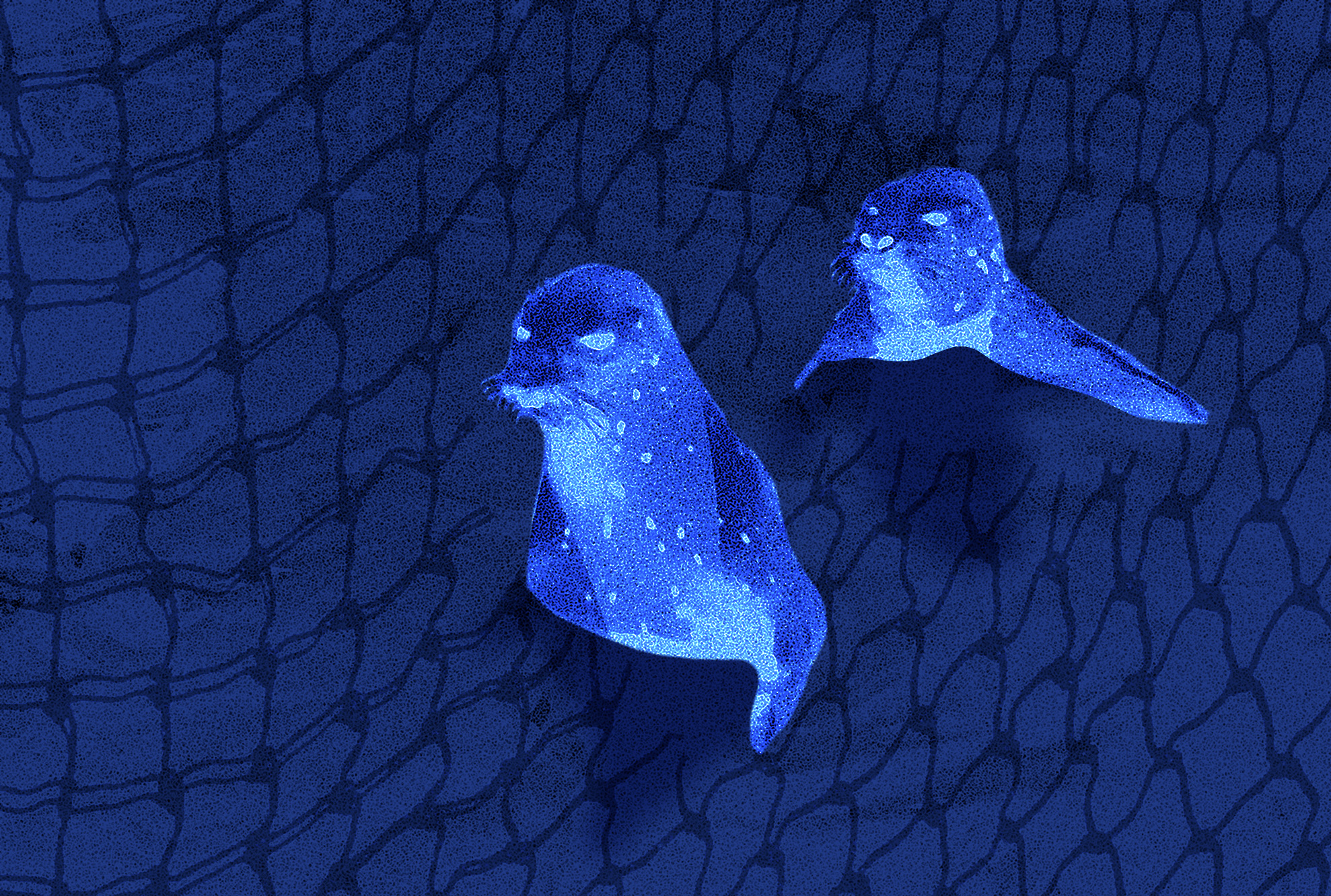
Every year, Hokkaido’s fishing fleets cast their nets in local waters, hauling in tons of salmon and mackerel that is sent to consumers in Japan and around the world. But while the industry and Hokkaido officials are anxious to expand the local seafood market, there is one particular group of fish lovers they do not want: Kurile harbor seals.
Living on rocky reefs that dot the eastern coast of Hokkaido, harbor seals were once hunted by the indigenous Ainu and late 19th-century Japanese settlers for their meat and fur. During the 20th century, their numbers declined due to coastal construction, and they eventually were placed on the environment ministry’s "red list" as an endangered species.
Conservation efforts helped their numbers rise again. Although their exact number is unknown, the ministry removed them from the endangered species list in 2015. However, the growth in their population – coupled with the scarcity of fish due to rising sea temperatures – has forced the animals to go after fish caught in nets, resulting in huge economic losses.
Cape Erimo is the home to the prefecture’s largest population of seals, somewhere around 1,000. Males are normally between 1.4 and 1.9 meters long and can weigh up to 170 kilograms. Females are usually between 1.2 and 1.7 meters, and weigh between 60 and 145 kilograms.
The seals consume an average of 5 to 7 kilograms of food a day. Their favorites are medium-sized creatures found in local waters, including cod, octopus, squid, shrimp, and crab. But they have a special fondness, as Hokkaido fishers know, for salmon and herring.
Schools of those fish caught in fishing nets present the seals with a free all-you-can-eat buffet. That’s great for them; not so for the fishing fleets that show up to haul in their catch only to discover their expensive nets have been ripped apart and that some or much of the fish has already been eaten. In addition, the seals themselves occasionally end up drowning after getting tangled up in the drift nets.
The fishing industry has long complained to Hokkaido politicians that they need to do something about the rogue seals stealing their catches. In response, the environment ministry’s Hokkaido branch has decided to place underwater acoustic devices in the vicinity of the driftnets that will emit sounds, including those made by other marine predators, in the hope of deterring the seals.
The plan is part of a five-year program to deal with the seals that began last year. The goal is to ensure that the probability of Erimo area Kuril harbor seals becoming extinct within the next 100 years remains below 10%, and to reduce damage to fisheries.
The program entails the use of non-lethal damage mitigation measures, which is where the underwater acoustic devices come in. The plan is to start introducing them in FY 2026, beginning April 1.
The ministry says that non-lethal measures alone will not be enough to prevent nets from being attacked. Problem seals will be relocated or culled, with adult seals that repeatedly enter salmon nets the prime target. Those that aren’t killed will be transferred, where practical, to zoos and aquariums.
Pressure from the fishing industry to stop the seals from stealing catches comes at a time of rising domestic and international demand for Hokkaido salmon and mackerel, even as climate change and warming oceans around the island have led to declining stocks.
Electronic monitoring by underwater drones of seals around Cape Erimo provides government bureaucrats and academic researchers with valuable information about the seal population. But it is hoped that the use of acoustic devices will make it less necessary to capture or kill seals that repeatedly attack fishing nets.
The Cape Erimo area has attempted to promote itself as a center for ecotourism, and the seals are an important part of that appeal, as is the harvest of local kelp, another favorite food among seals.
Whatever the environmental pros and cons, officials hope that the acoustic devices will solve the problem and end the ongoing tussle between the area’s seal and human populations.
Eric Johnston is the Senior National Correspondent for the Japan Times. Views expressed within are his own and do not necessarily reflect those of the Japan Times.
