


Issue:
January 2026 | Black Box Diaries
Shiori Ito answers her critics at bad-tempered Black Box Diaries screening
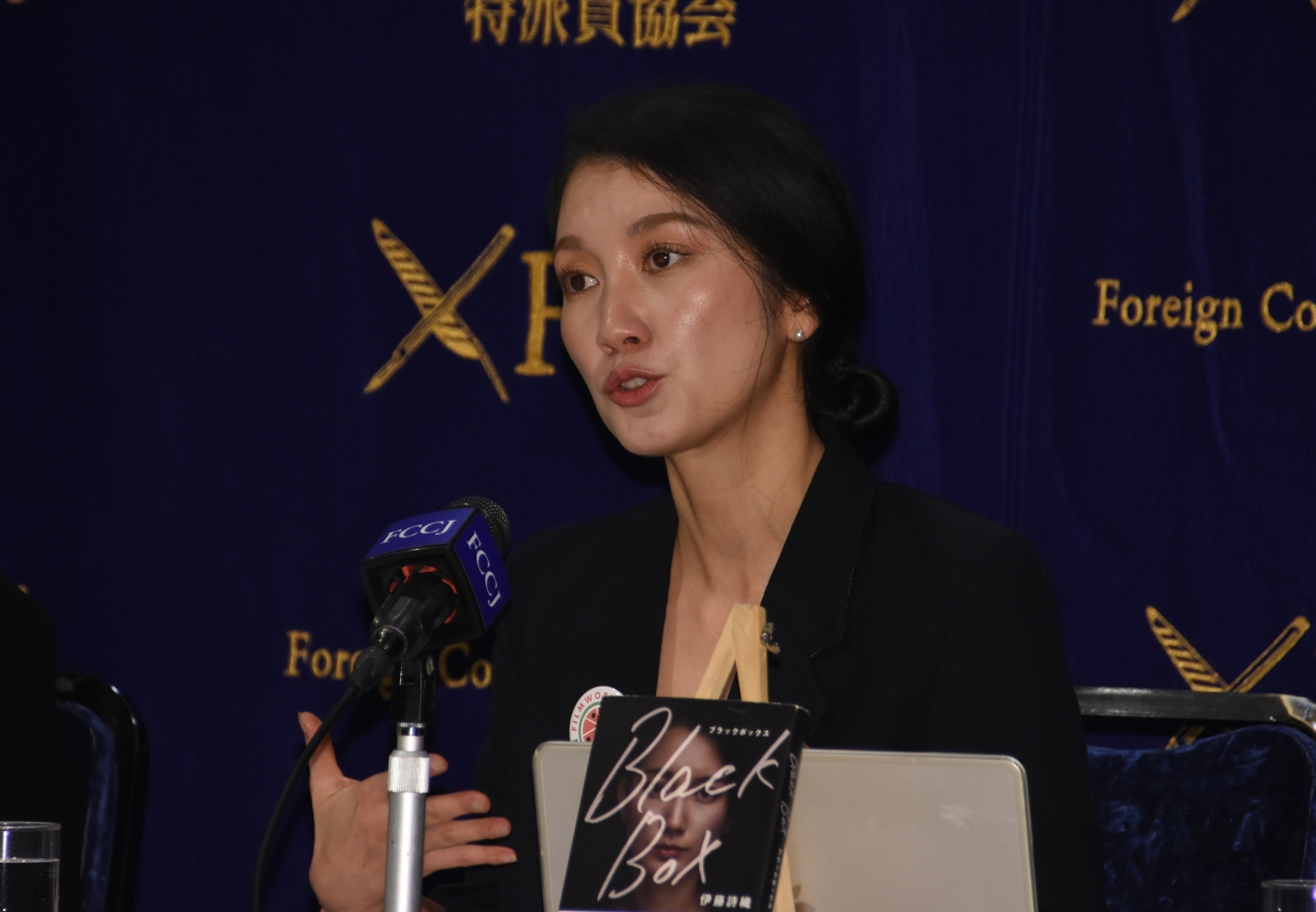
Almost two years since its debut at the Sundance Film Festival, Black Box Diaries, Shiori Ito’s wrenching account of her rape and its aftermath can finally be seen in Japan. In an occasionally tense encounter with journalists at the FCCJ to mark the occasion, Ito explained why her homeland was last on a list of 60 countries to have found a distributor for a single screen in Tokyo.
“It wasn’t like we were avoiding it; we wanted to do it in Japan but it was so difficult,” Ito said. She then directly accused Isoko Mochizuki, a prominent reporter for the Tokyo Shimbun, of “shocking” misreporting that helped delay its release. Mochizuki claimed that Ito had included footage of a rape-survivors’ meeting without the consent of the attendees.
In her rebuttal, Mochizuki, herself the subject of two movies, accused Ito of ignoring her lawyers’ ethical and legal concerns and “hurting” other victims. Ito responded that she had offered to screen the movie to the lawyers but they had declined. The encounter ended with Mochizuki shouting at Ito before host Jake Adelstein asked them to continue their discussion elsewhere.
The bad-tempered spat surprised few who had followed the story. Mochizuki leads a domestic backlash against the documentary that includes lawyer Yoko Nishihiro, head of the legal team that represented Ito in her landmark civil lawsuit against Noriyuki Yamaguchi, a senior TBS reporter and biographer of Shinzo Abe.
Ito was awarded damages from Yamaguchi in December 2019, a judgment finalized by Japan’s appellate courts in 2022. Nishihiro said she felt like she had been ”completely torn apart” when she learned that the movie had been screened abroad, without the consent of several interviewees, after “trying so hard to protect [Ito] for eight and a half years”.
Nishihiro’s decision to go public at the FCCJ earlier this year with her criticism of Ito’s use of surveillance footage and secretly recorded audio and video raised eyebrows. Ito complained that Nishihiro’s “one-sided” claims were also published without fact-checking, and helped poison the movie’s reputation in Japan.
But Eric Nyari, the film’s producer, noted that even before Nishihiro’s intervention, Black Box Diaries was being blackballed at home. While distribution offers worldwide came quickly, “inside Japan we faced what I would consider self-censorship on the part of exhibitors as distinct from distributors, in consideration of relations with the government as well as businesses unrelated to film”.
Nyari said they had revised small sections of the movie to satisfy critics in Japan, notably using computer-generated imagery to alter CCTV footage shot outside the Sheraton Miyako Hotel in Tokyo, where the sexual assault took place. The footage showing Yamaguchi tugging the incapacitated Ito out of a taxi and half dragging her through the lobby, was non-negotiable, said Ito, because it was the evidence that had persuaded a detective to investigate her allegations.
“Nobody can be identified except for me and Mr. Yamaguchi,” she told the packed room. “This is the only visual evidence I have as a survivor.” Ito said that she determined the footage “indispensable” to raise awareness of sexual violence. “The responsibility for that decision is mine and mine alone.”
She reminded the audience that footage leaked in 2020, right before she won the civil case, showing Ito walking steadily out of the hotel the following morning had triggered a fierce online hate campaign against her. The footage was provided to Yamaguchi’s defense team as evidence, and remains online.
“It was one of the reasons why I felt I had to show how I got here,” she said.
Another key scene, in which she interviews the taxi driver who had taken her and Yamaguchi to the hotel, has been shortened. The driver gave his permission to use the footage, Ito said, after he “generously accepted” her apology for including it in the original version. A phone call with Nishihiro shown in the original has been removed.
Perhaps the most startling part of the press conference came when Ito recalled her ethical dilemmas while making the movie, directly addressing perhaps the central issue raised by her critics: that she blurred the line between emotional purging and the dry professional codes of journalism. Initially, she confessed, she had aimed for journalistic “balance”, even, astonishingly, considering an interview with her rapist.
“The hard part was in the editing room – 450 hours of my life. As a journalist, I initially cut all the parts that I was talking directly to camera. But half way through I realized there is no way it could be impartial. At some point I could see that I had to cross the line as a journalist, to tell my own personal story.” This decision meant she had to deal with her own story in all its complexity, “as a journalist, survivor, directly, daughter, sister”.
None of this seems to have appeased her critics. In a statement released ahead of the movie’s debut in Tokyo, Nishihiro said its legal issues remain “unfortunately” unresolved and that the documentary “poses serious human rights issues”.
Another reporter accused Ito of “violating basic journalistic standards” by revealing the identity of investigator A to his colleagues. Ito countered that the movie disguised his identity. Moreover, given she was documenting what appeared to be decision by senior police to halt the investigation against Yamaguchi, it was in the public interest.
The FCCJ press conference probably won’t clear the air, but it matters little, anyway. Black Box Diaries has won a Peabody Award, and received Oscar and BAFTA nominations and numerous other international prizes.
Ito has seen off all of the legal challenges launched against her and is one of the few people who can claim to have permanently changed the debate in Japan on sexual assault. Her case was a catalyst for revisions to Japan’s rape laws in 2023, which redefined rape to focus on non-consensual acts. By any definition, she has answered her critics.
David McNeill is professor of communications and English at University of the Sacred Heart in Tokyo, and co-chair of the FCCJ’s Freedom of the Press Committee. He was previously a correspondent for the Independent, the Economist and the Chronicle of Higher Education.
Black Box Diaries Press Notes

FCCJ member David Umeda offers his personal reflections on Ito’s film and her recent press conference
On July 8, 2022, the Supreme Court upheld a December 2019 high court ruling that had ordered journalist Shiori Ito’s assailant, Noriyuki Yamaguchi, to pay her damages in a civil court verdict, though no criminal charges were brought against him.
In October 2017, on the final day of proofreading her book about the rape, Black Box Diaries, Ito’s Japanese publisher convinced her that publication should come on October 12, 10 days before Japan was due to hold lower house elections.
In scene from the documentary version of her book, a journalist attending one of Ito’s press conferences admitted she had regretted not taking more notice of the case, saying she felt “ashamed” for not doing anything to help.
Towards the end of the documentary, which Ito directed, she speaks directly to the camera. “I don’t think I can take this anymore,” she says.
The police officer who led the investigation explains to Ito over the telephone that he can't defy orders from above not to execute the warrant to arrest her alleged rapist. He states that he needs to support and raise a family, but he urges her to continue to seek justice: “Don’t forget to eat,” he says.
In the documentary, the younger lawyer on her team, when hearing of the need to appeal, simply responds, “Bring it on.”
Referring to her decision to file a civil lawsuit against Yamaguchi in September 2017, Ito describes in the film how she was “so scared going by myself” against the establishment, and feared that she was putting her parents in danger. Her father, though, wanted his daughter to persevere and “have a happy life”.
Ito describes a recurring dream in which she is “running and running and running. I don’t want to face myself (in the mirror the next morning)”.
The film’s producer, Eric Nyari, told the FCCJ press conference that he had been determined to keep as much of the original film in the Japanese version.
The past year had been traumatic, he said, adding that he was “grateful for the film’s success”. An earlier version of the documentary appeared at the Sundance Film Festival in 2024 and was nominated for an Academy Award in January 2025. It recently received a Peabody Award.
Ito told the FCCJ event that she had made the difficult decision not to take a strictly journalistic, balanced approach to the documentary, preferring to focus on telling her side of the story.
Despite sinking into the depths of despair the night before the supreme court appeal hearing in 2022, Ito called the doorman who was on duty at the hotel where she was raped to ask if she could mention his job title at the hearing, since this would be her last opportunity to make her case in full.
His response brought her to tears. She could use his name, he said. Adding that he no longer cared about being fired (he wasn’t). As Ito shed tears, the doorman said he would also be present at the court hearing.
Ito went through 450 hours of footage to make the documentary. To this day, she does not know the identity of the person who in October 2024 leaked security camera footage of the doorman standing by as Yamaguchi dragged her out of a taxi and into the hotel.
At the FCCJ event the film’s producer, Hanna Acvilin, recalled dealing with the backlash against Ito, including from those who questioned whether she had really been raped. That toxic response is addressed in the film, when an older Japanese woman standing outside the court yells at Ito, calling her a liar. “What you said happened never happened,” she says.
The documentary shows a press conference at the FCCJ on December 19, 2019, in which Yamaguchi denied Ito’s accusations. This haunting documentary is Ito’s devastating response.
David Umeda is reserve director on the current FCCJ Board of Directors.
