


Issue:
February 2026 | Cover story
The dish’s evolution reflects profound changes in Japanese society – and there’s more to come
Photos by Erez Golani Solomon
The evolution of sushi, from a meticulously prepared dish grounded in personal interaction between chef and diner to a meal delivered on a computerized conveyor belt, reflects Japan’s gradual retreat from human contact. This shift is not inherently negative, yet it exposes profound changes in consumption habits, social relations, and the ways technology increasingly substitutes direct interaction.
What ends up on our plates is changing faster than we think. Most of us no longer eat what our parents ate, and even less what our grandparents once considered everyday food. Ingredients shift, preparation methods evolve, and entire culinary traditions cross borders and settle into new homes. In an age of globalization and relative affluence, our meals reflect broader transformations in lifestyle, identity, and taste.
Few foods illustrate this quiet culinary revolution more vividly than sushi, a dish long regarded as timeless yet repeatedly reinvented in ways that would have astonished earlier generations. Although today it is often treated as a symbol of refined immediacy and freshness, the underlying idea of sushi is far more universal and ancient. Throughout history, human societies have sought methods to preserve surplus food for periods of scarcity, and sushi emerged from precisely such practices. Its earliest known form, narezushi, reached Japan from Southeast Asia more than a thousand years ago. In this method, fish were cleaned of their internal organs, packed tightly with fermented rice, and stored for months. Before consumption, the rice was discarded, and only the fish, marked by its intense flavor and pungent aroma, was eaten. What we now recognize as sushi thus began not as a delicacy, but as a pragmatic solution to the challenges of preservation.
Over time, the Japanese came to view the disposal of the rice as wasteful. This insight gave rise to namarezushi, in which fresh or lightly salted fish underwent partial fermentation together with the rice, allowing both components to be consumed. During the Edo period (1600–1868), the growth of urban life generated demand for food that could be prepared quickly and eaten immediately. This shift led to the emergence of hayazushi, or “fast sushi,” in which rice seasoned with vinegar replaced lengthy fermentation and made instant consumption possible. Sushi thus adapted to the rhythms of city life, becoming more accessible and practical for an increasingly mobile population.
At the beginning of the nineteenth century, makizushi, or “rolled sushi,” also appeared. This form, now widely familiar from sushi restaurants outside Japan, consisted of rice, vegetables, and a slice of raw fish wrapped in dried seaweed. Initially sold at street stalls as inexpensive fare, makizushi was later embraced as a dish that could be prepared quickly at home and easily carried to work or school. Its portability and simplicity contributed to sushi’s transformation from a specialized food into an everyday meal.
The form of sushi most commonly found today in Japanese restaurants is known as nigirizushi, literally “hand-pressed sushi,” and it differs markedly from all earlier varieties. It too emerged during the late Edo period and is generally attributed to Hanaya Yohei, a restaurant owner in Edo, present-day Tokyo. Around 1824, Hanaya began serving small hand-pressed mounds of rice seasoned with vinegar, topped with slices of fresh raw fish. At the time, a single piece of sushi was roughly three times larger than what is customary today, the seasoning was noticeably milder, and the range of seafood used was more limited. Even so, then as now, nigirizushi has been eaten by hand, without ceremony, and in a single bite, ideally at the moment it is served.
Nigirizushi, also known as Edo-mae (in front of Edo [castle]), named after the city where it emerged and the bay from which its fish were caught, quickly became a remarkable success. It was sold at street stalls and spread beyond the confines of Edo, although over time such sales were prohibited, first on hygienic grounds and later for reasons of prestige. Japanese immigrants introduced nigirizushi to the United States as early as the beginning of the 20th century, but it was not until the late 1960s that restaurants began to serve it regularly, initially in Los Angeles. A few years later, the California roll was created, a variation of makizushi incorporating avocado and crab meat in place of raw tuna. This adaptation helped many Americans overcome their aversion to raw fish and paved the way for the widespread acceptance and global success of sushi in its many forms.
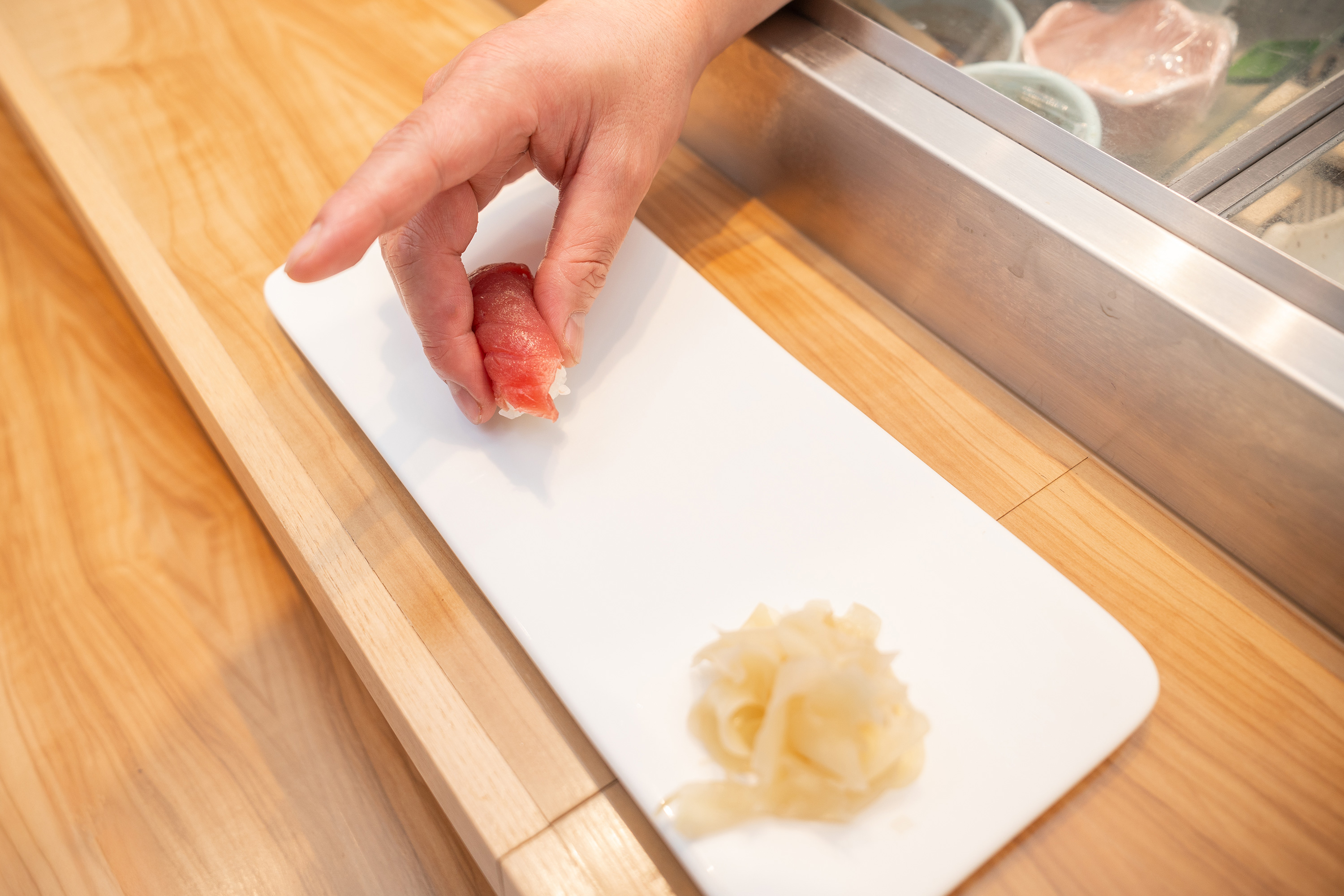
Nigirizushi was designed for speed and convenience. Its hand pressed format, pre seasoned rice, and use of already prepared or lightly cured toppings made it an early form of urban fast food rather than elite cuisine. Nigirizushi also helped establish the basic size, shape, and rice to fish ratio that later became canonical, providing a template for modern sushi worldwide. Photo: Ikebukuro, Tokyo, 2026.
In the 1980s, amid the extraordinary success of the Japanese economy and a growing global fascination with Japanese culture, sushi became a familiar dish worldwide and an integral component of international cuisine. This expansion preserved its Japanese roots to a degree, yet it also introduced striking adaptations to the tastes, expectations, and practical constraints of the national cuisines that embraced it. Such flexibility did not reflect a disregard for tradition, but rather an acknowledgment that food, like culture itself, inevitably evolves. It is therefore hardly surprising that even in Japan, often regarded as a bastion of culinary purism, sushi as a restaurant food has undergone profound transformations, changes that have only accelerated in recent decades. Within a relatively short span of time, two additional “generations” of sushi restaurants have emerged, now operating alongside traditional establishments. How, then, can each of these be distinguished?
In the beginning
The practice of dining out to eat sushi, and nigirizushi in particular, developed in specialized establishments known as sushi-ya or sushi-ten. Today these are typically high-end establishments with a relatively fixed structure and set of rituals. They are characterized by a central wooden counter, behind which stands the sushi chef, the itamae, assisted by a small team. Most such restaurants are intimate in scale, offering a limited number of seats, usually between six and twelve stools along the counter, sometimes complemented by a few side tables or a private room with tatami flooring made of woven straw mats. Their design is minimalist and generally traditional, marked by extensive use of wood, clean lines, restrained decoration, and a deliberate emphasis on calm, cleanliness, and carefully cultivated aesthetics.
The sushi chef stands at the very heart of the restaurant. His training is long and exacting, and he commands every stage of preparation with practiced authority, adjusting the cut, temperature, and proportion of rice to the particular qualities of each fish or ingredient. Before him is a transparent display case holding fresh fish and seafood, meticulously selected that very morning. Diners may choose individual items themselves or entrust the entire selection to the chef, a practice known as omakase. Each piece is prepared directly before the customer’s eyes, moments before it is served, to ensure the highest possible level of freshness.
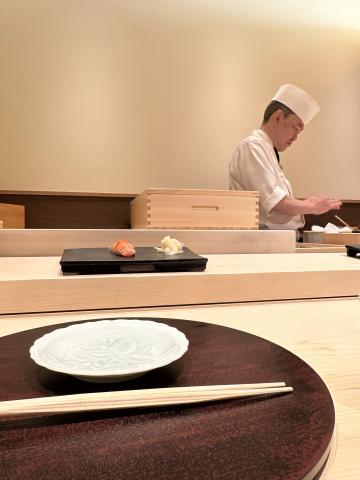
Literally meaning “in front of the cutting board,” the itamae traditionally occupies a position of visible authority behind the counter, embodying skill, discipline, and trust in the handling of raw fish. Historically, becoming an itamae required a long apprenticeship, emphasizing repetition, observation, and mastery of rice preparation, knife work, and timing before creative expression was permitted. Photo: Ginza, Tokyo, 2026.
Eating is a ritual in its own right. The fish is sliced with great precision, and the sushi is placed either on a small wooden board, known as a geta, or directly on the diner’s plate at the counter. Serving is done one piece at a time, according to a fixed and carefully considered sequence. Unlike many restaurants in Japan, there is no set meal served all at once. Instead, diners receive a succession of pairs of nigiri, offered at a relaxed pace that allows the experience to unfold over one to two hours. It is customary to begin with white fish and delicate flavors, then gradually move on to fattier fish with reddish or brown hues, followed by shrimp, octopus, and squid, and to conclude with sushi topped with omelet, tamagoyaki, or, heaven forbid, even a simple makizushi.
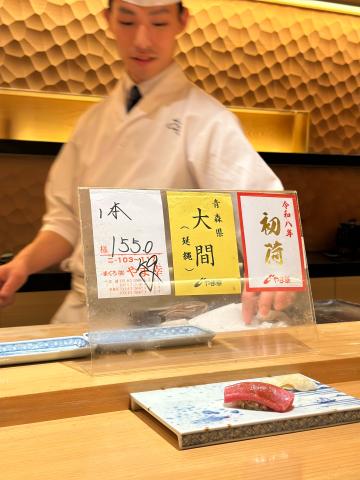
Placed near the counter to inform customers and staff about the fish being served, such labels are customary in high quality sushi restaurants. Read from left to right, the card identifies a 155 kilogram tuna, listing its weight and supplier, its origin in Ōma, Aomori Prefecture, and its capture by individual longline fishing, a method associated with superior quality and minimal damage. The final panel notes the “first catch of Reiwa 8,” meaning the season’s inaugural shipment in 2026. Together, the label signals a highly prized bluefin tuna, emphasizing freshness, provenance, and status. Photo: Futakotamagawa, Tokyo, 2026.
Despite sushi’s somewhat popular image in its early days, restaurants that serve it in a “traditional” manner can be extremely expensive. Some of the most renowned sushi restaurants in Tokyo, such as Harutaka today, or Sukiyabashi Jiro, Sushi Saito, and Sushi Yoshitake in the past, have earned three, or at least two, Michelin stars. Kyoto and Osaka are also home to outstanding sushi restaurants, although even the best among them usually hold no more than two stars. Dining at establishments of this caliber requires reservations well in advance, and prices typically range from 30,000 to 60,000 yen per person.
Unsurprisingly, such restaurants, and even those that are only slightly less exclusive, are relatively rare. In the university town where I lived in Japan at the end of the last century, there were only two sushi restaurants among hundreds of eateries. Both were regarded as particularly luxurious and prohibitively expensive, so much so that as a student I avoided them altogether. Several years later, I found myself in a better financial position, more fluent in the language and cultural codes, and finally ready to break my personal boycott. The opportunity arose during a visit to Osaka, when, late in the evening, I passed one such restaurant, despite having already eaten dinner.
I stepped inside. Although it was an intimate restaurant where no advance reservation was required, there was no mistaking its quality. Instead of a menu, sheets of paper bearing the names of fish hung on the wall, most of them written in kanji not included in the standard school curriculum and therefore unfamiliar to me. Worse still, no prices were listed. Left to guesswork, I ordered a small portion of two nigirizushi, which proved exquisitely delicious. That sufficed for the evening.
Pleased with my culinary boldness, I made my way to the cashier, where a shock awaited me: a printed bill for over ¥4,000, about 40 U.S. dollars at the time, for the tiny portion, a kind of penalty for my spontaneity. The explanation soon followed. The sushi contained toro, the fatty cut of tuna, which in the distant past had been discarded or sold cheaply but, after the Second World War, became a delicacy and the most expensive item in most sushi restaurants. This historical footnote offered little consolation, and it would be years before I returned to a restaurant of this kind.
Conveyor belt boom
The emphasis on supreme quality and highly personalized service gradually pushed many sushi restaurants beyond the reach of ordinary Japanese diners. Under these circumstances, it was only a matter of time before someone rose to the challenge and devised a cheaper, yet still appealing, way to make sushi accessible to a broader public. In 1958, in the city of Higashi-Osaka, a sushi restaurant employing a conveyor belt opened, offering relatively inexpensive dishes designed for quick consumption. The entrepreneur behind this innovation was Shiraishi Yoshiaki, the owner of a small restaurant, who conceived the idea after observing a beer bottling production line.
Shiraishi’s establishment, Mawaru Genroku Sushi, literally “Revolving Genroku Sushi,” was an immediate success, though it took some time for the new format to spread widely. The concept gained nationwide visibility when Genroku Sushi became a major attraction at the Osaka World’s Fair in 1970. Over the years, Shiraishi expanded the business into a chain that, at its peak, comprised approximately 250 branches. The new format came to be known as kaitenzushi, literally “conveyor-belt sushi.”
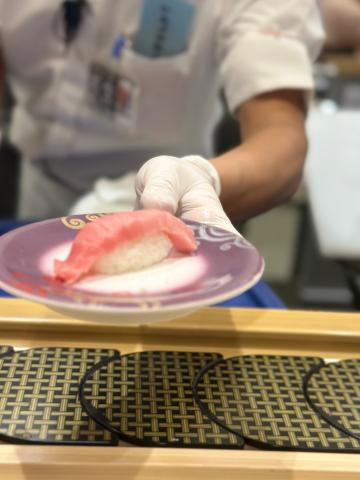
Sushi 2.0 restaurants are typically organized around a circular or U-shaped conveyor belt positioned at the center of the dining space. Customers sit either along a counter or at tables on the outer side of the belt, while the cooks stand on the inner side, where they prepare the dishes. Although diners may place specific orders, most items, usually pairs of nigirizushi or sets of four makizushi slices, are prepared in advance and set on small plates that glide slowly along the belt until a customer selects them. Remarkably little is left to chance. The plates always move clockwise, making them easier to lift with the right hand. They are color-coded, with each color corresponding to a fixed price, clearly explained on charts displayed on the walls. In front of every diner or table are hot-water taps, tea bags, soy sauce, wasabi, and pickled ginger, all freely available and entirely self-service.
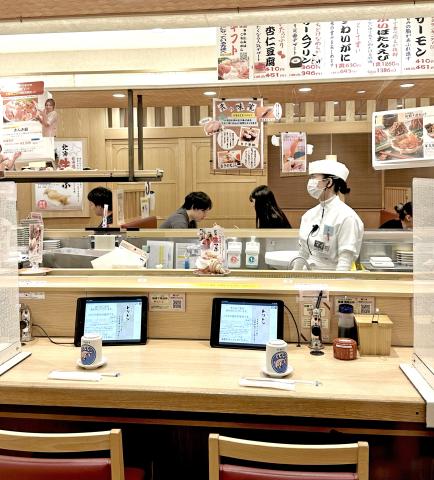
The space is typically bright, functional, and noisy, with the sounds of clinking plates, staff calls, and conveyor mechanisms forming an integral part of the experience. At the same time, there is a reassuring sense of predictability and order, created by standardized menus, clear pricing, and visible preparation. Together, these features make kaitenzushi accessible and family friendly, in sharp contrast to the quiet ritual of traditional sushi counter. Photo: Ikebukuro, Tokyo, 2026.
The success of Shiraishi’s revolutionary restaurant reflected broader trends of urbanization and democratization in postwar Japan, above all the rise of a large middle class eager to enjoy pleasures that had previously been the preserve of social elites. Sushi was no exception to this transformation. In the early 1970s, fast-food chains began to spread across Japan, covering a wide range of cuisines. The most prominent among them were McDonald’s, Mister Donut, and Baskin-Robbins, all of which introduced a new mode of consumption that was inexpensive, quick, and informal. In a comparable way, Sushi 2.0 restaurants offered an entirely new dining experience. Eating sushi became something akin to an amusement-park game, in which diners accumulated plates at their own rhythm, without the supervision or instruction of a demanding chef. The experience emphasized autonomy, speed, and playfulness rather than ritual and hierarchy, reshaping sushi into a form of everyday entertainment.
Moreover, because installing a conveyor belt required substantial investment in equipment, most kaitenzushi restaurants developed as branches of large chains. These chains pursued aggressive strategies to expand their market share, relying on intense price competition and continual technological innovation. During the 1980s, as the cost of electronic components declined, more sophisticated and curved conveyor belts were introduced, allowing for more efficient use of restaurant space. The updated model proved particularly successful in suburban areas and shopping malls.
At the same time, Japan emerged as one of the world’s leading consumers of seafood, accounting for roughly 20 percent of global consumption. Sushi restaurants played a significant role in driving this demand, with particular emphasis on tuna, whose popularity at one point nearly led to its depletion. The industry also stimulated efforts to secure a stable, year-round supply of the most popular fish and seafood varieties. Rising demand encouraged the Japanese fishing fleet to extend its operations across distant waters, to develop aquaculture facilities along Japan’s coasts, and to establish shrimp farms and fish ponds throughout Southeast Asia.
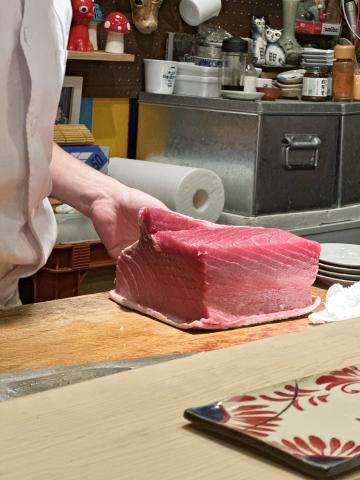
Tuna occupies a central place in sushi culture and hierarchy. Valued for its clean flavor, layered textures, and visual appeal, especially in cuts such as akami, chūtoro, and ōtoro, it has long functioned as a key measure of a sushi chef’s skill and a restaurant’s, and even a chain’s, overall quality. Its status reflects both historical patterns of availability and modern notions of prestige, elevating tuna beyond a mere ingredient to a defining reference point in nigirizushi. Photo: Nakai, Tokyo, 2026.
The use of a conveyor belt was not merely a marketing gimmick but a genuine revolution in the social status of sushi, which gradually became a popular and accessible food. I vividly remember my first visit to such a restaurant, on a spring lunchtime in Tokyo at the height of the bubble economy. Around me sat families with children alongside manual workers, all smiling, excited, and noisy, in sharp contrast to the etiquette and formality that characterized Sushi 1.0 establishments. After receiving a brief explanation of how the system worked, the smile did not leave my face. Suddenly, there was no need to know the names of the fish or their prices, nor even to place an order; it was enough simply to extend a quick hand toward the dish I desired before it glided past.
Beyond the gimmick, it was also the price that truly disrupted the market and won my heart. At the time, roughly half of the plates were offered at a minimum price of 100 yen, and sometimes even less. Remarkably, despite inflation, competition in the sector has helped keep this base price largely unchanged in most conveyor-belt sushi restaurants to this day, apart from the value-added tax, which has since risen to 10 percent. As a result, I could enjoy a respectable meal of 10 to 12 plates at an affordable cost of 1,000 to 1,500 yen (approximately U.S.$6-10).
To be sure, the quality, freshness, and portion size did not match what was customary in Sushi 1.0 establishments, yet the dishes served in Sushi 2.0 restaurants were perfectly edible and often quite tasty. At the end of the meal, none of the rituals associated with traditional sushi dining were required. A press of an electric buzzer installed at the table immediately summoned a waiter, who counted the plates, presented the bill on the spot, and bowed politely in thanks for my visit.
With the spread of what is often described as Sushi 2.0, this form of dining has become a major industry in Japan, which is now home to several giant chains that own or franchise thousands of restaurants. The “Big Four” kaitenzushi chains, leading Japan’s mass market sushi segment, are Sushiro, Kura-zushi, Hama-zushi, and Kappa-zushi. By January 2026, according to a recent article in the weekly magazine Friday, Sushiro maintained its position as the clear market leader, a status it has held since 2011. It operated 660 restaurants in Japan and 239 overseas, with revenues of approximately 397 billion yen, or roughly $2.5 billion. Although slightly more expensive than its competitors, Sushiro is widely noted for its consistent quality and its extensive range of side dishes, including dozens of new dessert items developed each year.
Hama-zushi, operated by the group behind the largest gyudon beef bowl chain, Sukiya, ranks second, with 646 domestic restaurants and 110 overseas, and revenues of approximately ¥248 billion. Kura-zushi follows closely in third place, operating 550 restaurants in Japan and 144 overseas, with revenues of about ¥245 billion. Kura-zushi is known for its continually expanding menu and for the fact that sushi always physically circulates on the conveyor belt. The fourth chain, Kappa-zushi, lags far behind the others, with 299 domestic restaurants and only eight overseas, and revenues of roughly ¥73 billion.
Competition among the four major chains is cut throat, occasionally prompting them to offer special menus with items priced as low as 10 yen per plate. At the same time, their dominance is constantly challenged by emerging competitors. Some, such as Genki-zushi and Uobei, compete at times on even lower prices or streamlined delivery systems, while others pursue a different strategy by offering higher priced, gourmet style conveyor belt sushi. Notable regional brands in this latter category include Nemuro Hanamaru, Toriton, and Kanazawa Maimon Sushi.
Personal touch
The thousands of Sushi 2.0 restaurants that mushroomed across Japan and later spread overseas have transformed the country’s patterns of sushi consumption. Once an occasional, often ceremonial meal, sushi has become an everyday dining option, shaped by speed, affordability, standardization. Over time, however, cracks began to appear even in this highly successful model of popular conveyor-belt dining. Connoisseurs increasingly complained about declining quality, in particular the growing reliance on frozen imported fish and inexpensive substitutes, and many of them turned instead to more upscale establishments. At the same time, a broader public continued to appreciate the appeal of restaurants that were inexpensive, accessible, and entertaining, yet voiced mounting concerns in other areas, foremost among them issues of hygiene.
In theory, a sushi plate can circulate on a conveyor belt for hours without being selected, until it becomes questionable from a health perspective and potentially even dangerous. This issue initially concerned few customers when conveyor-belt restaurants first appeared, but over time Japan’s increasingly high standards regarding food freshness, together with growing public sensitivity, turned it into a serious concern. Equally troubling was the fear that customers might touch passing sushi, sample it, or deliberately tamper with it. In early 2023, Japan was shaken by a series of incidents in which customers, mostly young people, engaged in pranks, or more accurately acts of food harassment, at Sushi 2.0 restaurants. The phenomenon, dubbed in Japanese sushi tero (“sushi terrorism”), received extensive media attention after videos of these acts spread rapidly across social media.
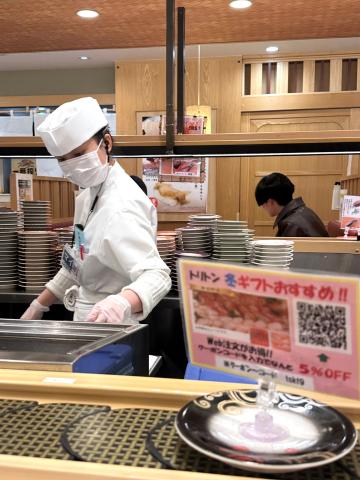
In recent years, in response to Covid, incidents of so called “sushi terrorism,” and growing public expectations, sushi restaurants have adopted stricter hygiene measures that combine regulation, technology, and design. These include improved cold chain management, frequent temperature monitoring, touch screen ordering, covered conveyor systems, and tighter staff protocols. Together, they signal a shift away from reliance on artisanal trust toward visible, systematized hygiene. Photo: Ikebukuro, Tokyo, 2026.
In retrospect, these incidents may have been little more than pranks. Yet the exceptionally high standards that have developed in Japan regarding food freshness, combined with the heightened sensitivities of the Covid era, created the conditions for a perfect storm. Sushi chains, which had long since begun covering plates with transparent lids, responded by further tightening hygiene protocols in their restaurants, but these measures proved insufficient. Sushiro, the largest chain with around 600 branches, whose share price suffered a temporary decline, went so far as to file a lawsuit against a customer, seeking 67 million yen in damages for harm to its reputation and loss of revenue.
It remains unclear who, if anyone, stood behind this wave of incidents. Yet it was precisely during these years that the major sushi chains were already in the midst of transitioning to a new model, Sushi 3.0 restaurants, which promised an experience largely free of hygiene risks and opportunities for mischief. In this sense, rumors and viral videos merely accelerated an ongoing shift.
These new restaurants integrated a range of technologies that had existed for years but had not previously been adopted on a broad scale. As early as the 1990s, personalized ordering conveyor systems were developed, allowing customers to order directly from the chef, with dishes delivered via a dedicated high-speed “express lane.” In the early 2000s, tablet-based ordering systems began to appear at individual seats or tables. In the following decade, they were joined by robots for rice preparation, machines for shaping nigiri, automated sterilization systems, and sensors that monitor how long a dish remains on the belt and remove it once it exceeds the permitted freshness threshold.
In recent years, a significant portion of Sushi 2.0 restaurants in Japan have gradually been converted to this new model, while elsewhere Sushi 3.0 establishments have been built from the outset. Last year I became a regular customer at one such restaurant in a suburb of Kyoto, and the experience was entirely different from anything I had known before. The restaurant is spacious and bustling, with seating for around 250 diners. Instead of a single central conveyor belt, roughly ten conveyor systems run through the hall, each consisting of two belts on separate levels emerging from a small opening in the wall. The use of two distinct belts prevents situations in which customers who hesitate to retrieve their dishes obstruct delivery to others.
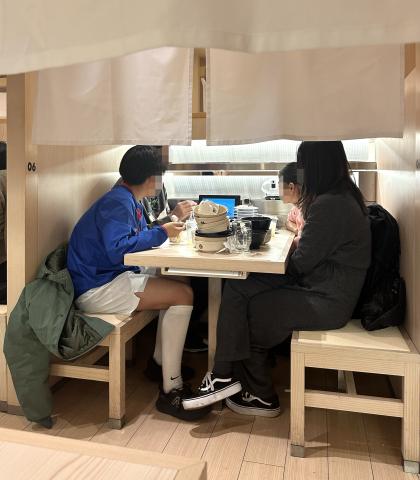
Sushi 3.0 represents a further rationalization of conveyor sushi. Large, purpose built spaces rely on multiple, multi level conveyor systems that deliver orders directly to tables. By separating delivery flows, these restaurants minimize delays, reduce congestion, and maximize speed, capacity, and turnover while preserving the familiarity of sushi dining. Photo: Oshiage, Tokyo, 2026.
Tables are arranged along the conveyors, alongside a single counter, with partitions separating diners, a legacy of the coronavirus period. Entry to the restaurant is managed by a computerized system that allows customers to select their preferred seating area. When a place becomes available, they are summoned via a display screen, in a manner reminiscent of the queue systems used in health clinics or banks.
Upon being seated, diners place their orders through a personal tablet that presents a detailed, multilingual menu listing all available dishes and their prices. The range is striking. Alongside classic offerings appear inventive creations such as nigiri topped with a miniature hamburger wrapped in melted yellow cheese, or with smoked duck, as well as soups and desserts of many kinds. Customers may order individual items or several dishes at once, which typically arrive within one or two minutes. The dishes travel swiftly along the conveyor belt, accompanied by a musical alert from the tablet, and come to a precise stop directly in front of the diner. At any moment, the system allows customers to track their orders, what has already arrived, what is still on the way, and the cumulative cost. At the end of the meal, the diner signals completion via the tablet and proceeds to the main cashier, where the bill is already waiting.
Disappearing chefs
Sushi 3.0 restaurants are exhilarating for some and deeply unsettling for others. Beyond their distinctive mode of service and the remarkably wide range of dishes on offer, their most striking feature is the near absence of human service staff. The chefs, some of them foreign workers, or the robots that increasingly replace them, are concealed behind walls, while waitstaff are largely absent from the dining area. The primary motivation for this arrangement is economic, yet the contrast with Sushi 1.0 establishments, where the chef stood at the very center of the dining experience, has never been more pronounced.
The absence of human contact appears to trouble few customers, who are in any case more physically and socially separated from one another than diners in traditional sushi establishments. This reduction in personnel and the minimal interaction it entails mirrors broader trends across Japan’s service sector, particularly in supermarkets, where the rapid expansion of self-checkout systems has transformed everyday consumption. For me, dining in these new establishments therefore becomes more than a culinary experience. It serves as a quietly unsettling reminder of the deeper social and psychological currents shaping contemporary Japan, where efficiency and convenience increasingly replace direct human engagement.
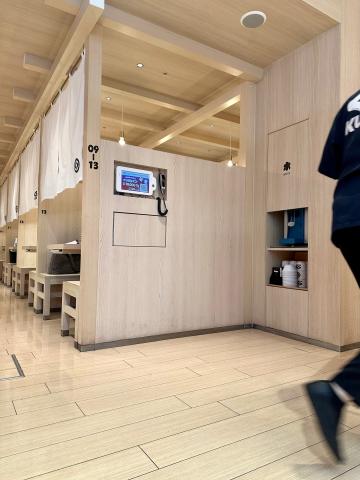
Sushi 3.0 restaurants replace human presence with systems. Chefs and robots operate out of sight, service staff are largely absent, and diners interact mainly with screens and conveyor belts. This extreme efficiency minimizes contact and mirrors wider shifts in Japan’s service economy, where convenience increasingly displaces human exchange. Photo: Oshiage, Tokyo, 2026.
Japan today stands at the forefront of a broader trend toward social alienation and loneliness. A range of phenomena reflects this trajectory, including hikikomori, which describes prolonged social withdrawal at home, primarily among young people; jōhatsu, literally “evaporation,” referring to the abandonment of family and the deliberate disappearance from one’s former life; o-hitori-sama, literally “the one-person customer,” denoting older individuals who live, dine, and travel alone; koshoku, or solitary eating; and kodokushi, the deaths of elderly people who pass away in isolation and remain undiscovered for extended periods.
As difficulties in forming relationships, declining marriage and birth rates, and rapid population aging weaken traditional community structures, long working hours and a demanding corporate culture further intensify feelings of isolation. At the same time, heavy reliance on technology and social media replaces much face-to-face interaction and encourages more superficial relationships and emotional distance. These phenomena are not unique to Japan and can be observed across many developed societies, yet in Japan they manifest with particular intensity and visibility.
In this sense, the evolution of sushi restaurants offers a revealing mirror of the transformations Japanese society has undergone over the past half century. The current stage is by no means final, especially since all earlier forms of sushi establishments continue to exist alongside it. Whether encountered in a restaurant, a convenience store, or at home, one thing is clear: sushi today is more ubiquitous, dynamic, and deeply embedded in everyday life in Japan than ever before. Moreover, even in an era of seemingly borderless globalization, Japan continues to shape the directions of sushi’s evolution and the norms of its consumption, despite having long since lost exclusive ownership of the dish. For those seeking to fully grasp the culinary and cultural richness that sushi embodies, there is still, despite all these transformations, no real substitute for experiencing it in Japan itself.
Rotem Kowner is a historian and professor of Japanese Studies at the University of Haifa, Israel, with research interests that include Japan's environmental issues. His book A Hardening Hierarchy: The Japanese in the Global Formation of Racial Ideologies, 1735–1854 (McGill-Queen’s University Press) is forthcoming.
