


Issue:
February 2026
Riken Yamamoto rails against the architects and politicians turning Tokyo into a city of ‘ugly’ towers and malls
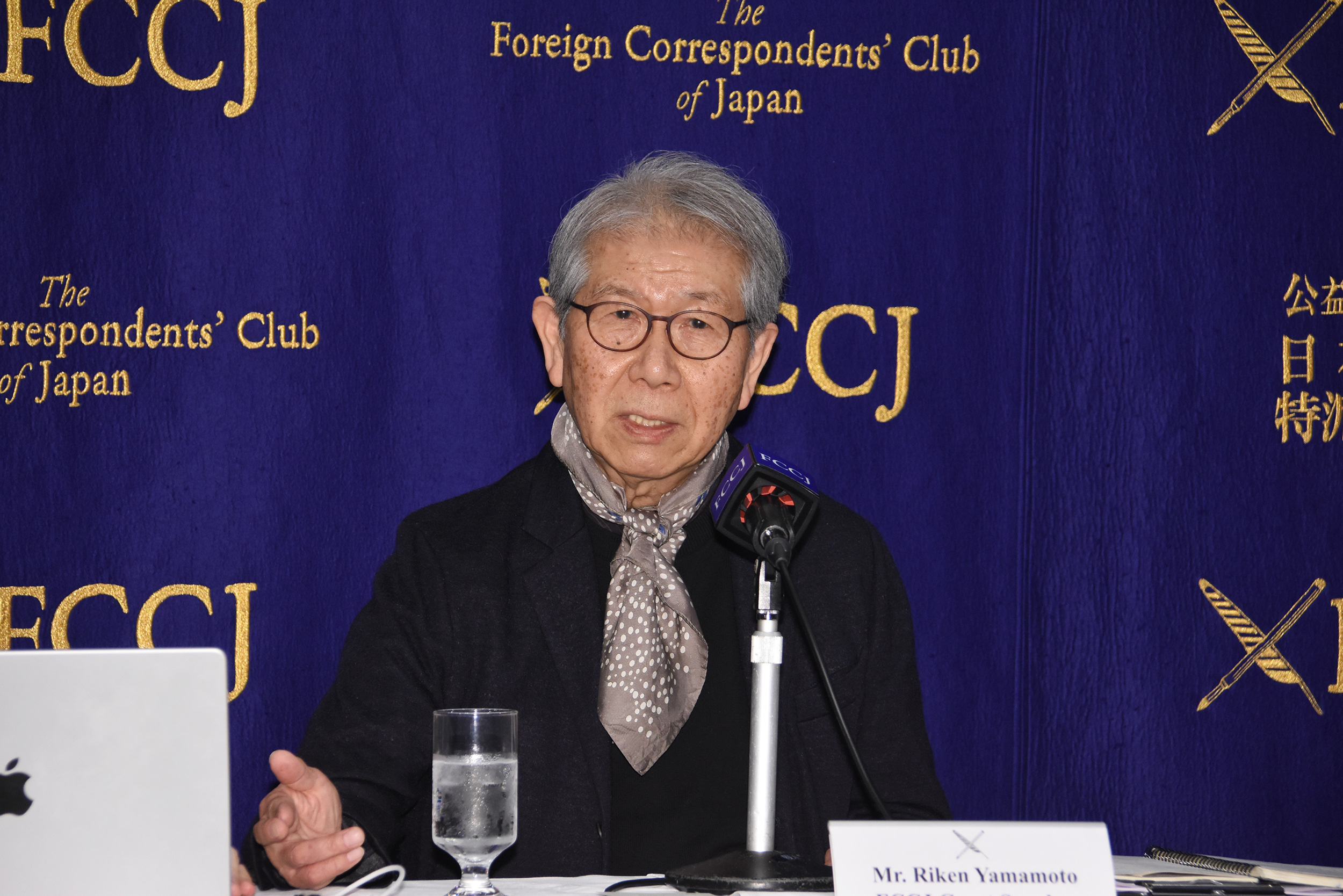
Riken Yamamoto is not happy. At the Foreign Correspondents’ Club of Japan on January 15, the renowned architect, urbanist, and Pritzker Prize laureate told us why.
For decades, Yamamoto has been a close observer and incisive critic of Tokyo’s growth. Change is often said to be the only constant in this vast metropolis, where a new breed of urban redevelopment has proliferated in recent decades. These projects involve demolishing entire neighborhoods and replacing them with towers and shopping malls.
“The current way of redevelopment is a major failure,” Yamamoto said. “[Does anyone] actually believe those buildings are really beneficial and useful to the people living in the local community?”
Yamamoto prefers traditional neighborhood patterns, claiming they foster social connectivity and greater economic opportunity for small businesses. Taking aim at Tokyu Corporation's ongoing redevelopment of Shibuya, Yamamoto said “there was a wonderful community surrounding Shibuya station, but that was totally destroyed.”
This wave of construction was encouraged by the Urban Renaissance Special Measures Act of 2002, which incentivized large, privately-led urban redevelopments. In an email following his lecture, Yamamoto criticized the Urban Renaissance law, as well as the re-deregulatory policies of Heizo Takenaka, a minister in Prime Minister Junichiro Koizumi’s administration.
Of Tokyo’s major developers, Yamamoto holds Mori Building Company in particular contempt. Mori’s projects involve acquiring small parcels in the center city over many years to create a large, contiguous area for redevelopment. Ultimately, entire neighborhoods are demolished to make way for office and condominium towers rising from high-end shopping malls.
Famously, or infamously, Mori’s Roppongi Hills project involved buying and clearing more than 400 individual parcels. Completed in 1990, the complex is home to the Japan offices of Apple and Barclays, as well as high-end retailers like Louis Vuitton. Yamamoto described Mori’s more recent Azabudai Hills development, which opened in 2023, as a “colony,” noting that a penthouse condominium there sold for ¥20 billion. The complex is “very ugly,” he added.
Yamamoto scolded high-profile architects for not pushing back against these trends, calling out Tadao Ando and Kengo Kuma by name. He also criticized Tokyo Governor Yuriko Koike for allowing Tsukiji Market to be demolished, claiming that “she destroyed the heart, the very core place of Tokyo”.
In contrast to the sculptural, attention-grabbing architecture that circulates on social media, Yamamoto is interested in the small, unassuming buildings that form the basic fabric of urban neighborhoods. After the 2011 Tohoku Earthquake, Yamamoto founded the Chiiki Shakai-ken Kenkyūjo, or Regional Community Research Institute, which investigates sustainable development practices. This research examines informal, citizen-led town planning in Japan, as well as in places like Manila and Jakarta.
At the FCCJ, Yamamoto highlighted his work in Venezuela, which he has visited five times in recent years to conduct fieldwork and collaborate with a community on the outskirts of Caracas. He envisions building a terraced hillside neighborhood, which he claims will improve housing conditions and preserve small businesses while creating new public spaces. Unlike the clean-slate projects in Tokyo he criticizes, this gentler form of redevelopment is meant to retain a community’s sense of place.
The recent political turmoil in Venezuela is a hurdle, though Yamamoto remains committed to the project. President Nicolás Maduro’s government was supportive of the effort before he was, in Yamamoto’s words, “knapsacked” by the U.S. military. On previous visits to Venezuela, Yamamoto met with Delcy Rodríguez, now Venezuela’s acting leader.
It would surprise some that Yamamoto himself has designed enormous mixed-use developments. Jian Wai SOHO, a project he completed in Beijing in 2004, includes many high-rises and has a floor area of more than 700,000 square meters – similar in scale to Roppongi Hills. But he clarified in his remarks that he does not see development as an enemy.
“Developers are definitely needed,” he said, encouraging them to engage with neighborhood residents early in the process. He also asked the government to listen to the advice of architects on how to rejuvenate the city without erasing it. “It's not so difficult,” Yamamoto said, concluding his remarks on a brighter note. “As long as we work together with the community, I believe that it's possible.”
Yamamoto has set himself up against powerful forces. Unafraid of controversy, he is stepping into the space occupied by earlier architect-cum-public intellectuals such as Fumihiko Maki, Arata Isozaki, and Kenzo Tange. Though they fear to bite the hand that feeds them, many architects quietly agree with Yamamoto’s assessments. He is hardly alone in identifying the disconnect between Japan’s falling population and rising towers.
For now, large-scale development in Tokyo grinds on. Perhaps with sufficient passion and persuasion, the machinery shaping the city can be turned to other, higher purposes.
Don O’Keefe is an architect and writer working in the U.S. and Japan. He is currently a Lecturer in Architecture at Harvard University.
